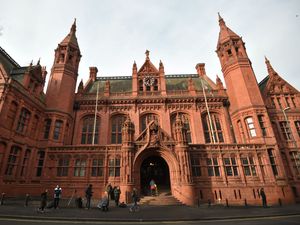
Crown court backlog hits record level with thousands of cases waiting for justice in the West Midlands and Shropshire
The crown court backlog in England and Wales has risen to a record level, with more than 6,000 cases in the West Midlands waiting for justice.
Data published today (Thursday) showed the open caseload was 78,329 at the end of June, up 2 per cent from 76,957 at the end of March, when the backlog passed 75,000 for the first time.
Those include nearly 1,500 at Wolverhampton Crown Court, more than 750 at Shrewsbury and more than 2,000 at Birmingham.
Crown Court backlogs in the West Midlands and Mold:
Below are the open caseloads at each court (and the corresponding figure for 2024)
Birmingham: 2,284 (1,872)
Mold: 483 (460)
Shrewsbury: 759 (624)
Stafford: 843 (690)
Stoke-on-Trent: 699 (617)
Wolverhampton: 1,495 (1,262)
Worcester: 855 (806)
The national caseload is up 10 per cent from 70,893 a year earlier, according to Ministry of Justice figures.
Some 19,164 cases had been open for at least a year at the end of June, up 17 per cent from 16,378 a year earlier and the highest since current data began.
Open caseload refers to the number of outstanding cases.
Deputy Prime Minister and Justice Secretary David Lammy said: “Today’s statistics show the crown court backlog has hit a new record high and it lays bare the unacceptable wait victims face.
“That’s why since we came to power we have invested a record amount into our courts so we can deliver swifter justice for victims.
“However, money alone cannot turn the tide on the rising backlog which is why we asked Sir Brian Leveson to propose bold and ambitious reform, to put our justice system back on sustainable ground.”
Ministers are set to respond this autumn to recommendations made by Sir Brian to overhaul the courts system and tackle the backlog, where some cases are listed for 2029.
The major review, published in July, proposed to reduce the number of jury trials and create a new type of crown court where trials are heard by judges.
The review commissioned by the Government is aimed at trying to “reduce the risk of total system collapse”.
Nearly a third of the crown court backlog at the end of June was cases involving violence against the person (31 per cent), with around one in six being sexual offences (17 per cent) and around one in seven drug offences (14 per cent).
These three categories of offence together accounted for nearly two thirds (62 per cent) of the full backlog.
The number of cases in the backlog involving sexual offences rose year on year from 11,062 to 13,238, a jump of 20 per cent, while cases for violence against the person increased from 21,150 to 24,364, up 15 per cent.
Earlier this month Shrewsbury Crown Court's Resident Judge hit out at the “chronic” backlog of cases after TV presenter Jay Blades was told he will not face trial for two years.
Judge Anthony Lowe said “it is not a proper justice system where people are having to wait that length of time for their trial”, as he adjourned the 55-year-old’s rape case until September 2027.
There were a record 4,086 rape cases in the crown court backlog as of the end of June, up 31 per cent year on year from 3,114.
Reacting to the latest figures, chairwoman of the Criminal Bar Association Riel Karmy-Jones KC said that on Thursday a case was listed for trial in October 2029 at Isleworth Crown Court.
“Criminal barristers who prosecute and defend cases involving the very vulnerable have been working to keep this crumbling system from collapsing for years – but it has become unsustainable,” she said.
“The right approach now is to fix the infrastructure of the courts, focus on the many efficiency measures that could improve productivity, and open back up courtrooms that have been shut for a year or more to claw back wasted time.”
Elsewhere, Westminster Magistrates’ Court was closed due to a lack of water on Thursday.
Manchester Arena bomb plotter Hashem Abedi was among those due to appear at the court charged with attempting to murder prison officers, but court officials said there was no water in the building and that it was a public health risk.
There is also a new record backlog in magistrates’ courts of 361,027 cases, up 25 per cent on 289,595 a year earlier.
The rise comes as magistrates were given more sentencing powers in October last year, allowing them to hear cases that carry a maximum prison sentence of up to 12 months, up from six months previously.
The move aimed to free up crown court time to deal with the most serious cases and cut the backlog while also seeking to better-support victims.
Reacting to Thursday’s figures, Katie Kempen, chief executive of charity Victim Support, said: “Yet another record crown court backlog means further delays for victims, many of whom are now waiting years for their case to come to trial, their lives on hold while they are denied access to justice.
“These are not just statistics – they are real people, often struggling to cope, losing faith in the system and facing serious emotional and psychological consequences.”