
Will we see the September Harvest Moon from the West Midlands and Shropshire? Here's when to look up

The 2026 Harvest Moon should be clearly visible from across the West Midlands and Shropshire, weather permitting
Stargazers across the West Midlands and Shropshire will have a chance to see September's spectacular Harvest Moon later this month.
The full moon will reach its peak on Saturday, September 26, making it the 10th full moon of 2026.
And the good news for skywatchers across the region is that yes – the Harvest Moon will be visible from the West Midlands and Shropshire, provided skies are clear.
The exact moment of the full moon is 5.49pm BST, but that doesn't mean you need to be outside at precisely that time. The moon will rise around sunset and will look full for much of the evening and into the following nights.
When can we see the Harvest Moon in the West Midlands?
For Birmingham, the moon is expected to rise at around 6.33pm on September 26, shortly before sunset.
In Shropshire, moonrise is around 6.37pm, giving people across the county an excellent opportunity to watch it appear above the eastern horizon.
That means you don't need to stay up late to see it.
In fact, the period shortly after sunset could provide the most dramatic view, as the low moon can appear particularly large and golden or orange against the horizon.
If you live in Birmingham, Wolverhampton, Coventry or elsewhere in the built-up West Midlands, the moon should still be easily visible with the naked eye. The biggest challenge will be finding somewhere with a clear view towards the eastern horizon and avoiding buildings and trees blocking the moon as it rises.
What makes the Harvest Moon special?
The Harvest Moon isn't necessarily bigger or brighter than every other full moon.
Its name comes from its relationship with the September equinox, which falls on September 23 this year. The full moon closest to the equinox is traditionally known as the Harvest Moon.
There is also a particularly interesting feature of the Harvest Moon.
Normally, the moon rises roughly 50 minutes later each day. Around the September equinox, however, the difference between successive moonrises becomes much smaller in the Northern Hemisphere.
That means the moon rises at a similar time on several consecutive evenings – providing extra moonlight around sunset.
Historically, that extra light was useful to farmers trying to bring in crops before the arrival of autumn.
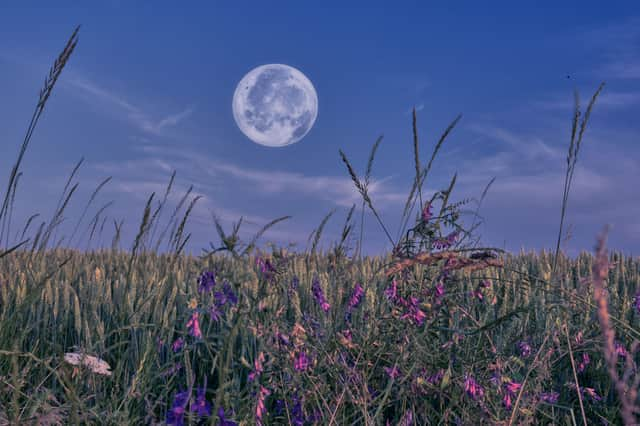

Why might it look orange?
Don't be surprised if the moon looks yellow, orange or even reddish as it first appears.
This isn't because the moon itself has suddenly changed colour.
When the moon is low above the horizon, its light has to travel through more of Earth's atmosphere before reaching our eyes. The atmosphere scatters shorter blue wavelengths, leaving more of the warmer red and orange light reaching us.
There is also the famous "moon illusion", which can make a low moon appear enormous when it is close to the horizon.
So if the Harvest Moon looks huge above a Shropshire hillside or a West Midlands skyline, it isn't actually growing in size.
What else can we see?
There is an added bonus this year.
Saturn will appear close to the Harvest Moon, making September 26 an especially interesting night for anyone with an interest in astronomy. NASA says Saturn should be visible with the naked eye, while much fainter Neptune will require binoculars or a telescope.
So, while the moon itself requires no equipment at all, a pair of binoculars could make the evening even more rewarding.
And if you're looking for Mars, don't confuse the two – Saturn is the planet to look for near the Harvest Moon on September 26.
Where are the best places to see it in Shropshire?
Shropshire has something of an advantage when it comes to stargazing.
The Shropshire Hills are home to four Dark Sky Discovery Sites around the Long Mynd, where light pollution is sufficiently low for the Milky Way to be visible to the naked eye.
Those sites include:
- Carding Mill Valley
- Cross Dyke Car Park
- Pole Cottage
- Shooting Box, Long Mynd
The Shropshire Hills tourism organisation says all four have the darkest Milky Way classification.
Other good options include Lyth Hill, just outside Shrewsbury, which has panoramic views across the Shropshire Hills and relatively low light pollution.
The Stiperstones and Clee Hill are also popular with stargazers looking to escape the glow of towns and cities.
You don't necessarily need to travel into the countryside, however. The full moon is bright enough to be seen from urban areas – although a darker location will give you a much better view of the surrounding stars.
What about the rest of the West Midlands?
You should still have a good chance of seeing the Harvest Moon from towns and cities across the region.
Light pollution matters much less when you're looking at something as bright as a full moon.
If you're closer to Birmingham, Wolverhampton, Walsall, Solihull or Coventry, try to find an open area where you have an unobstructed view towards the east.
For a darker-sky experience, Cannock Chase and areas around the Staffordshire-Shropshire border offer better conditions than the centres of the major cities. The West Midlands also has recognised Dark Sky Discovery locations, including Barr Beacon.
The most important thing? Check the weather
There is really only one major thing that could stop people in the West Midlands and Shropshire seeing the Harvest Moon – cloud.
A perfectly timed full moon is no use to stargazers if it is hidden behind thick cloud.
So, as September 26 approaches, keep an eye on the forecast and, if conditions look promising, head somewhere with a clear eastern horizon shortly before or after sunset.
You don't need a telescope.
You don't even need binoculars.
All you really need is a clear sky, an open view and a few minutes to look up.
And from the West Midlands to the Shropshire Hills, September's Harvest Moon should be putting on a show.
Comment Guidelines
Iconic Media encourages reader discussion on our stories. User feedback, insights and back-and-forth exchanges add a rich layer of context to reporting. Please review our Community Guidelines before commenting.