
Alan Ayckbourn’s robotic Romeo tackles big questions in sci-fi courtroom drama - review
John Hargreaves reviews The Trial of Romeo Oscar, a futuristic take on Shakespeare that blends humour, touching moments and thought-provoking ideas
Hot on the heels of middle-aged star-crossed lovers Romeo and Juliet at the New Vic last month comes a robotic Romeo and an orphaned Juliet on a moon of Uranus in the year 2194.
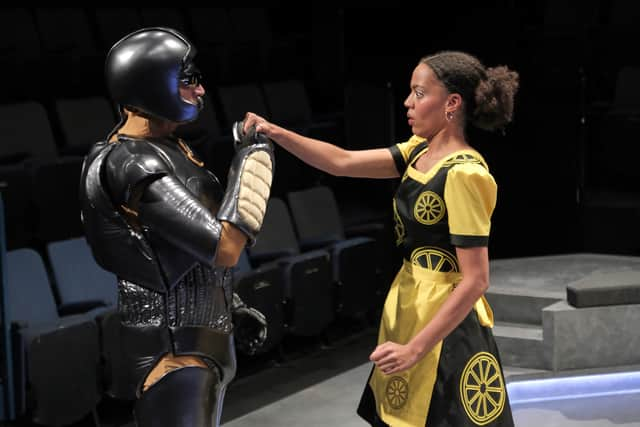

The Trial of Romeo Oscar cleverly inserts chunks of the balcony and tomb scenes from Shakespeare’s tragedy into a sci-fi courtroom drama. Search-and-destroy military unit RSDO83 (R for Romeo, O for Oscar) is on trial for murdering Juliet. This is the first legal case brought against a robot. It follows a long campaign by the android community to establish its rights, alongside which come responsibilities.
Written and directed by Alan Ayckbourn, the play opens with a strikingly theatrical descent from a devastated Earth’s surface to Level 27. A severely damaged fighting robot twitches pathetically as his memory is stimulated, and he sings ‘Mary had a little lamb’ as if to a child. One of the few human characters observes: ‘To destroy the soul of a civilisation, first destroy its art.’
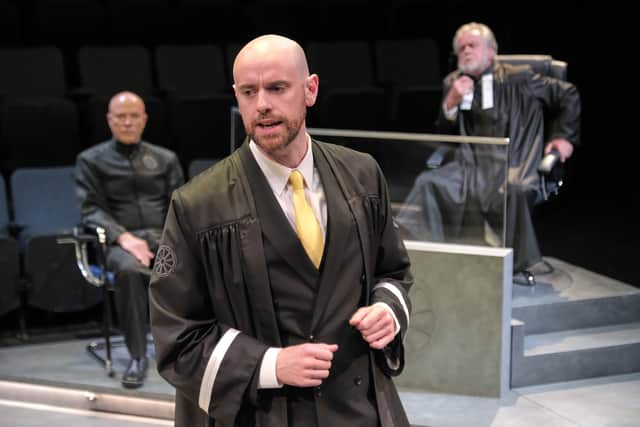
As ever – and this is Ayckbourn’s 92nd play – the production is rich with ideas and raises complex questions.
A sophisticated android who delights in human wordplay savours the phrase ‘If it weren’t so sad, it would be funny’. He could equally have enjoyed ‘If it weren’t so funny, it would be sad’. Ayckbourn’s work has typically embraced both to brilliant effect. There is much humour and some deeply touching scenes in The Trial of Romeo Oscar, but their synergy is diluted by lengthy sci-fi scene-setting and courtroom manoeuvres.
Richard Stacey’s Romeo switches convincingly from mechanical wreck to stiffly obedient war hero to emotionally responsive carer. Elizabeth Boag is a cocky, gum-chewing engineer, ever cynical about corporate power. Olivia Woolhouse plays a waitress on Level 3 chosen to act as Juliet at the trial. Her career will surely benefit from her performance, much as her character hopes hers will in 2194.
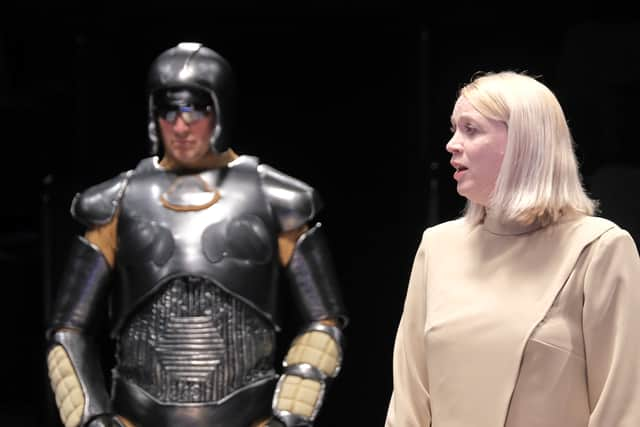
Assistant Arbiter Octavius, played by Leigh Symonds, is central to the narration and to our perception of an android approaching humanity. Symonds nails the role with minimal off-human mannerisms that are charmingly intelligent.
It is tempting to consider what AI would have made of the concept and raw material of the play. Gone would be Ayckbourn’s forgivably indulgent borrowings from his love of 1950s sci-fi novels. Gone would be his affectionate in-jokes about contemporary theatre. Gone, too, would be Tchaikovsky’s Romeo and Juliet Fantasy Overture, which provides such a moving finale.
By John Hargreaves