
Review: Ex Cathedra explores space, homelessness and humanity
James Fraser Andrews reviews Ex Cathedra’s concert at St Martin-in-the-Fields in London, featuring works by Thomas Tallis, Roderick Williams and Alec Roth
This concert by one of Shrewsbury’s favourite and internationally famous choirs launched us into space both familiar and unnerving.
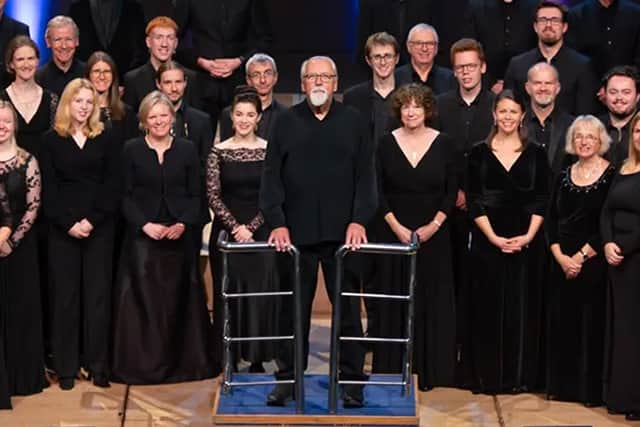

A programme built around 40 voices is a programme about where those voices stand. At St Martin-in-the-Fields – a church opening onto Trafalgar Square, the haunt of historic protest, traffic-addled pigeons, tourists and the human dispossessed – each of the three works placed Ex Cathedra, a regional music powerhouse, in radically different formations and spaces.
Together, they made a small history of how music can imagine space, from the 16th century to lunar horizons and the restless urban landscape beyond the church’s neoclassical porticoes.
After opening with his setting of the Eighth Tune from Parker’s Psalter, Tallis’s Spem in alium set the standard. Ex Cathedra honoured this epic tour de force with luminous confidence.
The eight choirs were arranged across the nave and balconies, enveloping us in waves of Elizabethan surround sound. Organic and anchored, each line was beautifully resilient within the lattice of intricate polyphony. As the counterpoint swept between the choirs, the nave itself became part of the instrument.
Written, some think, as a riposte to Florentine composer Alessandro Striggio’s 40-part motet Ecce beatam lucem, Tallis’s sonic explorations were curated under Jeffrey Skidmore’s direction with unfussy, very English élan. Here, space was defined by architecture, the voices meeting in pulsating fervour to convey apprehension and awe.
A more spiritual and moral dismemberment followed in the world premiere of Roderick Williams’s The Wilderness, an unflinching examination of urban alienation, written “in all humility” for the “myriad homeless”.
Provocative, searching and remarkably singable, it reworked the 40-voice aesthetic with singular aptness and seems destined to become a classic of the multi-voice repertoire.
Commissioned by Ex Cathedra and the RIAS Kammerchor Berlin, Williams reshaped the Tallis forces into innovative groupings, including two ripieno choirs of 12 and eight, two consorts of five, two trios of sopranos and basses, and four soloists: Katie Trelawney, Elena Stamp, Daniel Marles and Lawrence White, all of whom triumphed.
Texts from Muller, Matthew’s Gospel, RL Stevenson and John Gould Fletcher’s poem In the City of Night merged in disorientating, fascinating fashion, like multilingual conversations in an unnamed city converging through time and space.
At one point, blue lights and sirens from an emergency outside scoured the nave. The choirs were both at odds and at one, their dissonant, bluesy harmonies holding to a shared centre of purpose.
Its most startling moment – shades of Britten’s Peter Grimes – came when the bass trio intoned words from the Vagrancy Act 1824, bureaucratic prose colliding with refrains from Fletcher’s City of Night.
The figures in these texts seek belonging but find institutional indifference and loneliness: “the touch of the loved hand, perish and vanish, one by one, from the earth”.
The work’s visceral, excoriating spirit stayed with me, along with the sight of dozens of homeless men sheltering on cardboard near the church. The city was a living presence within the piece, not merely its backdrop.
The Wilderness ended with a hint of irresolution: the city as a project forever unfinished, where the winners are few. It was an uncomfortable ending, and fitting given the setting.
Alec Roth’s Earthrise, the centrepiece of the second half, brought the 40 voices together again. Using Spem in alium as a template for eight five-part choirs, the work began with visual unity before breaking into angular splinterings and pugnacious, electric word-painting.
Images of trampling underfoot (omnia subiecisti sub pedibus eius, from the Vulgate text) flared across the vocal groups with impeccable timing. The bewildered questions of quis? ubi? – who? where? – pierced the music’s initially mellifluous texture. Here was Job, his faith on the ropes.
Ultimately, however, the piece came to rest in an appeal for calm and understanding. Its richly coloured, oceanic harmonies invited immersion in meditations inspired by the view of Earth offered to the Apollo 8 astronauts as it rose above the Moon. Soloist Tim Burton was pin-sharp on the antiphon, while the balance between the choral forces achieved lush enjoyment without louche indulgence.
Commissioned for Ex Cathedra’s 40th anniversary in 2009, 40 years after that famous lunar voyage, Earthrise also offered a reminder of the choir’s contribution to English choral tradition over more than half a century.
As founding director Skidmore begins his final valedictory year, the importance of his work in nurturing musical roots in the choir’s West Midlands base cannot be overstated.
How far they have travelled.
First performed in Birmingham in 2010, Earthrise once offered a consoling vision of a planet whose beauty might make us wiser. Today, that reassurance sounds different. As it closed, I couldn’t help thinking that its final plea for wisdom sounded more like a forlorn hope.
Taken together, the three works offered three ideas of space: architecture, vantage point and the shared, contested ground of the city. Tallis supplied the blueprint; Williams used it to ask who, in the end, a space is really for?
In 40 Parts: Ex Cathedra at St Martin-in-the-Fields, London
Jeffrey Skidmore (conductor), October 22, 2026