
Why we can all learn from Eton - after all, education should ready us for the realities of life
Roshan Doug explains why state schools should learn from the likes of Eton
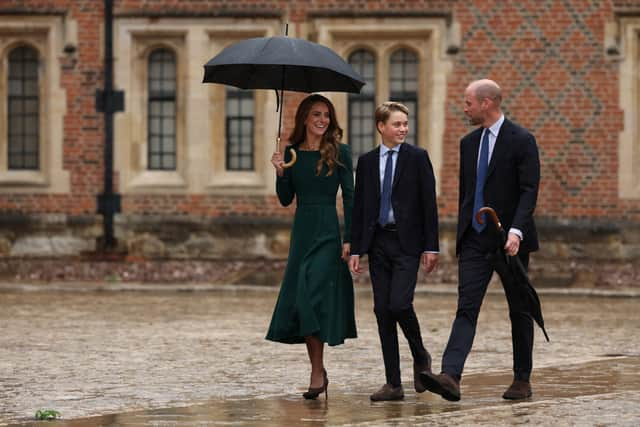
Last week we saw pictures of Prince George heading into one of Britain’s most famous schools while his parents looked on proudly.
I have done some work in similar schools myself. They aren’t simply schools. They are part of an institution, a community, a tradition and, importantly, a network.
I’ve spent decades working in education management – training leaders and members of government bodies. I have also designed courses for public schools, and I am regularly invited to speak in all sorts of educational settings. What I find interesting is what different institutions ask me to discuss.
State schools have tended to invite me to speak about diversity, equality and multiculturalism. Public schools have asked me to talk about technology, conflict management, communication, leadership, competition, self-reliance and individualism.
That difference has stayed with me. Are we preparing young people simply to fit into society, or to shape it?
There are obvious differences between the sectors. Public schools can offer smaller classes, often fewer than 18 pupils, compared with state schools where classes of more than 30 are not unusual.
But it isn’t just about class size. When I visit state schools – where pupils wear modern attire – I often see pictures of rainbows and flags from other nations. There’s always a strong emphasis on role models from other cultures and countries. I cannot remember visiting one where I haven’t seen pictures of Nelson Mandela, Mahatma Gandhi or Martin Luther King Jr.
I sometimes wonder why state schools think British history is less prominent. Why don’t we see the Union Jack portraits of Charles I, Oliver Cromwell or Margaret Thatcher? Whatever your politics, Thatcher was Britain’s first woman Prime Minister and influenced politicians across the political divide, including Tony Blair and David Cameron. Children should know about her.

Walk into one of the great public schools and the walls can look rather formidable – sometimes positively austere. They are often covered with figures who shaped Britain: Elizabeth I, Churchill, Wellington, Robert Peel, Henry VIII and many others. The message is clear: history, tradition and continuity matter.
This is where I think public schools often get something right. They tend to give pupils – wearing top hats, gowns or tail coats – an unapologetic sense of history and national identity, while encouraging them to think about leadership, competition and personal responsibility.
I am not suggesting children shouldn’t learn about identity, equality or climate change. Of course they should.
But should they leave school knowing more about social-policy terminology than finance, technology, history, languages and how the world actually works?
The French sociologist Pierre Bourdieu wrote about ‘cultural capital’ – the knowledge, confidence and social skills that help people navigate influential environments. Public schools are particularly good at providing this. Sport, debating, drama, music, travel and societies all become part of education.
Pupils may play rugby, cricket, rowing or polo, learn to ride, speak languages, discuss finance or entrepreneurship and build friendships that can last for decades. A polo stick isn’t going to improve your mathematics. But the collective effect can be considerable.
You may simply become more comfortable walking into an unfamiliar room, speaking to influential people or making your voice heard.
Competition, properly handled, can teach resilience, ambition, discipline and determination – not bad qualities for future leaders.
It may also explain why some state-school pupils can achieve excellent grades yet arrive at Oxbridge and somehow feel that they don’t quite belong.
This is one reason I made an unconventional decision about my own son’s education. He’s home educated because, very early in his formative years, I became increasingly uncomfortable with what I regarded as an emphasis on social-policy agendas at the expense of knowledge, intellectual independence, discipline and leadership.
I wanted him to read, think, travel and develop practical skills rather than simply collect qualifications. Most importantly, I wanted him to develop the confidence to lead.
And this brings us to parents. Having children is a great responsibility. The state provides an important safety net, but where parents have the means, I believe they should provide as much as they reasonably can themselves. If you can afford private education and wider opportunities, why wouldn’t you give your children those advantages?
Free state education is an enormous privilege, but parental responsibility should not end at the school gate. Free doesn’t necessarily mean free. It’s an entrapment.
Britain is not a feudal society. Your surname does not determine your destiny. But neither is Britain a pure meritocracy.
Money can buy opportunities. Education can create them. And connections can open doors. That may be uncomfortable to admit, but pretending otherwise doesn’t help children from less privileged backgrounds. If anything, we should be giving them more of the knowledge, confidence and networks that traditionally belonged to the elite.
Education should not simply prepare young people to enter the economy. It should prepare them to influence it, lead it and, perhaps, change it.
That, ultimately, is what Prince George is being given at Eton.Not merely lessons. The world.
Comment Guidelines
Iconic Media encourages reader discussion on our stories. User feedback, insights and back-and-forth exchanges add a rich layer of context to reporting. Please review our Community Guidelines before commenting.