
Birmingham city centre Smithfield project ‘leaking potential’


Planned cuts to a showpiece Birmingham city centre development plan would risk diminishing the giant project, opposition city councillors have claimed.
Tories on the city council were responding to news that leisure and culture facilities were set to be squeezed for financial reasons when the Smithfield scheme became a reality.
The scheme will transform Birmingham’s former wholesale market site into a destination providing homes, retail space, civic squares, a market complex, leisure facilities, a park and more.
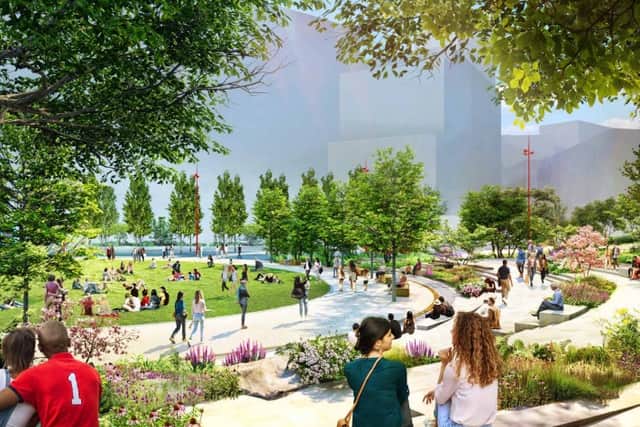
The council said the project would boost the city’s international standing and signify its “renewed energy, vigour and confidence”.
But the authority has revealed the Art Shed cultural building and the Round House music venue are now proposed to be incorporated into a single building, rather than two separate structures.
And a ‘big-box’ style leisure complex incorporating ‘Future Worlds’, an immersive digital edutainment playground, and the ‘Urban Adventure Playground’, an extreme indoor sports/activity destination, will “no longer be offered,” it said.
“The leisure offer will now consist of two smaller leisure provisions,” an outline business case for Smithfield said.
The council could also face a £29 million bill to meet the demand for extra school places arising from families who would move to Smithfield – which it admitted was “less than ideal”.
The Birmingham Conservative Group claimed that Smithfield’s potential was “leaking away”.
Group leader Councillor Robert Alden said at a meeting yesterday (July 22) that the plans were being drawn into “delays, cost increases and changes”.
Councillor Saima Suleman, the Labour cabinet member responsible for culture, acknowledged “some of the early ambitions around the culture and leisure components of the scheme have been refined”.
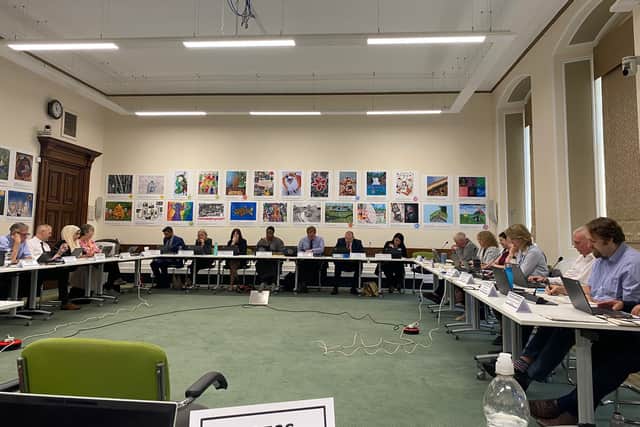
But she said: “I’m pleased the commitment remains to deliver a high-quality and inclusive offer that aligns with Birmingham’s distinct identity and evolving needs.”
Council deputy leader Councillor Sharon Thompson described the Smithfield scheme as “one of the city’s most significant development opportunities”.
“I, alongside others, have been putting some rigour behind the questions we’ve been asking to officers and what we’re requiring to make sure we can have the best possible outcome,” she said.
“We’ve been very keen to make sure it was tested against the lessons learnt from Perry Barr, that was a red line for the entire cabinet.”
Councillor Thompson said the project’s finances would be robustly monitored.
She said: “Councillor Suleman has talked about the digital and heritage aspects this is going to bring and I think it’s really important we highlight that.
“If we listen to all the comments around the table, we’d think this is a scheme that isn’t going to bring anything to Birmingham – but it is.”
Councillor Thompson said delays were sometimes necessary “from time to time” to ensure due diligence.
Culture and leisure changes
The changes to Smithfield’s culture offer was made amid a need to reduce the funding requirement, as requested by government-appointed commissioners, who were sent in to oversee the crisis-hit authority’s recovery.
“To address the budget shortfall the council set a principle not to commit to any new prudential borrowing and to consider any new investment in regeneration projects on a case-by-case basis,” the outline business case said.
“In September 2024, the commissioners did not support the £209m EZ [Enterprise Zone] funding ask for the Smithfield proposal and requested the EZ gap funding ask be eliminated or reduced to the minimum.”
The requested funding linked to the Enterprise Zone, which invests in projects and initiatives that drive economic growth, was £172.8m.
The council said the changes could not have been foreseen at the time of procuring development partner Lendlease and highlighted “wider, viability pressures” arising from the higher levels of inflation recorded during 2022-24.
Of the leisure facilities being cut, the council said digital immersive experiences were becoming more common across UK cities while extreme indoor playgrounds were typically found out-of-town due to needing large footprint areas.
It also said updated research advised against pursuing proposals for an urban adventure playground.
Cabinet members yesterday approved the use of Enterprise Zone funding.
Council facing £29m cost
Of the school places, a council report said: “Additional requirements of Smithfield is likely to lead to the need for over 1,000 primary/secondary/early years/SEND places at an estimated cost in the region of £29.58m.
“At this stage, if the scheme is to progress, the council, as a worst-case position, will need to underwrite the costs of the education provision.”
The authority admitted that this would increase the pressure on already “extremely constrained capital resources”.
With other schemes also set to increase the number of homes in central Birmingham, it said: “A more strategic approach to identifying the increased demand on service provision, including education, will now be required.”
In a bid to minimise the impact on its resources, the council said officers would explore “all routes” for external funding.
It added: “Education officers will continue to work collaboratively with the project team to plan effectively and ensure that school places are created in a timely manner as demand materialises”.
In the report, the authority said developers agreed to provide 2,900 sq m of space for education as part of the housing provision – a position accepted by planning on the grounds of scheme viability.
“However, following discussions with Education, it was determined the proposed education space – located beneath residential development – would not adequately support education needs and was therefore rejected,” it said.
Comment Guidelines
Iconic Media encourages reader discussion on our stories. User feedback, insights and back-and-forth exchanges add a rich layer of context to reporting. Please review our Community Guidelines before commenting.