CES 2026: Robots, AI companions and wearables among highlights on day two
Robots, AI companions, assistants, health longevity tech, wearables and more were on show as the showroom floors opened on day two of CES 2026.
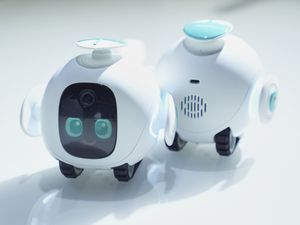
Crowds flooded the freshly opened showroom floors on day two of CES 2026 and were met by thousands of robots, AI companions, assistants, health longevity tech, wearables and more.
Siemens president and chief executive Roland Busch kicked off the day with a keynote detailing how its customers are harnessing artificial intelligence (AI) to transform their businesses.
He was joined on stage by Nvidia chief executive Jensen Huang to announce an expanded partnership, saying they are launching a new AI-driven industrial revolution to reinvent all aspects of manufacturing, production and supply chain management.

Lenovo ended the day with a guest star-rich visual banquet dedicated to spotlighting how its AI platforms can help people personally (wearables), with their businesses (enterprise platforms) and the world around them.
To strike home his points, chief executive Yang Yuanqing was joined by tech superstars such as Nvidia’s Mr Huang, AMD chief executive Lisa Su and Intel chief executive Lip-Bu Tan.
The CES is a huge opportunity annually for companies large and small to parade products they plan to put on shelves this year.
Gaming tech company Razer is well known for bringing buzz-worthy hardware to CES, such as haptic, or tactile, seat cushions and tri-screen laptops.
This year, it is reaching beyond its standard gaming base and demonstrating two AI-powered prototypes – an over-ear gaming headset that doubles as a general-purpose assistant, and an AI desk companion that can provide gaming advice and also organise a user’s life.
The holographic companion, based on a Razer on-screen AI assistant launched last year (Project Ava), has transitioned off-screen into a small glass tube that sits near your computer.

The animated sprite has built-in speakers and a camera so it can see the world around it.
Both devices are AI agnostic, so you can use your preferred model.
For the demo, the headset – Project Motoko – ran on OpenAI’s ChatGPT.
Project Ava worked off xAI’s Grok.
Although still in development, Razer said it expects both to be released commercially later this year.
Meanwhile, Oshkosh Corporation debuted a fleet of autonomous airport robots designed to help airlines pull off what it calls “the perfect turn” – a tightly timed process that happens after a plane lands, including fuelling, cleaning, handling cargo and getting passengers off and back on.
For travellers, chief executive John Pfeifer says the goal is fewer delays without compromising safety.
The technology is also designed to keep those tarmac tasks moving even during severe weather, such as winter storms or extreme heat, when conditions are daunting for human crews, Mr Pfeifer said.

Testing with major airlines is already under way, and the robots would be likely to debut at large hub airports such as Atlanta or Dallas, with a goal of rolling them out over the next few years.
Chinese robovac maker Roborock introduced a vacuum that literally sprouts chicken-like legs to navigate stairs and clean steps along the way.
The Saros Rover was a tad slow in its ascent and descent (but it was cleaning each step) during the demo, but Roborock says it will be able to traverse almost any style of stairwell, including spiralled.
No release date was given for the Rover, which the company says is still in development.
While it may look like a typical scale you would buy for your bathroom, Withings’ new Body Scan 2 measures much more than weight.
Taking off their shoes and socks, people lined up to try out the “smart scale” that in 90 seconds measures 60 different biomarkers, including their heart age, vascular age and their metabolism using the pads of their feet and hands.
The 600 dollar (£444) scale, which will be available for purchase in the spring, also provides a nerve health score and measures changes in someone’s electrodermal activity, or the skin’s electrical properties due to sweat gland activity.
The smart scale and a corresponding app, which costs 10 dollars (£7.40) a month or 100 dollars (£74) a year, provide personalised advice and a health trajectory for its users.

The French company’s goals are to help people monitor their health and reverse bad habits to promote longevity.
Commonwealth Fusion Systems (CFS), Nvidia and Siemens announced that they are working together to use AI to hasten making nuclear fusion a new source of carbon-free energy.
In Massachusetts, CFS is building a prototype fusion power plant called Sparc, which is about 70% complete.
Through the new partnership, it will create a “digital twin”, or online simulation, of the physical machine.
CFS chief executive Bob Mumgaard said it will ask questions of the simulation to speed up progress on the physical machine and rapidly analyse data, compressing years of manual experimentation into weeks of understanding.
Sparc is a prototype for the company’s first planned power plant, called Arc, that is meant to connect to the grid in the early 2030s.
The device will use very strong magnets to create conditions for fusion to happen.
Mr Mumgaard also said CFS’s first high-temperature superconducting magnet has been installed in Sparc.