Aid entering Gaza ramps up as Israelis await release of hostages
It comes amid hope a ceasefire deal will signal the end of the devastating two-year war.
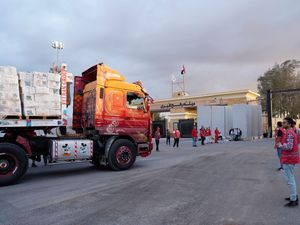
Preparations are under way for a ramp-up of aid entering the Gaza Strip under a ceasefire deal many hope will signal an end to the devastating two-year war.
The Israeli defence body in charge of humanitarian aid in Gaza, COGAT, said the volume entering Gaza is likely to now increase to around 600 trucks per day, as stipulated in the agreement.
Egypt said it is sending 400 trucks carrying aid into Gaza on Sunday. The trucks will have to be inspected by Israeli forces before being allowed in.
UN officials said real progress was being made on Sunday with the aid being allowed into Gaza.
Eri Kaneko, a spokesperson for the UN’s Office for the Co-ordination of Humanitarian Affairs, said supplies of cooking gas had entered Gaza for the first time since March. Other aid moving through include flour, fruit and meat.
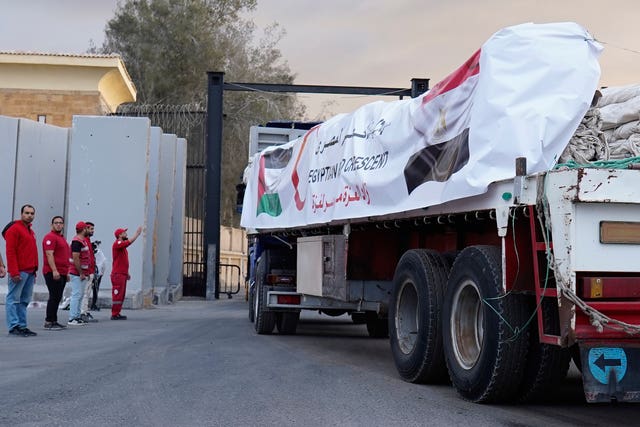
Associated Press footage showed dozens of trucks crossing the Egyptian side of the Rafah crossing. The Egyptian Red Crescent said the trucks include medical supplies, tents, blankets, food and fuel.
In recent months, the UN and its partners have been able to deliver only 20% of the aid needed in Gaza because of the fighting, border closures and Israeli restrictions on what enters.
Expanding Israeli offensives and restrictions on humanitarian aid have triggered a hunger crisis, including famine in parts of the territory.
“Much of Gaza is a wasteland,” UN humanitarian chief Tom Fletcher told The Associated Press. He said the UN has a plan for the next two months to restore basic medical and other services, bring in thousands of tons of food and fuel and remove rubble.
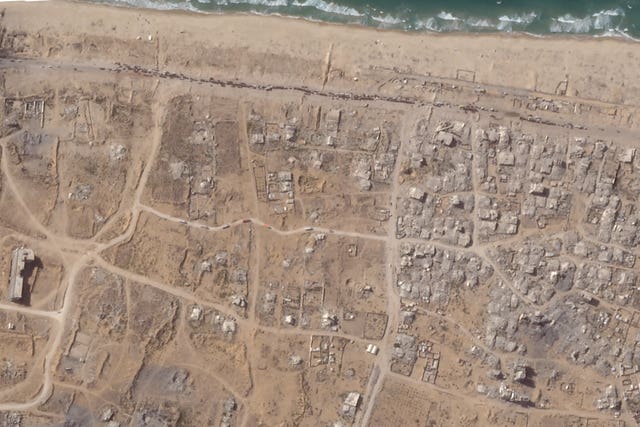
The UN has said it has about 170,000 metric tons of food, medicine and other humanitarian aid ready to enter Gaza once Israel gives the green light.
Abeer Etifa, a spokeswoman for the World Food Programme, said workers are clearing and repairing roads inside Gaza on Sunday to facilitate delivery.
Preparations are also under way on Sunday for the release of Israeli hostages held in Gaza and Palestinian prisoners detained in Israel.
A message sent on Saturday from Gal Hirsch, Israel’s co-ordinator, told hostage families to prepare for the release of their loved ones starting Monday morning. One of the families of the hostages confirmed the note’s authenticity.
Mr Hirsch said preparations in hospitals and in Rei’im camp are complete to receive the live hostages, while the dead will be transferred to the Institute of Forensic Medicine for identification.
Israeli Prime Minister Benjamin Netanyahu, whose name was booed repeatedly on Saturday night at a weekly rally for the hostages in Tel Aviv, said in a statement that Monday would be a “path of healing.” Many Israelis have accused him of drawing out the war for political aims, which he has denied.
An international taskforce will start working to locate deceased hostages who are not returned within the 72-hour period, said Mr Hirsch. Officials have said the search for the bodies of the dead, some of whom may be buried under rubble, could take time.
Israel said on Sunday that it expected all of the living hostages to be released Monday.
“We are expecting all 20 of our living hostages to be released together at one time to the Red Cross and transported among six to eight vehicles,” Israeli government spokesperson Shosh Bedrosian said, noting that Israel did not expect militants to stage the exchanges in the same manner as previous rounds.
“In a few hours, we will all be reunited,” Israel’s military chief of staff, Lt Gen Eyal Zamir, said in a statement.
Israeli officials believe about 20 of the hostages out of 48 held by Hamas and other Palestinian factions in Gaza are still alive.
US President Donald Trump, who pushed to clinch the ceasefire deal, is expected to arrive in Israel on Monday morning. He will meet with families of hostages and speak at the Knesset, Israel’s parliament, according to a schedule released by the White House.
He will then continue on to Egypt, where the office of Egyptian President Abdel-Fattah el-Sissi has said he will co-chair a “peace summit” attended by regional and international leaders.
Mahmoud Abbas, leader of the internationally recognised Palestinian Authority, will attend, Mahmoud al-Habbash, a judge and adviser to Mr Abbas, told the AP.
Timing has not yet been announced for the release of some 2,000 Palestinian prisoners held in Israel who are to be freed under the deal. They include 250 people serving life sentences in addition to 1,700 people seized from Gaza during the war and held without charge.
Dr Mounir al-Boursh, head of Gaza’s Health Ministry, said he hoped the bodies of medical personnel who died in Israeli detention centres will be among those handed over.
Germany wants to provide rapid support for the reconstruction of Gaza in the event of a lasting peace agreement, Development Minister Reem Alabali Radovan said.
“Germany is ready to assist with the reconstruction,” Ms Alabali Radovan told the Handelsblatt newspaper on Sunday.
She said Germany wants to initially help with mobile temporary housing and was in favour of bringing in the private sector for the reconstruction.
“It won’t work without private capital. The reconstruction of Gaza, Syria or Ukraine requires sums of money that we could never raise from public budgets alone,” she said.