Israel’s growing frustration over war in Gaza erupts in nationwide protests
Groups representing families of hostages organised the demonstrations.
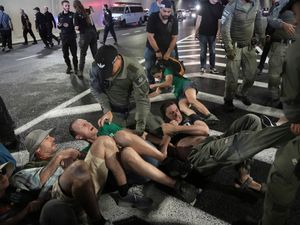
Israeli police made dozens of arrests on Sunday as tens of thousands of protesters demanding a deal to free hostages in Gaza tried to shut down the country in one of the largest and fiercest protests in 22 months of war.
Groups representing families of hostages organised the demonstrations, and gave an even larger estimate of attendees, as frustration grows in Israel over plans for a new military offensive in some of Gaza’s most populated areas.
Many Israelis fear this could further endanger the remaining hostages. Twenty of the 50 who remain are believed to be alive.
“We don’t win a war over the bodies of hostages,” protesters chanted.
Even some former Israeli army and intelligence chiefs now call for a deal to end the fighting.
Protesters gathered at dozens of places including outside politicians’ homes, military headquarters and on major roads. They blocked lanes and lit bonfires. Some restaurants and theatres closed in solidarity. Police said they arrested 38 people.
“The only way to bring (hostages) back is through a deal, all at once, without games,” former hostage Arbel Yehoud said at a demonstration in Tel Aviv. Her boyfriend Ariel Cunio is still held by Hamas.

One protester carried a photo of an emaciated Palestinian child from Gaza. Such images were once rare at Israeli demonstrations but now appear more often as outrage grows over conditions for Palestinian civilians after more than 250 malnutrition-related deaths.
An end to the war does not seem near. Israeli prime minister Benjamin Netanyahu is balancing competing pressures including the potential for mutiny within his coalition.
“Those who today call for an end to the war without defeating Hamas are not only hardening Hamas’s position and delaying the release of our hostages, they are also ensuring that the horrors of October 7 will be repeated,” Mr Netanyahu said, referencing the Hamas-led attack in 2023 that killed some 1,200 people and sparked the war.
The last time Israel agreed to a ceasefire that released hostages earlier this year, far-right members of his cabinet threatened to topple Mr Netanyahu’s government.

Finance minister Bezalel Smotrich called the demonstrations on Sunday “a bad and harmful campaign that plays into Hamas’s hands, buries the hostages in the tunnels and attempts to get Israel to surrender to its enemies and jeopardise its security and future”.
The new offensive would require the call-up of thousands of reservists, another concern for many Israelis.
Hospitals and witnesses in Gaza said Israeli forces killed at least 17 aid-seekers on Sunday, including nine awaiting UN aid trucks close to the Morag corridor.
Hamza Asfour said he was just north of the corridor awaiting a convoy when Israeli snipers fired, first to disperse the crowds, then from tanks hundreds of metres away. He saw two people with gunshot wounds.
“It’s either to take this risk or wait and see my family die of starvation,” he said.

The Gaza Humanitarian Foundation, which runs the Israeli-backed and US-supported distribution points that have become the main source of aid since they opened in May, said there was no gunfire “at or near” its sites, which are located in military-controlled areas.
Israel’s military did not immediately respond to questions.
Israel’s air and ground war has displaced most of Gaza’s population and killed more than 61,900 people, according to Gaza’s health ministry, which does not specify how many were fighters or civilians but says around half were women and children.
Two children and five adults died of malnutrition-related causes on Sunday, according to the ministry, which is part of the Hamas-run government and staffed by medical professionals. The UN and independent experts consider it the most reliable source on casualties. Israel disputes its figures but has not provided its own.
The United Nations has warned that levels of starvation and malnutrition in Gaza are at their highest since the war began. Most aid has been blocked from entering Gaza since Israel imposed a total blockade in March after ending a ceasefire. Deliveries have since partially resumed, though aid organisations say the flow is far below what is needed.
It is not clear when Israel’s military will begin the new offensive in the crowded Gaza City, Muwasi and what Mr Netanyahu has called the “central camps” of Gaza.

The military body that co-ordinates its humanitarian aid to Gaza, COGAT, this weekend noted plans to forcibly evacuate people from combat zones to southern Gaza “for their protection”. But designated “safe zones” have also been bombed during the war.
War-weary Palestinians said on Sunday that they would not leave, arguing that there was “no safe place” in Gaza.
Meanwhile, Israeli airstrikes hit Yemen’s capital on Sunday, escalating strikes on the Iran-backed Houthi rebels, who since the war in Gaza began have fired missiles at Israel and targeted ships in the Red Sea.
The Houthi-run Al-Masirah Television said the strikes targeted a power plant in the southern district of Sanhan, sparking a fire and knocking it out of service.
Israel’s military said the strikes were launched in response to missiles and drones aimed at Israel.