Train driver told to go at normal speed just minutes before derailment – inquiry
Train 1T08 crashed at Carmont near Stonehaven on August 12 2020 after it hit a pile of gravel washed onto the railway track.
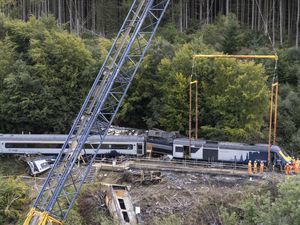
The driver of a train that derailed after hitting a landslip was told it was “fine” to proceed at normal speed just minutes before the incident, an inquiry has heard.
Train 1T08 crashed at Carmont near Stonehaven on August 12 2020 after it hit a pile of gravel washed onto the railway track by heavy rain before striking a bridge parapet.
It had been travelling to Glasgow, having left Aberdeen at 6.39am.
Of the nine people who were aboard the train, three – train driver Brett McCullough, 45; conductor Donald Dinnie, 58; and passenger Christopher Stuchbury, 62 – were killed.
The fatal incident inquiry (FAI) at Aberdeen Sheriff Court heard on Wednesday afternoon that heavy rainfall on August 11 and 12 had caused “severe” disruption to much of Scotland’s rail network on the morning of the crash.
Ash Gardner, inspector of rail accidents at the Rail Accident Investigation Branch (RAIB), told the inquiry train 1T08 passed the site of the derailment at 6.59am on its journey south.

A couple of minutes later, shortly after it had passed Carmont signal box, the driver was told to stop and return north to Stonehaven due to a landslip on the line ahead.
He said the landslip was one of four known weather-related incidents on the line within 11 miles of the signal box, with reports of flooding at the three other locations.
Mr Gardner said turning the train took two-and-a-half hours as an engineer had to come to manually adjust the points, meaning the signaller did not instruct the driver to begin returning north until 9.28am.
“During this conversation, the driver queried whether there was any speed restriction to Stonehaven; the signaller replied that the line was fine between Carmont and Stonehaven, and that the driver could proceed at normal speed,” Mr Gardner said.
“In response, the driver said that he would be in no rush to get there.
“After travelling slowly past Carmont signal box and once the rear of train 1T08 was clear of the crossover, the driver of train 1T08 accelerated towards the washout.”
The derailment was first reported at 9.37am, according to a RAIB report into the incident.
Mr Gardner added: “OTDR data shows that, as train 1T08 reached the site of the derailment, it was travelling marginally slower than the average speed of the 19 trains formed of HSTs that had passed the site of the derailment in the down direction on the previous day.”
He said investigations had found the landslip most likely occurred between 8.15am and 9am.
Mr Gardner said an RAIB inspection had found failings in the way management had assessed and managed risks relating to the severe weather.
This included, he said, that an extreme weather action team (EWAT) was not convened on August 11 or 12, despite the fact conditions in parts of Scotland meant one should have been called according to National Rail standards.
He also pointed to the fact a “gold command structure” – which he said could have called for a “cessation of travel” around the network – was not put into effect until after 10am – too late to prevent the accident from happening.
Mr Gardner added that the rail control room operation on the morning of August 12 had been under “severe workload pressure” as a result of the number of weather-related incidents around Scotland.
As a result, he said, controllers lacked the “situational awareness” necessary to asses the risks facing individual trains on the network, including train 1T08.
He was also critical of the fact control room staff were not making full use of the National Rail Weather System, which is designed to enable monitoring of extreme weather events, despite the fact it had been procured by National Rail in 2015.
Earlier in the day, the inquiry heard the outcome of the crash would have been improved if the train had been “compliant with modern crashworthiness standards”.
Dominique Louis, a principal inspector at the RAIB, said the 50-year-old train had been built before the requirement for safety measures like “anti-climb devices” and “energy-absorbing vehicle ends” came into force.
Had these been in place, he said, they would have reduced the risk of coach D “overriding” the lead power car, which he said caused a “complete loss of survival space” that resulted in the death of Mr Dinnie.
He said these measures, along with stronger “couplers” between coaches, could also have enabled coach D to keep the lead power car on track for long enough to make it over the bridge.

The FAI was previously told the death toll would have “almost certainly” been higher had the train been full.
The crash took place during the Covid-19 pandemic, with the Aberdeen area in lockdown, and there was a drop of around 65% in passenger numbers across the entire network at the time, the inquiry heard.
A criminal prosecution saw Network Rail fined £6.7 million in 2023 after it admitted health and safety failings over the crash.
A Network Rail spokesperson said on Monday the Government-owned company is “committed to supporting the work of the inquiry and continuing to deliver on the recommendations made by RAIB”.
They added: “We’ve made significant changes to how we manage the risk of severe weather since the accident and our work to make our network more resilient will continue.”
The inquiry before Sheriff Lesley Johnson continues.