Zelensky says Ukraine ‘can’t manage’ without US or European support
Sir Keir Starmer hosted Volodymyr Zelensky along with French President Emmanuel Macron and German Chancellor Friedrich Merz for private talks.
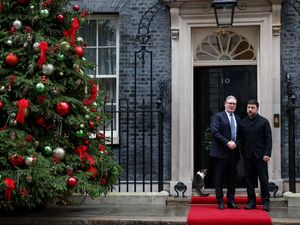
Crisis talks over the future of Ukraine have been held in Downing Street after the country’s president Volodymyr Zelensky arrived in London to meet European allies.
Mr Zelensky said ahead of the meeting that his country “can’t manage” without European and American support.
Prime Minister Sir Keir Starmer hosted Mr Zelensky along with French President Emmanuel Macron and German Chancellor Friedrich Merz for private talks as efforts continue to find a way to end the war with Russia.
The discussions came as US President Donald Trump accused Mr Zelensky of having failed to read the latest peace plan, saying he was “a little disappointed” in the Ukrainian leader, while insisting Russia’s Vladimir Putin was “fine with it”.

Speaking as European leaders gathered at Downing Street, President Zelensky said: “I think that now it’s very important to organise sessions to meet and discuss very sensitive issues regarding these talks (we had) in the United States.
“A lot of what we have to discuss… are things that are very important for unity between Europe and Ukraine, and also unity between Europe and Ukraine and the United States.

“We can’t manage without Americans, we can’t manage without Europe and that is why we need to make some important decisions.”
Mr Macron meanwhile insisted Ukraine’s allies have “a lot of cards”.
He pointed to the funding of equipment and arms for Ukraine, the Ukrainian resistance and the economic impact of sanctions imposed by the US and Europe on Russia as positive signs.
President Macron said: “Now I think the main issue is the convergence between our common positions – Europeans and Ukrainians and the US – to finalise these peace negotiations and re-engage in a new phase that means the best possible conditions for Ukraine, for the Europeans, and for collective security.”

Sir Keir meanwhile insisted any ceasefire in Ukraine must be “just” and “lasting”, telling the other leaders: “We are at a critical stage in the push for peace.
“The principles remain the same: we stand with Ukraine, and if there is to be a ceasefire, it needs to be a just and lasting ceasefire.”
The Prime Minister and Mr Macron have been leading efforts with the “coalition of the willing” countries prepared to support Ukraine in the event of a peace deal, with the UK ready to commit troops to the effort.
Speaking ahead of the talks, Sir Keir had told the Press Association there had to be “hard-edged security guarantees” behind any ceasefire.
Despite Mr Trump’s White House criticising European leaders for having “unrealistic expectations” about the war, the Prime Minister paid tribute to the US president.

“You can never get from conflict to peace by an easy, straight route,” he said.
“It’s always a complicated business, but I do think that we’re making progress, and I think what President Trump has been able to achieve in the last few weeks, getting it this far, has been the furthest we’ve got in the four years.
“And I therefore pay tribute to him for that, and hopefully we can make some further progress this afternoon.”
Mr Zelensky’s visit to London comes after his officials concluded three days of talks with their US counterparts on those proposals as the White House presses Kyiv to accept a deal.

Over the weekend, Mr Zelensky said he had discussed “next steps” with Mr Trump’s advisers and was “determined to keep working in good faith”.
But the negotiators also acknowledged that any “real progress” will depend “on Russia’s readiness to show serious commitment to long-term peace”.
Ukraine and its European allies are likely to insist that any ceasefire comes with security guarantees from both the US and the coalition of the willing convened by the UK and France, while also resisting the transfer of territory to Russia.
Sir Keir has repeatedly said that Ukraine must be allowed to determine its own future, while one of his senior ministers said on Sunday that the country must not be left “toothless” in the face of Russian aggression.
But Russia has repeatedly rejected the prospect of allied troops being stationed in Ukraine and continues to demand large swathes of Ukrainian territory in exchange for peace.

And Russian forces have continued their assault on Ukraine over the weekend.
At least four people were killed in drone and missile strikes on Sunday, while Moscow continues to target Ukrainian infrastructure in a bid to “weaponise” the cold by denying civilians access to heat and power.
During the meeting at No 10, Mr Zelensky is expected to hear updates on a host of support European allies are providing to Ukraine, including on how immobilised Russian assets could be utilised.
British officials suggested they were hopeful of movement on using these assets in the coming days.
The meeting also comes in the wake of the publication of a new US national security strategy that made improving relations with Moscow one of Washington’s top priorities.

Kremlin spokesman Dmitry Peskov welcomed the document, saying it was broadly in line with Moscow’s own vision.
On Sunday, Mr Trump told reporters that Mr Zelensky has yet to read the US-authored peace proposal.
“Russia is, I believe, fine with it, but I’m not sure that Zelensky’s fine with it. His people love it, but he hasn’t read it,” he said.
Meanwhile, Foreign Secretary Yvette Cooper is in Washington for talks with her US counterpart Marco Rubio.
She is expected to focus on efforts to secure an end to the war in Ukraine, as well as UK-US co-operation on global security and the ceasefire in Gaza.