
Video: Former Archbishop of Canterbury discusses poverty in a talk in Wolverhampton
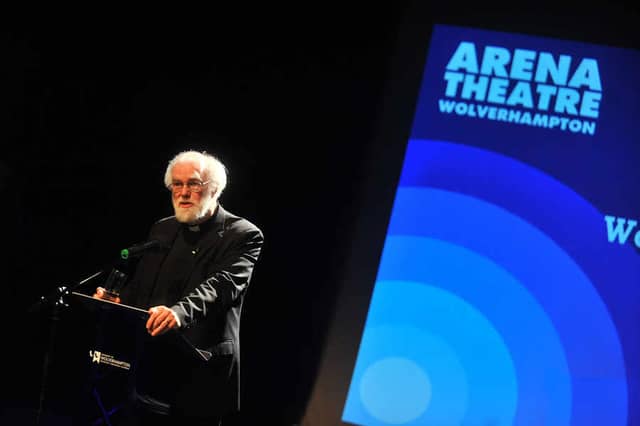

[gallery] He began his talk with the aim of encouraging people to think about poverty and started with two sentences from the same chapter of the Bible to highlight his message.
The former Archbishop of Canterbury Dr Rowan Williams quoted two lines from Chapter 15 of Deuteronomy - and it was in the apparent contradiction between them, he said, that those listening would hear the truth.
The first line was 'there shall be no poor among you', while the other was 'you always have the poor with you'.
He said the first showed that poverty was not a law of nature and it was possible to think of society without anyone at relative disadvantage to others, but 'given the human habit' the second sentence also rang true - that it was unlikely the situation would change very soon.
It was with that shot of realism that Dr Williams, now a master at Magdalene College, Cambridge, began his talk at Wolverhampton's Arena Theatre, organised by the University of Wolverhampton. He said he believed his message would resonate with the people of Wolverhampton still reeling from the announcement of a possible 2,000 job losses at the city council.
He delivered his speech after telling the Express & Star he believed that the controversial television programme Benefits Street had spread 'stereotypes and myths', that had not helped the ongoing national welfare debate.
Poverty existed in four forms, he said - the first being poverty of security: the vulnerability to crisis - not having emergency savings for life's surprises.
He said he suspected this would be how a lot of people in the city would be feeling especially now.
"I have a low-paid job, things went wrong, my partner became ill, so did my mum and then I had to look after her garden - unforeseen pressures and constraints which suddenly make a means of bare subsistence is not quite enough" - that was how Dr Williams summed it up.
The second, he said, was the poverty of relationship - not knowing on whom to rely; not having a safety net.
The third was poverty of access - people not knowing where to turn to find a way out of troubles, while the fourth he called poverty of culture. And no, he did not mean people who could not afford tickets to the National Theatre, so he quipped himself - rather the lack of a climate where people have an alternative image of what they could make of themselves.
Dr Williams said: "The poverty of culture is when your horizons contract and you cannot think outside of the box and see the current situation as inevitable.
"Then cynicism, apathy and hopelessness take over."
He said in order to have a sensible discussion about the issue however there was a need for public rhetoric to change.
His talk came as the welfare debate continues to dominate national political manoeuvring - which he acknowledged by saying it 'did not take much effort' to follow his thoughts onto images with which his audience had been confronted recently - a hint at Benefits Street and the ensuing fallout.
And he said in order for progress to be made, 'our cultural exchange on the subject needed to be humanely serious'.
This was not a talk in which he would set policies, he said, just engage people's minds.
He said: "We need to lay to rest the notion, recently revived, of the deserving and the undeserving poor.
"We need to think about the impact of poverty on those that can't choose it - the very old and the very young.
"The public rhetoric at the moment is that not everyone is interested in finding out what it is like to be poor in society.
"What confront us at the moment is a challenge to recognise poverty is an issue of relationship and not just prosperity."
And it was with that Dr Williams came full circle and reminded people that when they started to relate more to the issue themselves, they might make some progress.
"As I said in my beginning - poverty is not a law of nature and that's one of the most transforming things about thinking about poverty today."