Parents of M40 school minibus crash victim call for stricter rules on teachers driving 30 years after tragedy
A West Midlands couple whose daughter was killed in a school minibus crash have raised concerns their grandchildren face the same dangers more than 30 years on.
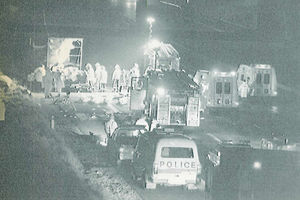
Liz and Steve Fitzgerald’s daughter Claire died in 1993 when the school minibus she was in collided with a lorry on the M40.
A teacher and 12 pupils from Hagley Catholic High School in Worcestershire were killed as they travelled back from a trip to London, two pupils survived.
Since the 13-year-old’s death, her parents have campaigned for improved road safety standards and are now calling for stricter rules to be put in place for teachers who drive minibuses.
“We desperately want both teachers and children to come home safe,” Mrs Fitzgerald told the Press Association, as she raised concerns over the lack of change in guidance over the past 30 years.
Current regulations permit any teacher who is over 21 and has held their standard licence for more than two years to drive a minibus which holds up to 16 passengers.
Under section 19 permits, teachers are not required to hold a D1 licence, which would involve a medical examination, passing a Passenger Carrying Vehicle (PCV) theory test, and passing a practical driving test in a 17-seat minibus.
However, someone driving for commercial purposes would require a D1 licence.
This discrepancy has been criticised by Mr Fitzgerald, who questioned why schools are not held to higher standards.
He told PA he welcomes the progress made on road safety over the past 30 years, but said “they don’t prevent accidents”.
The couple, alongside their local MP Sarah Edwards, are campaigning for a national safety standard to be applied to all schools.
Ms Edwards, Labour MP for Tamworth, said it should be mandatory for teachers to hold a D1 licence to drive a minibus.
Mrs Fitzgerald told PA she would prefer it if “teachers didn’t drive at all, frankly”.
“Teachers, teach. Drivers, drive.”
'Our two grandchildren were in she same position as Claire'
Reflecting on the lack of change since the death of her daughter Claire, she said: “I just realised like a bolt one night that our two grandchildren, who at that time were under one and nearly five, were in the same position that Claire was in.
“Which was a horrific thing for us to realise, to come to terms with.”
Teachers’ union the NASUWT strongly advises members not to drive minibuses, and argues it should not be part of their contractual duty.
One in four teachers have been pressured into driving a minibus, a survey by the union found.
It also reported one in 10 teachers have been required to drive more than 50 miles after a full day of teaching.
Ms Edwards said teachers who are “too tired, or aren’t confident” should not be behind the wheel.
She added: “We know that every time we get into a car or a vehicle, that you could be in an accident, and it only takes one silly driver or one real lapse of judgment for that to happen.
“But this is about saying if we’re going to go down that road, let’s make sure that those people that have that responsibility for safety are feeling that they are as empowered as possible.
“And that the result is that everybody is as safe as they can be, rather than having a system that feels like it is trending towards what is cheap or convenient, rather than what is best practice and what is right.”
'Indefensible'
Matt Wrack, NASUWT general secretary, said: “It is indefensible that there is still nothing to stop an untrained member of staff driving 16 children in a minibus.
“This loophole has been known for more than 30 years, has cost lives and must be closed.
“Parents expect that when their children travel in a school minibus, they are being transported by someone with proper training and the right licence.
“The Government’s failure to act leaves pupils, staff and the public at unnecessary risk.”
Drivers who passed their test pre-1997 automatically hold a D1 licence and are therefore able to drive 17-seater minibuses.
A Government spokesperson said: “Road safety is a top priority, and we provide guidance to schools and local authorities on driving minibuses. Drivers should make sure they have the right entitlements, ensure they are properly trained and take regular breaks.
“Ministers from the Department for Transport and the Department for Education have met with campaigners to listen to their concerns and will always work to make sure staff and children are safe when travelling to or from school activities.”