Fusion plants could start powering and heating homes from 2040, scientists say
Fusion power could be providing energy and heat to our homes in just over 20 years, according to scientists who are halfway towards proving the technology’s commercial potential.Thirty-five nations are contributing to the International Thermonuclear Experimental Reactor (Iter) being built at Saint-Paul-les-Durance in southern France.In December the Iter team announced the £16 billion reactor, said …
Fusion power could be providing energy and heat to our homes in just over 20 years, according to scientists who are halfway towards proving the technology’s commercial potential.
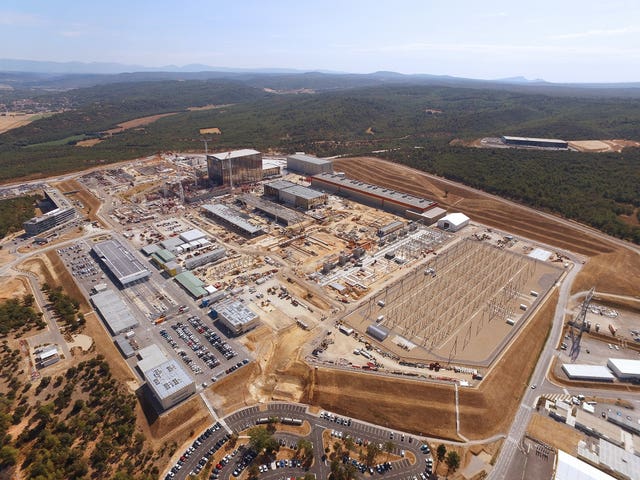
Thirty-five nations are contributing to the International Thermonuclear Experimental Reactor (Iter) being built at Saint-Paul-les-Durance in southern France.
In December the Iter team announced the £16 billion reactor, said to be the world’s most complex machine, is now 50% complete.
Atomic fusion is what powers the sun and other stars, and is responsible for the enormous destructive force of nuclear bombs.
It has the potential to provide the world with almost limitless amounts of clean energy using hydrogen as fuel.
However, the technical challenges are far greater than they are for conventional nuclear power plants which rely on atoms splitting apart instead of fusing together.
“Providing clean, abundant, safe, economic energy will be a miracle for our planet.”
In their latest release, the Iter scientists predicted that fusion plants will start to come online as early as 2040.
The exact timing is expected to depend on levels of public support, political will, and financial investment.
Iter is described as “the most complex science project in human history”.
Within the machine, hydrogen plasma will ultimately be heated to 150 million degrees Celsius – 10 times hotter than the centre of the sun – to trigger a fusion reaction.
One of the biggest challenges is keeping the electrically charged inferno away from the walls of the donut-shaped “tokamak” reactor using giant magnets.
To operate efficiently, the superconducting magnets must be cooled to minus 269C – the same temperature as interstellar space.
The European Union is paying 45% of the cost of Iter. China, India, Japan, Korea, Russia and the US each contribute 9% equally.