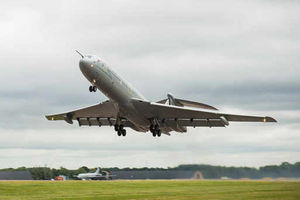
VC10 coming in to land at RAF Cosford
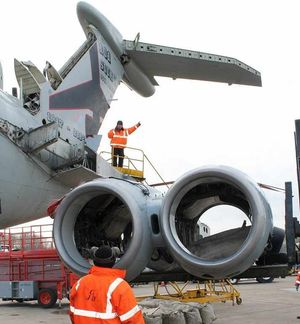
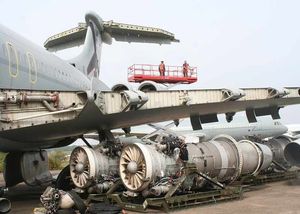
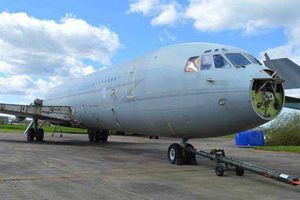
It's an aircraft with a proud tradition in Britain's military – but this VC10 is being dismantled piece by piece before it starts a new life at RAF Museum Cosford.
The 45-metre plane must be taken apart so the fuselage can be transported by lorry along Britain's motorway network to its new home near Wolverhampton.
Even once the plane has finished the 64-mile journey from Bruntingthorpe in Leicestershire – where it is being taken to pieces by a specialist aircraft salvage company – there will still be challenges to overcome.
The VC10 will be positioned on the airfield at RAF Cosford so the wings, fuselage and landing gear can be reassembled. It will then make the final few steps on to the museum site to allow the fitting of the rear fuselage fin, tail plane and engines.
When finished later in the summer, it will go on permanent display to visitors outside, next to the Lockheed Hercules C130K Mk3.
The VC10 is half way through its dismantling process. The process has taken a team of eight over seven months so far and the next few weeks will see the final work carried out, which includes removing the rear fuselage, inner wings and main undercarriage.
It is scheduled to leave Bruntingthorpe in June following the RAF Cosford Air Show to start the journey to the museum.
Staff at the museum have said the aircraft would play a vital role as an exhibit to help explain the history of the RAF to visitors.
The VC10 was a British aircraft originally built by Vickers-Armstrong and then later by the British Aircraft Corporation (BAC) and entered service with Royal Air Force in 1966.
At the end of its service career, this dual-role aircraft enabled the rapid deployment of troops and their weaponry and fast jet aircraft to many theatres of operations around the world.
With the ability to carry up to 124 troops at a time with nine crew members or a freight load of up to 20,400kg the VC10 has been one of the RAF's most significant assets for nearly 50 years.
Ian Thirsk, head of collections at RAF Museum Cosford, said: "The BAC VC10 formed the mainstay of the RAF's long range strategic transport force for almost fifty years.
"For one aircraft type to have been in service for such a long period is remarkable in itself.
"However, when this is added to the variety of roles and worldwide scope of operations, it is clear this is a unique aircraft and it would not be possible to accurately portray the history of the RAF without an example of the type.
"Therefore it is essential that such a pivotal and long serving aircraft is preserved by the RAF Museum."
The museum's new aircraft has a serial number XR808, meaning it was part of an initial order of five VC10s for the RAF and was to be used for VIP and far east routes.
After an initial period at RAF Fairford, XR808 spent the next 46 years based at RAF Brize Norton, in Oxfordshire.
In 1968 all 14 of the force's VC10s were named after RAF holders of the Victoria Cross - and XR808 was named Kenneth Campbell, after the flying officer who made a precision torpedo attack on the German battle ship Gneisenau.
The RAF VC10's allowed true global mobility offering a combination of speed and range never previously attained by an RAF Transport Command aircraft type.
Having travelled the world with No.10 Squadron including Colombo, Calgary, Hong Kong, Gutersloh and Bahrain, the aircraft was transferred to No.101 Squadron in 2006.
During the early stages of the Afghanistan War the aircraft operated support flight for joint Czech Republic and UK exercises during Operation Rhino, a raid by the United States Army Rangers on several Taliban targets.
As the number of VC10's began to dwindle, the museum's latest acquisition led a special formation flight over seven UK RAF stations to mark 50 years of the VC10 and 95 years of 101 Squadron.
The plane's importance and heritage is at the forefront of the engineers who are taking it apart ahead of the next chapter in its story.
Gary Spoors, accountable engineering manager at GJD Services, a specialist maintenance and aircraft salvage company which is dismantling the plane, said: "We have been given a fantastic opportunity to demonstrate our engineering skills and abilities during the dismantling and the eventual re building process of XR808.
"This is all made possible by the skill and dedication of the GJD staff and their overriding wish to make this happen.
"Personally I have a fond attachment to the VC10 as she was the first aircraft I flew on, then subsequently ended up working on during my RAF career and now again as the head of GJD.
"Having this example of a VC10 in the RAF Museum provides the best opportunity for the long term preservation of the type ensuring an icon of British Aviation is secured for future generations to enjoy.
"Preserving our aviation heritage is important to me and I am extremely proud to be given the opportunity to be part of this project."