Drought status declared for the West Midlands - Environment Agency update
The Environment Agency has announced that the West Midlands is now officially in drought status with hosepipe bans possible
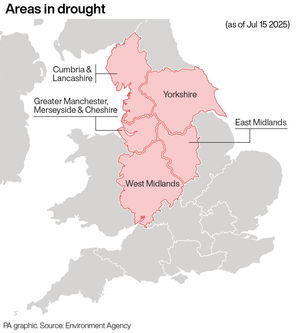
The West and East Midlands were put into drought status after the National Drought Group (NDG) met this morning (Tuesday, July 15).
Since the group of officials and experts last met on June 5, the situation has deteriorated further, the Environment Agency said.
The NDG heard that without further substantial rain, some water companies may need to implement further drought measures.
These would be likely to include more temporary use bans (TUBs) – also known as hosepipe bans.
The Environment Agency said it expects and will ensure water companies follow their drought management plans as well as step up work to fix leaks.
The public are also being urged to use water wisely across England and comply with any local restrictions as the dry weather continues to impact water resources nationwide.
The declaration of drought status for the East and West Midlands means the region joins Yorkshire, Cumbria and Lancashire, and Greater Manchester, Merseyside and Cheshire, which are already in drought as the UK struggles withthe driest start to the year since 1976.
The move comes in the wake of summer heatwaves and a drier than average June, with the Environment Agency (EA) warning three more areas – Lincolnshire and Northamptonshire, East Anglia, and Thames area – have also moved into prolonged dry weather status.
Across England, rainfall was 20% less than the long-term average for June, which was also the hottest on record for the country with two heatwaves driving unusually high demand for water, the Environment Agency said.
Reservoir levels continue to fall, with storage across the country at 75.6%.
Millions of households are facing water restrictions, with a hosepipe ban implemented in Yorkshire in the face of reservoir storage at only 53.8%.
And embattled utility Thames Water has announced a ban which will begin next Tuesday for customers in Oxfordshire, Gloucestershire, most of Wiltshire and some parts of Berkshire.
The Environment Agency warned that without substantial rain, more bans will follow.
Anglers, wild swimmers and boaters are also being urged to report any environmental issues they see, such as fish in distress in low water conditions.
What have the scientists say about the West Midlands drought?
Scientists said the recent extreme conditions have been made more likely due to human-caused climate change, bringing wide-ranging impacts on farmers, who are expected to see lower yields this year, and the environment.
Helen Wakeham, Environment Agency director for water and National Drought Group chairwoman, said: “This has been the driest start to the year since 1976, and we need to make sure our water supplies can sustain us through the summer.
“Today I have asked all the partners who make up the National Drought Group to step up their operational response to manage the drought and use water wisely.
“Environment Agency teams are out on the ground actively monitoring river levels and working to ensure there is enough water for the people and the environment.”
Water minister Emma Hardy said: “I have asked the National Drought Group to step up its response to ensure we are successfully managing the impacts of ongoing dry weather.
“Water companies must now take action to follow their drought plans – I will hold them to account if they delay.
“We face a growing water shortage in the next decade. That’s why we are pushing ahead with urgent water reforms under our plan for change, which includes £104 billion of private investment to build nine reservoirs and new pipes to cut leaks.”
What is the outlook for the weather in the West Midlands?
The Met Office said that while some areas of the country saw rainfall at the start of July, the month had been fairly dry for many, with a third heatwave of the summer.
Dr Will Lang, chief meteorologist at the Met Office, said: “Following a period of fresher, more unsettled conditions it’s likely to turn warmer and more humid again across many parts of England later this week.
“There’s also the possibility of heavy, thundery showers for some places too.
“It does look as though we’ll see typical changeable weather during the latter third of July and into early August with a mix of rain, showers,” he added.