Rare US revolutionary autograph with links to Wolverhampton fails to fetch £60k target
The signature of an American revolutionary, who signed the Declaration of Independence and had a county named after him, failed to sell at auction.
Button Gwinnett, who is believed to be a distant ancestor of current UKIP councillor Malcolm Gwinnett, moved to Wolverhampton in 1754 after being born in Gloucestershire. He married Wulfrunian Ann Bourne in 1757 at St Peter's church, aged 22.
Last week, his signature failed to reach its reserve price tag of £60,000 as it went under the hammer at Ludlow Racecourse. It was predicted to sell for £80,000 but bids only reached £30,000.
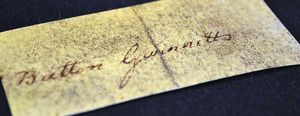
His signature, which is cut from an unknown document and until recently held by the North Missouri Historical Society, is sought by collectors who like to have a full set of Declaration of Independence signatures. But only 51 examples are known to exist as he died just 10 months after signing the historic document.
Councillor Gwinnett said of his prospective ancestor: "The signature is very very rare.
"I haven't actually done the research but people have come from America and Australia and said they think there's a link, especially as his signature looks exactly like mine.
"I am delighted with this link but I have to be sceptical having not done the research properly.
"In Wolverhampton he got a bit of a name for himself, some good, some bad, and then he moved to America with his wife."

Button moved to America in 1762, before travelling on to Georgia from Charleston in 1765. He was a merchant by trade but in Georgia he sold off all his merchandise to buy land and start a plantation.
He was so successful as a planter and gained such local influence that by 1769 he was elected to the Provincial Assembly.
Button signed the Declaration of Independence on August 2 1776 and served in the Georgia state legislature where he wrote the original draft of Georgia's first State Constitution.
He became acting President of the Congress and commander-in-chief of Georgia's militia in 1777 after a successful coup. In this role he tried to undermine his rival Lachlan McIntosh who was brigadier general of the 1st Regiment in the Continental Army.
He had McIntosh's brother arrested for treason and demanded McIntosh and his army invade East Florida. After the invasion failed, the pair blamed each other and ended up dueling. Both were shot and wounded by one another but Button died of his wounds on May 19 1777.
Gwinnett County, Georgia, now a suburban area of Atlanta, is named after him.