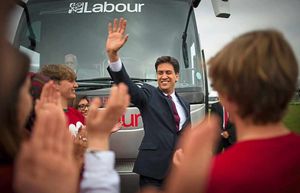
All aboard for Ed Miliband's battle bus
Ed Miliband sits at the back of the coach like he's the coolest kid in school.
He's allowed to. It's his battle bus and he's the boss currently enjoying a bit of a love in with younger fans thanks to the rise in online appreciation dubbed 'Milifandom'.
But the Labour leader also looks a bit tired.
When I tell him I'm shattered just covering the campaign he smiles but there is nothing approaching sympathy. That's understandable given the punishing schedule the party leaders are following as they go all over the country touting for votes in the most unpredictable General Election in a generation.
In our wide ranging interview Mr Miliband:
Urges people in the West Midlands to think about what they have have in common with working people in Scotland as he tries to quell fears about the SNP
Says he will address the concerns of Black Country business leaders about a shortage of skilled school leavers
Claims West Midlands businesses do not want a referendum on the European Union
Defends his decision to renew the Trident nuclear deterrent
Reveals he wants to be remembered for creating a country that works for working people.
Aboard the bus sits a collection of approved journalists and party campaigners.
There is no red bunting, no Labour pledge cards, nothing but plush but boringly beige seats. I'm not allowed to take any pictures myself in this fortress on wheels.
We are travelling from Nuneaton where Mr Miliband has just delivered a speech to a group of Labour party supporters to launch a poster campaign for the NHS.
Outside the grounds of the cricket club had gathered a group of UKIP supporters.
The real, hardworking people all the parties are trying to woo are nowhere to be seen. That's the same for the Tories too in this stage-managed campaign.
He promises that he will not put a disproportionate level of funding to Scotland, whose population is smaller than the West Midlands, as a result of any support the SNP's Nicola Sturgeon might offer.
"Not under me," Mr Miliband said. "It's a clear promise. There needs to be fair funding in England. Lots of areas have been hit by the Conservatives. Let me make this point to you. I think working people in the West Midlands and Scotland have more in common than divides them. People in both places are worried about wages being too low, zero hours contracts, whether their sons and daughters will get an apprenticeship, what's happening to our NHS.
"And we have a plan to help working people in the West Midlands and in Scotland. What unites us is more than what divides us.
"If it comes to a Labour Queen's speech it's up to the SNP what they do."
The Tories are pitching to undecided voters on the prospect of 'chaos' under a Labour/SNP alliance, claiming it will even mean the loss of promised improvements to the motorways, such as the £65 million set to be spent on junction 10 of the M6 in Walsall.
Mr Miliband has been winning over teenagers in recent days with the rise of the Twitter trend called 'Milifandom'.
It seems a selfie with the Labour leader is in almost as much demand as one with a member of One Direction. At least, that's the spin being put on it by the party faithful.
Businesses, however, don't seem so impressed. The Labour leader responds to criticism from Ninder Johal, president of the Black Country Chamber of Commerce, who accused Labour of playing to the populist agenda on immigration by attacking bosses who employ low paid migrants, rather than tackling the problem of 'unemployable' school leavers.
"Good employers have nothing to fear from what we're saying," Mr Miliband says. "This is about upholding basic standards, which most employers do, on paying the minimum wage, not just advertising jobs abroad, not having landlords putting 15 migrants in a room.
"The Chamber of Commerce is right about training local people. Our plans for apprenticeships will give employers more control on the money raised for them. It's not just the Black Country Chamber of Commerce. So many businesses I've spoken to say we can't get the skilled workforce."
Labour has promised an apprenticeship for every school leaver who gets good grades.
Mr Miliband says: "We need to give skills to those who do not. For young people who aspire to get good grades we have to have something to inspire them. But you also have to give proper qualifications to others. That's why we're saying maths and English to 18 and other things. We need to value every young person. Schools and further education colleges are not always teaching the skills we need."
Asked what one thing he would change about New Labour's 13 years in power he did not even pause to think before saying: "Bank regulation. We didn't get bank regulation right along with governments all around the world. And we take our share of responsibility for what happened."
On the prospect of a European referendum and why he won't trust the British people he said: "I do. People will make the decision at the election. I don't want to spend two years debating whether or not to exit the European Union. That would be a disaster for jobs and families and businesses. And businesses in the West Midlands know that perhaps more than any other region. West Midlands manufacturing relies on export. We will have a referendum if there is a transfer of power to Brussels. That's unlikely to happen.
"My priority is tackling the cost of living crisis and protecting the NHS." Would he ever push the button to launch a Trident nuclear missile? It is something he was challenged on by Leanne Wood, the leader of the Welsh nationalist party, Plaid Cymru. He says: "No responsible leader ever speculates about this. I will do what it takes to keep this country safe. The reason to have a nuclear deterrent is precisely what it is, a deterrent."
What is the one thing he wants to achieve and will he serve more than a term?
"You take it one election at a time. That's the lesson David Cameron learned. I want to build a country that works for working people. So many people say this country doesn't work for them any more. Do we build a recovery that goes outside the city of London and reaches people's front doors? It's how we put working people first and I want that to be my legacy."