Our man's tribute to the Birch
Paul Birch's death at the age of 46 brought to a sad conclusion one final battle by the former Villa and Wolves player, explains Martin Swain.
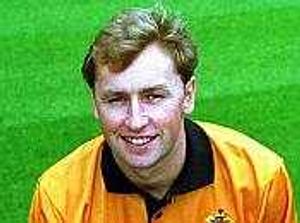
Since the outside world became aware of his bone cancer in May of last year, Birch fought furiously against an illness he was told from the outset would be terminal. That battle ended at 10am yesterday.
Such naked, raw courage in the face of something so inevitable was the popular former player's final triumph, in a life cut so desperately short by the lottery of Mother Nature.
His former team-mates all knewthe news from the Good Hope Hospital in Sutton Coldfield was coming but such was Birch's spirit and defiance that it still seemed to surprise them.
"It's incredible," Steve Bull pondered, "that a player who was so fit and energetic should be taken like this. It just doesn't make sense. . . "
Indeed it doesn't, but if the illness eventually robbed Birch of his vitality and good health, it could do nothing against this chirpy, bubbly ex-footballer's indomitable spirit.
I was that spirit which probably enabled Birch to make such an extended career for himself, with more than 400 first-team appearances spread over nearly 17 years.
He would never claim to have been the most gifted midfield player of his or any other era, but he could fly around the pitch with extraordinary zest and it was that which gave him his edge to compete at the highest levels.
Born in Baggies country, Birch nevertheless was recruited by Villa during the most successful era the club has so far known – their 1980-81 domestic championship to be followed by the European Cup.
He looked on as the most illustrious team in the club's history established a legacy their successors have struggled to follow and made the most auspicious debut imaginable – replacing one of his heroes, Gary Shaw, for the last 12 minutes of the 3-0 victory over Barcelona in 1983 which brought Villa the European Super Cup.
But it was Birch's fate to be in the right place at the wrong time. As that famous team was broken up – some might argue a little too early – when new manager Graham Turner tried to establish his own regime at Villa, so a decline began which not even the furious energy of Birch in midfield could hold back.
Turner would ultimately give way to Billy McNeill, who would give in to relegation in 1987, a period of football so unremarkable in Villa's history that it is easier to recall the young Birch's peroxide-dyed blond hair than any other highlights.
But it is easy to imagine that his 38 games and six goals the following season to help begin Graham Taylor's dramatic revival of Villa was the most satisfying campaign of his professional career.
For Villa fans, his finest hour came on an unforgettable night in the late autumn of 1990, when the team launched themselves with such fury at an Inter Milan side packed with the European game's biggest stars that the mighty Italians were beaten 2-0.
Birch was that night detailed by manager Jozef Venglos to mark Lothar Matthaus, arguably the finest midfield player in the world at that time and Germany's World Cup-winning captain the previous summer.
On paper it seemed a hopeless mismatch, but out where it really mattered Matthaus never got a kick as Birch produced the performance of his career.
Within a few months of that game, Birchy was on his way to Wolves, reunited with Turner. It would be Graham Taylor who would ultimately gently push Birch towards retirement when he arrived to replace Turner in 1994.
He loved Birch's qualities but, as he remembered, had to conclude those little legs of his were finally struggling to get him around the pitch.
Taylor said: "Paul was a dream for a manager, an absolute dream. My favourite story I always tell about him came in a game at Middlesbrough which was not going well for us and Birchy was on the bench.
"I sent him on only to realise after about five minutes I'd read the game wrong; I didn't need Birchy on there at all. So I made another substitution and took him off.
"I'll never forget the look on his face when he saw me calling him back to the bench. But the thing is he came off and never gave me a moment's trouble about it. I explained it to him and he just went: 'OK boss.'
"I texted him about that only recently and we were both imagining the furore that would cause if it happened today."
At Wolves, Birch was no less admired by his fellow professionals, not just for his contribution over more than 140 appearances in the frustrating and flawed campaigns of the early 1990s but his input around the club generally.
His Molineux "roomie" was goalkeeper Mike Stowell, who was another who spent yesterday in quiet reflection at the sad news of his old pal.
He said: "He lifted the spirits. Every morning we would hear that infectious laugh and giggle and the place was never dull with him around. He was absolutely fantastic, a joy to be around.
"I thought it was typical that he was even a postman for a while before he got into coaching – and I can always imagine him running on his round whistling as he went along . . . I'll miss him, we all will."