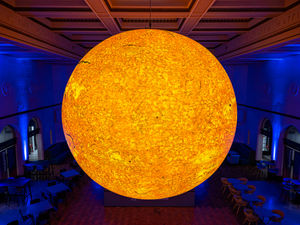
Illuminated sculpture of the sun goes on display in Birmingham city centre
Helios, by British artist Luke Jerram, is now on free public display at The Exchange with special events taking place throughout the duration of the installation.
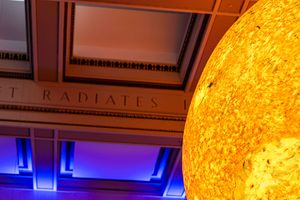
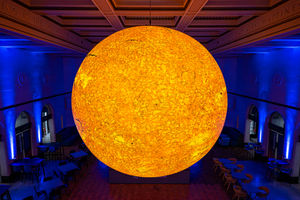
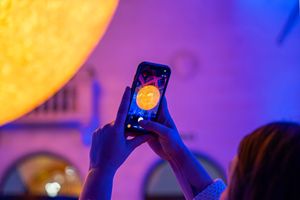
Helios, a breathtaking, large-scale illuminated sculpture of the sun by acclaimed British artist Luke Jerram, is now on free display to the public at The Exchange, the University of Birmingham's city centre venue.
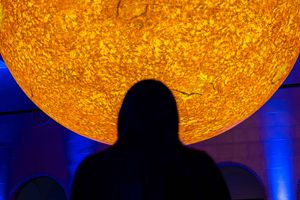
Using high-resolution (72dpi) photographic solar imagery, the five metres in diameter sculpture reveals the astonishing details of the sun's surface, from swirling sunspots to dramatic solar flares, all illuminated from within, casting a golden glow across the Banking Hall.
Helios and a wraparound exhibition called Seeing the Sun will be on display until November 1.
The official public opening, which is now sold out, coincides with the Spring Equinox on Friday. Hosted by Alice Roberts, Professor of Public Engagement in Science, it will feature a special Q&A event with Luke Jerram and Bill Chaplin, Professor of Astrophysics at the University of Birmingham.
The discussion will cover how artistic practice and scientific research can inform and challenge one another, and explore the possibilities that art and science collaborations can spark, such as public engagement and new ways of thinking.
As part of the launch, visitors will be able to explore some of the climate and space research carried out at the University of Birmingham featured in the exhibition, and meet the researchers behind it. Attendees will also be able to take part in artist-led activities, making sun-inspired collages and air-dry clay sun coasters with Sadie Barnett and Juneau Projects.
Cassie Chadderton, Director of Culture, Collections and Public Engagement at the University of Birmingham, said: “We're excited to welcome visitors to experience Helios at The Exchange. Like so much of Luke's work, Helios brings art and science together in an awe-inspiring, beautiful form. Helios is a wonderful invitation for everyone to explore our sun, to discover some of the world-changing science taking place right here in Birmingham, and experience the University as a place that is open, curious, creative and full of life. It’s a perfect addition to our vibrant cultural offer, and we can’t wait to share it with people across Birmingham, the West Midlands and beyond.”
On Saturday (March 21) there will be a special family day at The Exchange. Designed for curious minds of all ages, this free, drop-in event will allow children and families to get close to Helios, meet researchers and explore real solar science up close, experience the sounds of the sun with musician Aaron Diaz, and create your own space‑weather superheroes with artist Tat Vision.
Across the installation, a wider programme of events will take place at The Exchange in connection with Helios. With free talks, creative workshops, family exploration days, accessible tours and quiet sessions, there is an opportunity for everyone to explore the sun and enjoy the beautiful artwork.
The University of Birmingham has permanently acquired Helios as part of its cultural collection. The sculpture will move to long-term display at the Edgbaston campus following its time at The Exchange. More information is available on the University of Birmingham website.