Wolverhampton Buddhists hold memorial to honour influential thinker
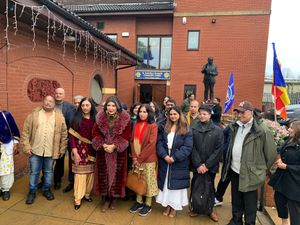
Last month, the Buddhist community in Wolverhampton gathered at Wat Phra Maha Somboon Buddha Vihara to solemnly observe the 69th Mahaparinirvan Diwas of B. R. Ambedkar, commemorating the death anniversary of one of the most influential social reformers, jurists and Buddhist thinkers of the modern era.
Mahaparinirvan Diwas, observed annually on December 6, marks Dr Ambedkar’s transition to parinirvana—a central Buddhist concept signifying liberation from the cycle of rebirth and suffering. The occasion holds deep spiritual and historical significance for Buddhist communities worldwide, particularly those inspired by Dr Ambedkar’s lifelong struggle for equality, justice and human dignity.
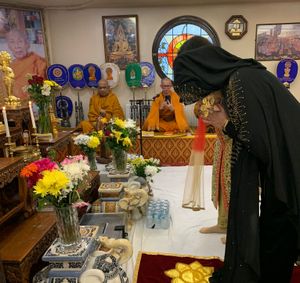
The commemorative event was organised by the Dr Ambedkar Memorial Committee of Great Britain, which arranged a special cultural and spiritual programme in tribute to Dr Ambedkar’s life and legacy.
Dr Ambedkar, principal architect of the Indian Constitution, was a tireless advocate for the rights of marginalised communities. In 1956, shortly before his death, he embraced Buddhism along with hundreds of thousands of followers, initiating a modern Buddhist revival rooted in social justice, compassion and equality—values that continue to resonate deeply within the global Buddhist community.

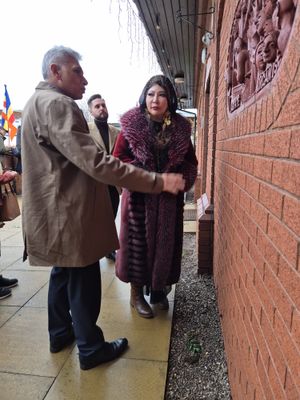
The event was made particularly special by the presence of Maha Putri Maria Amor Leonora Torres Mastura, of the Royal House of Luzon-Tagalog within the Sovereignty of the Sultanate of Maguindanao. Her Royal Highness was visiting Wolverhampton as part of her wider humanitarian tour of the West Midlands.
Following prayers led by Ven. Dr. Witharandeniye Kassapa OBE, Chief Incumbent of the Birmingham Buddhist Maha Vihara, HRH Maha Putri was invited to address the congregation. In her remarks, she reflected on Dr Ambedkar’s enduring relevance: “Dr Ambedkar’s life reminds us that spirituality and social responsibility are inseparable. His vision of liberation was not only spiritual, but human—freeing people from fear, discrimination and injustice. His teachings remain a guiding light for all who believe in dignity and equality.”
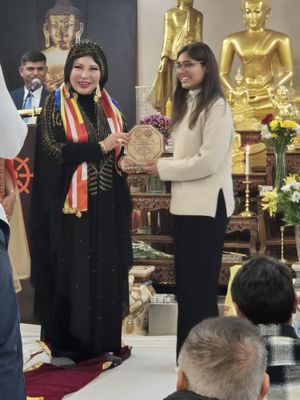
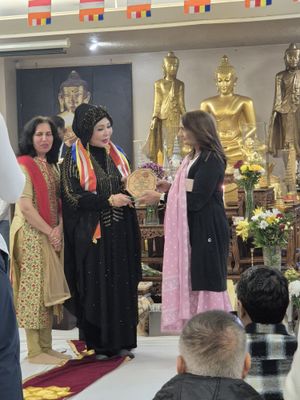
Her Royal Highness went on to thank Dev Suman, President, Milind Kal, Secretary, and the wider Committee for their warm welcome to Wolverhampton. She was later invited by Rekha Paul, Vice President, to present academic awards to members of the congregation who had successfully achieved university degrees—celebrating education as a cornerstone of empowerment, a principle central to Dr Ambedkar’s philosophy.
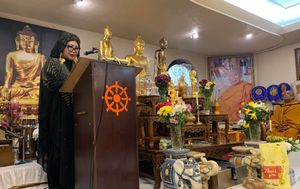
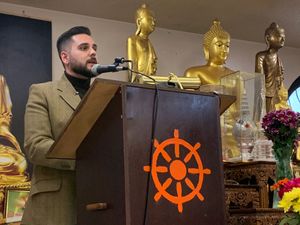
Jordan Nirankari-Bowen, Royal Envoy for Communications and Royal Legal Counsel to HRH Maha Putri, was also invited to address the gathering. He spoke on the universal relevance of Dr Ambedkar’s teachings: “Dr Ambedkar taught peace, harmony and oneness—not confined to one faith, but applicable to all humanity. These are values we must actively practise in our daily lives, regardless of religion or spiritual belief.”
He further conveyed royal regards from the Sultanate of Maguindanao and the 26th Supreme Sultan, Datu Zulkarnain.
Balbir Seimar BEM, Interim Regional Director of We Care for Humanity, spoke on ongoing dialogue between WCH and the Dr Ambedkar Memorial Committee of Great Britain, highlighting discussions around future joint humanitarian initiatives across Wolverhampton and the wider West Midlands.
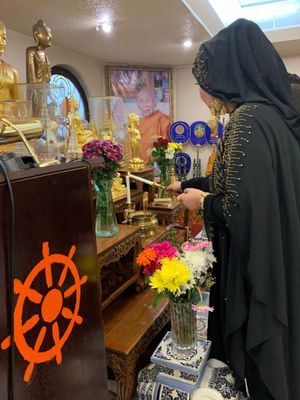
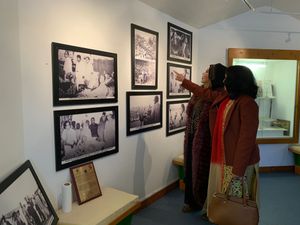
The Royal Delegation was invited to light candles in memory of departed loved ones before visiting the Dr Ambedkar Museum within the Vihara, where HRH Maha Putri paid her respects to Dr Ambedkar’s life, work and enduring influence.
About Dr Ambedkar and the Memorial Committee
Dr B. R. Ambedkar (1891–1956) was a scholar, economist, jurist and social reformer whose advocacy transformed the lives of millions. His embrace of Buddhism offered a moral and spiritual framework for equality, rationality and compassion—principles that continue to inspire generations.
The Dr Ambedkar Memorial Committee of Great Britain, established over four decades ago, has played a vital role in preserving and promoting Dr Ambedkar’s legacy in the UK through education, cultural programmes and interfaith engagement.
The Wolverhampton commemoration served not only as a moment of remembrance, but also as a reaffirmation of shared values—peace, justice and humanity—that transcend borders, faiths and generations.