
China launches Shenzhou 24 carrying first foreign crew member to space station
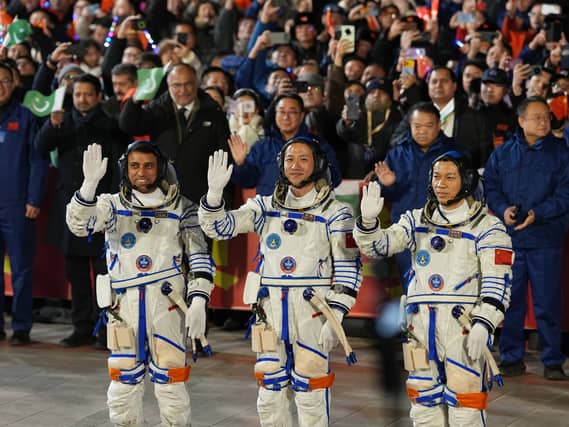

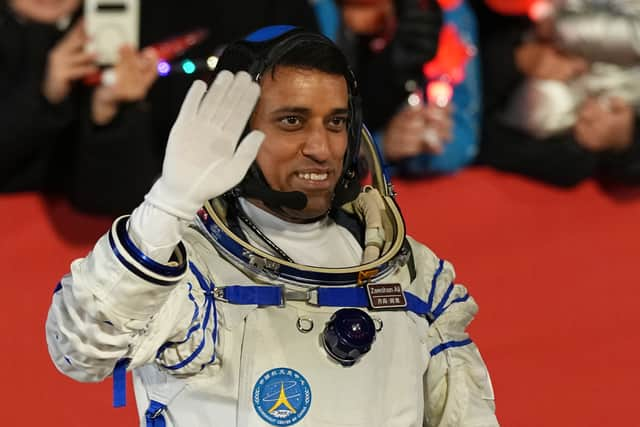
Pakistani astronaut Muhammad Zeeshan Ali, 40, flew alongside Chinese astronauts Tang Hongbo, 51, and Wu Yi, 39.
China has launched the Shenzhou 24 spacecraft with three astronauts, sending the first foreign crew member to its space station.
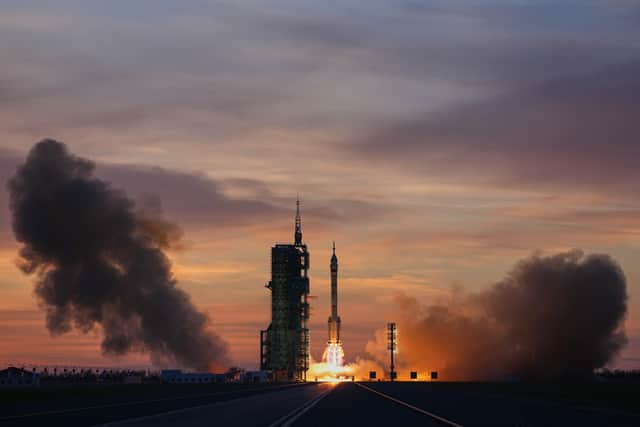
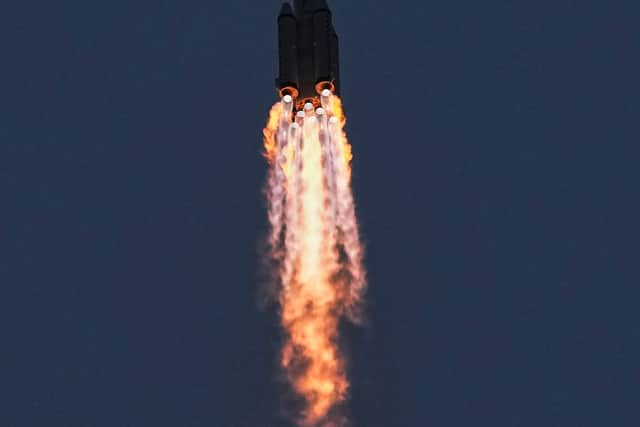
Pakistani astronaut Muhammad Zeeshan Ali, 40, flew alongside Chinese astronauts Tang Hongbo, 51, and Wu Yi, 39, after the craft blasted off from the Jiuquan Satellite Launch Centre in north-western China on Wednesday morning.
It successfully separated from a rocket and entered its predetermined orbit.
They later entered the space station and took group photos with three other astronauts from the Shenzhou 23 mission.
The launch marked the first joint flight involving Chinese and foreign astronauts in the history of China’s crewed space programme.
Hours earlier, crowds of people attended a send-off ceremony, with many holding up their phones to capture the moment.
In Pakistan, shouts of “God is great!” and “Long live Pakistan-China friendship!” rang out as the spacecraft carrying Mr Ali climbed toward space.
Many families living thousands of kilometres from the launch site shared the milestone for their country’s space programme through television broadcasts.
In restaurants, customers followed the images on television, joining the celebrations with cries celebrating Pakistan’s friendship with China.
Scientists at the headquarters of Pakistan’s space agency also watched the launch.
Pakistani President Asif Ali Zardari and Chinese President Xi Jinping exchanged letters congratulating each other, hailing the Pakistani astronaut’s inclusion in China’s space mission as a milestone in bilateral ties, according to a statement from Mr Zardari’s office.
Chinese state broadcaster CCTV reported that Mr Xi described China’s space station as a “boat” for peace, friendship and cooperation, and that China is willing to uphold the peaceful use of outer space with other countries and deepen cooperation.
Pakistan’s Prime Minister Shehbaz Sharif congratulated the nation on the launch, describing Mr Ali’s mission as a source of national pride and an inspiration for Pakistani youth.
“This is not just one astronaut’s journey, but the journey of 240 million Pakistanis,” he wrote on X.
Mr Sharif thanked China for including the Pakistani astronaut in the mission, saying the flight reflected close ties between the two countries and extended their cooperation into space.
Pakistan’s minister for planning, development and special initiatives, Ahsan Iqbal, told reporters at the centre that he hoped this would be the beginning of greater cooperation in the future.
He also thanked Mr Xi, the Chinese leadership, scientists and engineers.
When asked if Pakistan could send astronauts independently, he said: “Certainly that day will come.”
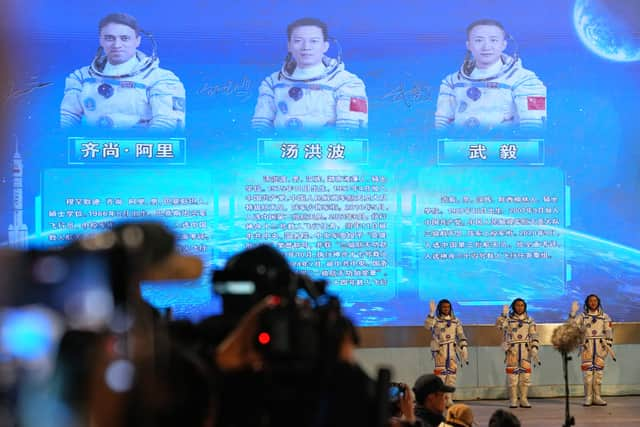
Mr Iqbal said Mr Ali carried not merely his name but the Pakistani flag on his shoulders and uniform, lifting the hopes, prayers and technological aspirations of Pakistanis into orbit.
“The sky is no longer our limit, it is our launching pad,” he said in a statement, describing the mission as an inspiration for young Pakistanis hoping to pursue careers in science and technology.
The joint flight is part of an agreement signed by China and Pakistan in February 2025.
The crew will conduct more than 90 scientific experiments and technology tests during their mission, China’s official Xinhua News Agency reported earlier.
Mr Ali will conduct a photosynthetic cyanobacteria experiment in orbit during his short-term mission before returning to Earth aboard the Shenzhou 23 spacecraft, it said.
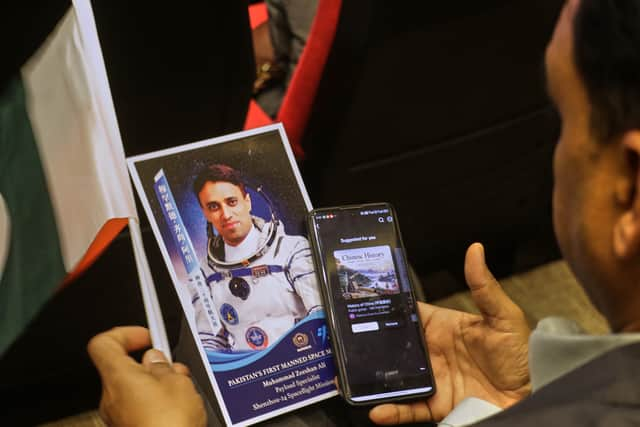
While this was the first spaceflight for Mr Ali and Mr Wu, Mr Tang has flown on two previous missions and has become the first astronaut to board the Tiangong space station three times, national broadcaster CCTV said.
At a news conference on Tuesday, Mr Tang said that differences in language, culture and psychology had made learning to work together more challenging on this mission, but that both sides’ efforts were paying off.
In front of reporters, those efforts were reflected in Mr Ali’s Mandarin proficiency.
He cited a line of Chinese poetry about climbing one story higher to see farther.
“It’s like my daily training. Day after day, reaching new heights,” he said in Mandarin.

Speaking in English, he said he hoped the next chapter of space cooperation between the two countries would go from one astronaut in one flight to multiple joint flights and to the Moon, Mars and beyond.
China is preparing for its first crewed lunar landing by 2030.
The US is widely seen as China’s main space rival, with Nasa aiming to land astronauts on the lunar surface in 2028.