Iran threatens to mine entire Persian Gulf if land invasion takes place
Tehran has also warned it will hit electrical plants and water infrastructure in Gulf Arab states if the US and Israel hit Iranian power facilities.
Iran’s defence council has threatened to deploy naval mines across the “entire Persian Gulf” if a land invasion happens.
The council issued the statement as concern in Tehran grows about the potential arrival of US marines in the region.
“Any attempt by the enemy to target Iran’s coasts or islands will, naturally and in accordance with established military practice, lead to the mining of all access routes … in the Persian Gulf and along the coasts,” the council said.
The US has been trying to reopen the Strait of Hormuz, the narrow mouth of the Persian Gulf, to energy shipments.
US marines could come ashore to seize either islands or territory in Iran to support that mission. Israel also has suggested a ground operation could take part in the war.
Earlier, Iran warned it will strike electrical plants across the Middle East if US president Donald Trump follows through on his threat to bomb power stations in the Islamic Republic.
The threat by Tehran puts at risk both electrical supplies and water in the Gulf Arab states, particularly as the desert nations commingle their power stations with desalination plants crucial for drinking water supplies.
Following the threat, Iran’s semi-official Fars news agency published a list of such facilities, including the United Arab Emirates’ nuclear power plant.
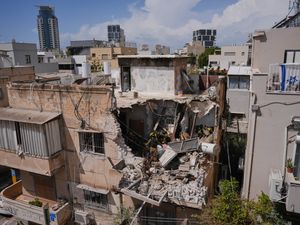
Over the weekend, Iran launched missiles targeting Dimona in Israel, near a facility key to its long-suspected atomic weapons programme. The Israeli facility was not damaged in the barrage.
Mr Trump said the US would attack Iran’s power stations unless the country releases its stranglehold on the Strait of Hormuz.

His self-declared 48-hour deadline expires just before midnight GMT on Tuesday, further raising the stakes of the ongoing war with Iran that has disrupted global energy supplies, sending natural gas and petrol prices soaring.
Fatih Birol, the head of the Paris-based International Energy Agency, said: “No country will be immune to the effects of this crisis if it continues to go in this direction.”
He told Australia’s National Press Club in Canberra on Monday that the crisis in the Middle East has had a worse impact on energy markets than the two oil shocks of the 1970s and the Russia-Ukraine war combined.
On Monday, Israel launched new attacks on the Iranian capital, saying it had “begun a wide-scale wave of strikes” on infrastructure targets in Tehran.
United States Central Command chief Admiral Brad Cooper claimed in an interview that Iran was launching missiles and drones from populated areas, and suggested those areas would be targeted.
“You need to stay inside for right now,” Admiral Cooper told Iranian civilians on Monday in the interview with the Farsi-language satellite network Iran International.
“There will be a clear signal at some point, as the president has indicated, for you to be able to come out.”
Air defences in the United Arab Emirates intercepted a ballistic missile near the Al Dhafra Air Base in Abu Dhabi, and one person on the ground was injured when hit with shrapnel.

Warning sirens sounded in Bahrain and Kuwait, while Saudi Arabia’s defence ministry said it had intercepted a missile targeting Riyadh, and had destroyed drones over the kingdom’s oil-rich Eastern Province.
Oil prices remained stubbornly high in early trading, with the price of Brent crude, the international standard at around 112 dollars a barrel, up nearly 55% since Israel and the US started the war on February 28 by attacking Iran.
The war has also caused wild fluctuations in global stock markets as traders grow increasingly concerned about a world energy crisis and other issues.
In addition to targeting Israel and American bases, Iran has been hitting the energy infrastructure of its Gulf Arab neighbours.
It also has a tight grip on shipping through the Strait of Hormuz, which leads from the Persian Gulf toward the open ocean and through which a fifth of the world’s oil is shipped, along with other important commodities.

Mr Trump said in a social media post that if Tehran did not open the strategic waterway to all ships, the United States would “obliterate” Iran’s power plants.
Iran’s paramilitary Revolutionary Guard said on Monday that if the US did that, Iran would respond by hitting power plants in all areas that supply electricity to American bases, “as well as the economic, industrial and energy infrastructures in which Americans have shares”.
The Fars news agency, which is close to the Revolutionary Guard, published a list of such sites in what appeared to be a veiled threat, including desalination plants as well as the UAE’s Barakah nuclear power plant, which has four reactors out in the western deserts of the country near its border with Saudi Arabia. The judiciary’s Mizan news agency also published the list.
Iran has also said it will completely close the strait if Mr Trump follows through with the threat to attack Iranian power plants.
Iranian parliament speaker Mohammad Bagher Qalibaf also said Iran would then consider vital infrastructure across the region – including energy and desalination facilities critical for drinking water in Gulf nations – as legitimate targets.
In his first one-on-one interview since the war started, Admiral Cooper said the campaign against Iran is “ahead or on plan” and that the US and Israel were targeting infrastructure and manufacturing facilities to destroy Iran’s capabilities to rebuild its military.
“It’s not just about the threat today,” he said. “We’re eliminating the threat of the future, both in terms of the drones, the missiles as well as the navy.”
He suggested Iran could bring a quick end to the war if it stopped firing back, though did not say whether that would prompt Israel and the US to relent before all infrastructure targets have been destroyed.
“They could stop this war right now, absolutely, if they chose to do so,” he said of Iran. “They need to stop putting the wonderful Iranian people at risk by firing missiles and drones from inside populated areas. They need to stop immediately attacking civilians throughout the Middle East region.”
Iran’s death toll in the war has surpassed 1,500, its health ministry has said. In Israel, 15 people have been killed by Iranian strikes. More than a dozen civilians in the occupied West Bank and Gulf Arab states have been killed in strikes.
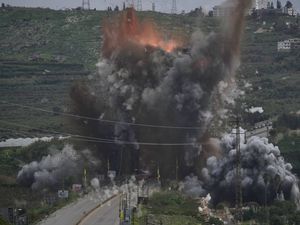
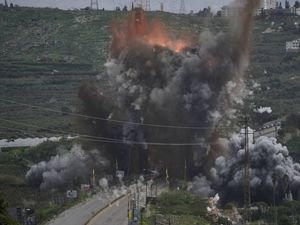
In Lebanon, authorities say Israeli strikes targeting Iran-linked militia Hezbollah have killed more than 1,000 people and displaced more than one million. Meanwhile, Hezbollah has fired hundreds of rockets into Israel.