Trump says US is considering ‘winding down’ its Middle East operation
Iran has threatened world tourism sites and says it is still building missiles
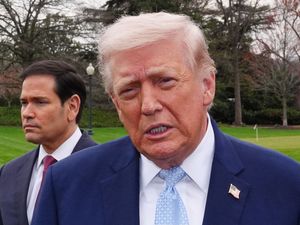
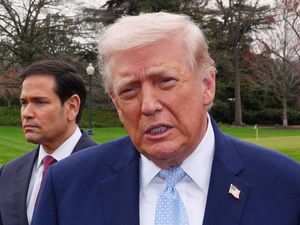
President Donald Trump said the US is considering “winding down” its Middle East military operation, even as his administration moves to send more troops and warships to the region and request billions of dollars more from Congress to fund the war.
Mr Trump made the comment in a post on social media on Friday evening after another climb in oil prices sent the US stock market sharply lower.
In his social media post, the president said: “We are getting very close to meeting our objectives as we consider winding down our great Military efforts in the Middle East.”
The president also left a muddled picture of whether the US would police the vital Strait of Hormuz shipping lane.
Mr Trump had said this week that the US did not need help, while also complaining that other countries did not help.
He also added a new objective for the Iran war. Though his administration for weeks has maintained that its four objectives remained “unchanged, unambiguous, and consistent” since the operation began, Mr Trump in his social media post added a fifth one.
The four objectives had been to block Iran’s path to a nuclear weapon, stop it from arming proxy militant groups, destroy its navy and destroy its ballistic missile capacity.
In his post Friday, Mr Trump enumerated those and added a fifth: “Protecting, at the highest level, our Middle Eastern Allies” and listed America’s Gulf partners.
It came as Iran threatened to target recreational and tourist sites worldwide and insisted it was still building missiles.
Its supreme leader issued another defiant statement on Friday, nearly three weeks into US-Israeli strikes that have killed a number of Tehran’s top leaders and hammered its weapons and energy industries.

The US was meanwhile deploying three more warships and roughly 2,500 additional marines to the Middle East, a US official told the Associated Press.
Later on Friday, President Donald Trump told reporters that Iran was “finished … from a military standpoint”.
US officials also announced that the Trump administration will lift sanctions on Iranian oil stranded at sea under a one-month licence as the White House tries to bring down soaring oil prices.
The pause applies to Iranian oil loaded on ships as of Friday and is set to end on April 19.
Iran fired on Israel and energy sites in neighbouring Gulf Arab states as many in the region marked one of the holiest days on the Muslim calendar.
Iranians were also marking the Persian new year, known as Nowruz, a normally festive holiday that is more subdued this year.
With little information coming out of Iran, it was not clear how much damage its arms, nuclear or energy facilities have sustained since the war began on February 28 or even who was truly in charge of the country.
But Iran has showed it is still capable of attacks that are choking off oil supplies and scrambling the global economy, raising food and fuel prices far beyond the Middle East.
The US and Israel have offered shifting rationales for the war, from hoping to foment an uprising that topples Iran’s leadership to eliminating its nuclear and missile programmes. There have been no public signs of any such uprising and no end in sight to the war.
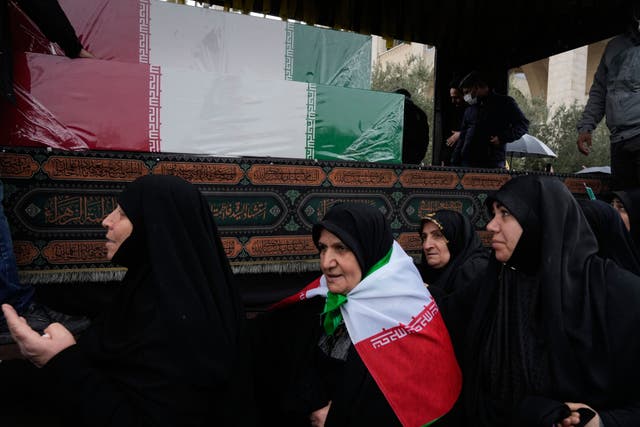
Iranian Supreme Leader Ayatollah Mojtaba Khamenei praised Iranians’ steadfastness in the face of war in a written statement read on Iranian television to mark Nowruz.
Mr Khamenei said the US and Israeli attacks were based on an illusion that killing Iran’s top leaders could cause the overthrow of the government. He commended Iranians for “building a nationwide defensive front” and “delivering such a bewildering blow that the enemy fell into contradictions and irrational statements”.
Mr Khamenei has not been seen in public since he became supreme leader following the assassination of his father, Ayatollah Ali Khamenei, in Israeli strikes at the start of the war. US and Israeli officials suspect the younger Khamenei was wounded.
Iran’s top military spokesman, General Abolfazl Shekarchi, warned on Friday that “parks, recreational areas and tourist destinations” worldwide will not be safe for Tehran’s enemies. The threat renewed concerns that Iran may revert to using militant attacks beyond the Middle East as a pressure tactic.
A US official confirmed the further build-up of American forces in the region, saying the USS Boxer and two other amphibious assault ships have deployed along with roughly 2,500 marines. Two other US officials confirmed that ships were deploying, without saying where they were headed.
A White House official said Mr Trump has said he has “no plans” to send troops into Iran, but retains all options.
US and Israeli leaders have said that weeks of strikes have decimated Iran’s military. Air strikes have also killed its supreme leader, the secretary of Iran’s Supreme National Security Council and a raft of other top-ranking military and political leaders.
The Israeli military said on Friday that Esmail Ahmadi, head of intelligence for the Basij, had been killed by a strike earlier in the week that hit other Basij leaders.

On Thursday, Israeli Prime Minister Benjamin Netanyahu claimed Iran’s navy was sunk and its air force in tatters, while adding that its ability to produce ballistic missiles had been taken out.
Iran’s paramilitary Revolutionary Guard disputed the missile claim on Friday.
“We are producing missiles even during war conditions, which is amazing, and there is no particular problem in stockpiling,” spokesman General Ali Mohammad Naeini was quoted as saying in Iran’s state-run IRAN newspaper.
A short time after the statement was released, Iranian state television said Gen Naeini was killed in an air strike.
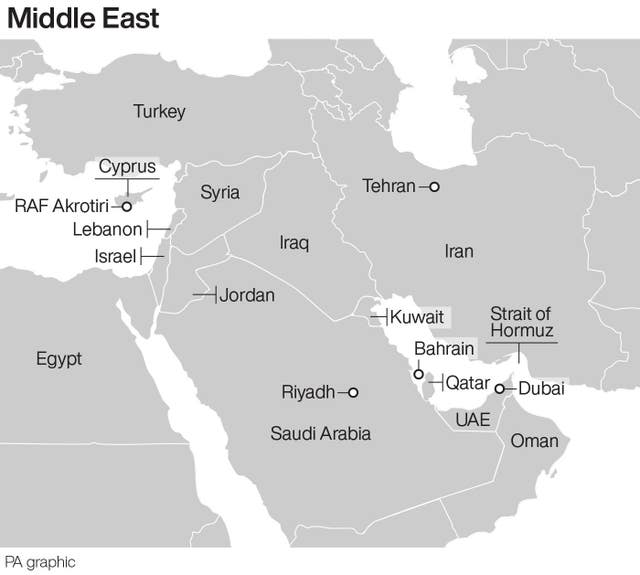
Nato’s top commander, General Alexus Grynkewich, confirmed on Friday that the alliance has pulled several hundred personnel out of Iraq and relocated them to Europe. They were part of Nato’s security advisory mission established in 2018 to advise Iraqi defence and security officials.
The move came after a string of Iranian attacks on other troops at British, French and Italian bases in the country.
Iran has stepped up its attacks on energy sites in Gulf Arab states after Israel bombed Iran’s massive South Pars offshore natural gas field earlier in the week.
Two waves of Iranian drones attacked a Kuwaiti oil refinery early on Friday, sparking a fire.
The Mina Al-Ahmadi refinery, which can process some 730,000 barrels of oil per day, is one of the largest in the Middle East. It was damaged on Thursday in another Iranian attack.
Defence ministry spokesman Colonel Saud al-Atwan said the country’s air defences shot down 15 of 25 more drones fired into Kuwait. He said the missile and the drones were fired into Kuwait over the past 24 hours.
Bahrain’s Interior Ministry said a fire broke out after shrapnel from an intercepted projectile landed on a warehouse, and Saudi Arabia reported shooting down multiple drones targeting its oil-rich Eastern Province.

Heavy explosions shook Dubai as air defences intercepted incoming fire over the city, where people were observing Eid al-Fitr, the end of the holy Muslim fasting month of Ramadan.
In Iran, meanwhile, many were marking Nowruz even as Israel said it had launched new strikes, and explosions were heard over Tehran.
The Persian new year, which coincides with the spring equinox, is a tradition observed across south-western Asia that dates back thousands of years.
Loud explosions could also be heard in Jerusalem after the Israeli army warned of incoming Iranian missiles.
The Israeli military said missile fragments struck the edge of Jerusalem’s Old City, home to sites sacred to Jews, Christians and Muslims.
In addition to steadily striking Iran, Israel has regularly hit Lebanon, targeting Iran-backed Hezbollah militants who have been firing rockets and drones into Israel.
On Friday, Israel broadened its attacks to Syria, saying it hit infrastructure there in response to what it described as attacks on the minority Druze population in the southern province of Sweida.
Syria’s foreign ministry said Israel had acted under “flimsy pretexts and fabricated excuses”.
More than 1,300 people have been killed in Iran during the war. Israeli strikes in Lebanon have displaced more than one million people, according to the Lebanese government, which says more than 1,000 people have been killed. Israel says it has killed more than 500 Hezbollah militants.
In Israel, 15 people have been killed by Iranian missile fire. Four people were also killed in the occupied West Bank by an Iranian missile strike.
At least 13 US military members have been killed.
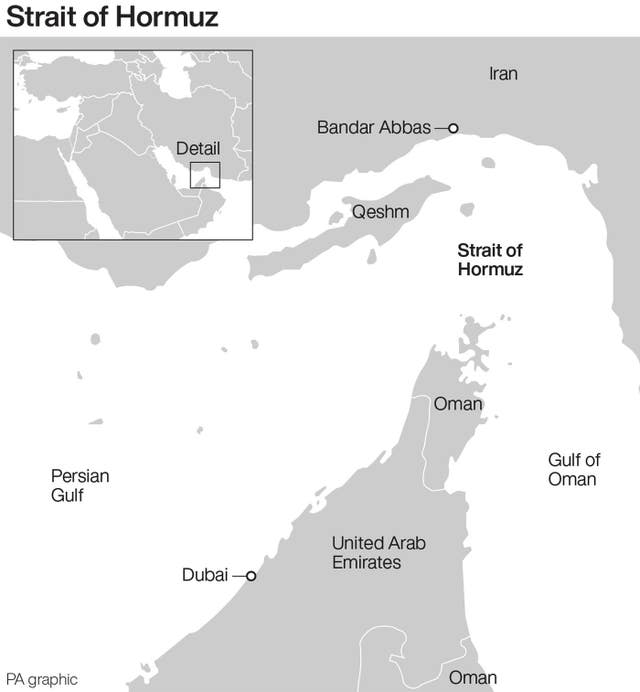
Iran’s attacks on energy infrastructure in the Gulf combined with its stranglehold on shipping in the Strait of Hormuz, a strategic waterway through which a fifth of the world’s oil and other critical goods are transported, has raised concerns of a global energy crisis.
Mr Trump lobbed fresh insults at Nato allies who have spurned his call for help protecting the strait.
US allies have refused to join the war, saying they were not consulted before the US and Israel launched it. Mr Trump called Nato members “cowards” in a social media post, saying: “Nato is a paper tiger.”
Brent crude oil, the international standard, has soared during the fighting, and was around 108 dollars per barrel on Friday, up from roughly 70 dollars per barrel before the war began.
Surging fuel prices come at a moment when many world leaders were already struggling to bring down high prices on food and many consumer goods. Asia is getting hit the hardest as most of the oil and gas exiting the Strait of Hormuz is transported there.
British ministers said they have agreed to allow the US military to use the UK’s bases in operations to prevent Iran from attacking more ships in the strait.
That came after Mr Trump had labelled Nato partners as “cowards” for not directly joining operations to secure the waterway.
Later on Friday, the president said as he prepared to leave the White House that Iran “from a military standpoint, they’re finished” but they’re “clogging up” the Strait of Hormuz.
Mr Trump said it would be a “simple military manoeuvre” to keep the vital shipping lane open but it requires help, which he described as “ships” and “volume”.
He said “it would be nice” if the countries that rely on the strait would get involved in helping to keep it open.
Mr Trump was asked about plans to have US forces further target Kharg Island in the Gulf, which is vital to Iran’s oil network.
He responded: “I may have a plan, I may not” but said he would not tell reporters one way or the other.
“It’s certainly a place that people are talking about. But I can’t tell you that,” Mr Trump added.