Trump warns Iran will be ‘hit very hard’ amid apology for strikes on neighbours
The US leader’s move came after his Iranian counterpart Masoud Pezeshkian apologised over attacks on neighbouring nations.
Iran’s president has apologised for attacks on “neighbouring countries” even as its missiles and drones flew towards Gulf Arab states and US President Donald Trump threatened that the country would be “hit very hard”.
President Masoud Pezeshkian, part of the three-member leadership council overseeing Iran since Supreme Leader Ayatollah Ali Khamenei was killed in an air strike on February 28 that started the war, delivered the message a week into the conflict that has rattled global markets and left Iran’s leadership weakened by hundreds of Israeli and American air strikes.
Mr Pezeshkian also dismissed Mr Trump’s call for Iran to surrender unconditionally.
“That’s a dream that they should take to their grave,” he said.
The message, seemingly filmed in a hurry, underlined the limited powers exercised by the theocracy’s leaders over the paramilitary Revolutionary Guard, which controls the ballistic missiles targeting Israel and other countries.
It answered only to Mr Khamenei and now appears to be picking its own targets.
Meanwhile, Israeli Prime Minister Benjamin Netanyahu said on Saturday night that Israel has “an organised plan with many surprises” for the next stage of the war in Iran. He added that the goal is to destabilise the regime and allow change.
Earlier Saturday, the Israeli military confirmed that Israel is moving into the second stage of the Iran war after striking more than 300 targets over the weekend.

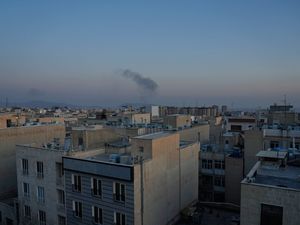
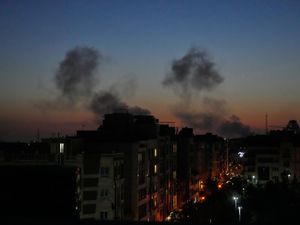
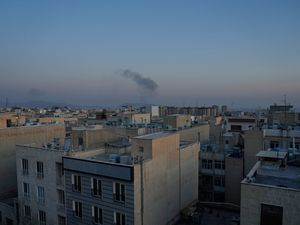
Witnesses said a refinery in southern Tehran was targeted by the latest air strikes — the first time a civil industrial facility has been targeted in the war. The flames lit up the horizon. Iran state media in response threatened to hit oil refineries in the northern Israeli city of Haifa.
Shortly after Mr Pezeshkian’s message, Mr Trump warned in a social media post that more Iranian “areas and groups of people” would now become targets, without elaborating.
Hours earlier, a wave of missiles and drones had disrupted flights at Dubai International Airport, targeted a major Saudi oil facility and sent people fleeing for cover in Bahrain.
And several hours after Mr Pezeshkian’s apology, the United Arab Emirates, Qatar and Bahrain were still sounding alerts or reporting intercepted missiles.

Mr Pezeshkian’s statement said Iran’s leadership council had been in touch with the armed forces over the attacks that have involved hundreds of missiles and drones.
“I should apologise to the neighbouring countries that were attacked by Iran, on my own behalf,” the president said. “From now on, they should not attack neighbouring countries or fire missiles at them, unless we are attacked by those countries. I think we should solve this through diplomacy.”
Gen Abolfazl Shekarchi, Iran’s armed forces spokesman, then added confusion by saying that Tehran has “not hit countries that did not provide space for America to invade our country”.
The US strikes have not been coming from the Gulf Arab governments under attack, but from US bases and vessels in the region.
Iran’s UN mission later asserted that Tehran “targets only military bases and US assets,” and suggested, without offering evidence, that strikes on non-military sites “may have resulted from interception by US electronic defence systems”.
Iran still awaits a new supreme leader. Prominent cleric Ayatollah Nasser Makarem Shirazi on Saturday urged Iran’s Assembly of Experts to act quickly to name a new one.
The Trump administration approved a new 151 million dollar arms sale to Israel after Mr Trump said he would not negotiate with Iran without its “unconditional surrender” and US officials warned of a bombing campaign they said would be the most intense yet.
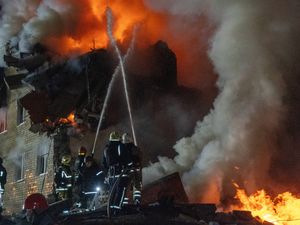
Associated Press video showed explosions over western Tehran as Israel said it carried out another wave of strikes and struck a Tehran airport it said was used to transfer weapons and cash to militant groups.
“Tehran is under severe bombardment” and even people far from military and government targets are living in fear, said a university student in western Tehran.
The US and Israel have battered Iran, targeting its military capabilities, leadership and nuclear programme. The war’s stated goals and timelines have repeatedly shifted as the US has at times suggested it seeks to topple Iran’s government or elevate new leadership from within.

The fighting has killed at least 1,230 people in Iran, more than 290 in Lebanon and 11 in Israel, according to officials in those countries. Six US troops have been killed.
Incoming missiles from Iran had people heading to bomb shelters again across Israel, and booms sounded in Jerusalem. There were no immediate reports of casualties.
Sirens sounded early Saturday in Bahrain as Iran targeted the island kingdom. Saudi Arabia said it destroyed drones headed towards its vast Shaybah oil field and shot down a ballistic missile launched towards Prince Sultan Air Base, which hosts US forces.
In Dubai, several blasts were heard on Saturday morning and the government said it had activated air defences. Passengers waiting for flights at Dubai International Airport were ushered into train tunnels.
Long-haul carrier Emirates later said all flights to and from Dubai were suspended until further notice, but then said it would resume operations.

The Iranian-backed militant group Hezbollah said its fighters clashed with an Israeli force that landed late Friday in eastern Lebanon’s mountains, and intense clashes and air strikes lasted into Saturday.
Lebanon’s Health Ministry said Israeli air strikes on Nabi Chit and nearby areas left at least 41 people dead and 40 wounded. The Lebanese army said the dead included three of its troops.
Israel did not acknowledge the fighting, and its military did not immediately respond to requests for comment.
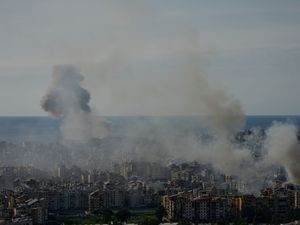
Israel also has carried out waves of air strikes on Beirut’s southern suburbs, where Hezbollah has a large presence. It is home to hundreds of thousands of civilians.
India’s foreign minister said on Saturday that an Iranian naval vessel has docked in India, speaking after a US submarine sank the Iranian warship IRIS Dena off Sri Lanka’s coast on Wednesday.

Subrahmanyam Jaishankar said the warship was moored in the southern city of Kochi after India granted permission when the vessel reported “having problems” on Sunday, a day after the war began.
“I think it was the humane thing to do,” Mr Jaishankar said.
Another Iranian vessel, the IRIS Bushehr, requested assistance from Sri Lanka, where more than 200 sailors were being brought ashore.
The ships previously took part in naval exercises hosted by India.