Uncertain outlook for US firms after tariffs ruling prompts Trump counter-move
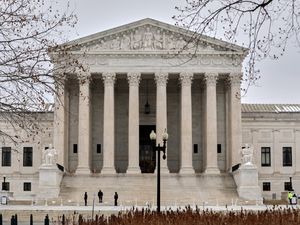
The US supreme court struck down tariffs imposed by the US president.
American businesses face a new wave of uncertainty after the US supreme court struck down tariffs imposed by president Donald Trump under an emergency powers law.
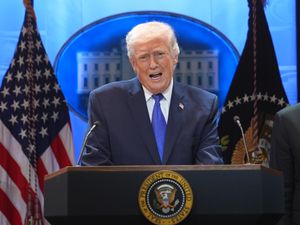
Mr Trump has vowed to work around the ruling to keep his tariffs in place.
The Trump administration says its tariffs help boost American manufacturers and reduce the trade gap, but many US businesses have had to raise prices and adjust in other ways to offset higher costs spurred by the tariffs.
It remains to be seen how much relief businesses and consumers will actually get from Friday’s ruling.
Within hours of the court’s decision, Mr Trump pledged to use a different law to impose a 10% tariff on all imports that would last 150 days, and to explore other ways to impose additional tariffs on countries he says engage in unfair trade practices.
Michael Pearce, an economist at Oxford Economics, said: “Any boost to the economy from lowering tariffs in the near-term is likely to be partly offset by a prolonged period of uncertainty.
“With the administration likely to rebuild tariffs through other, more durable, means, the overall tariffs rate may yet end up settling close to current levels.”
Efforts to claw back the estimated 133 billion dollar (£98.7 billion) to 175 billion dollars (£129.9 billion) of previously collected tariffs now deemed illegal are bound to be complicated, and will likely favour larger companies with more resources.
Consumers hoping for a refund are unlikely to be compensated.
With Mr Trump’s unyielding position on tariffs, many business are braced for years of court battles.
Basic Fun, a Florida-based maker of toys such as Lincoln Logs and Tonka trucks, last week joined a slew of other businesses in a lawsuit seeking to claw back tariffs paid to the government.
While company chief executive Jay Foreman is concerned about any new tariffs Mr Trump may impose, he does not think they will affect toys. However, he said, “I do worry about some type of perpetual fight over this, at least for the next three years.”

The new 10% tariff Trump announced Friday immediately raised questions for Daniel Posner, the owner of Grapes The Wine Co, in White Plains, New York. Since wine shipments take about two weeks to cross the Atlantic, he wonders if a shipment arriving Monday will be affected.
“We’re reactive to what’s become a very unstable situation,” Mr Posner said.
Ron Kurnik owns Superior Coffee Roasting Co in Sault Ste, Marie, Michigan, across the border from Canada. In addition to US tariffs, Mr Kurnik faced retaliatory tariffs from Canada for much of last year when he exported his coffee.
“It’s like a nightmare we just want to wake up from,” said Mr Kurnik, whose company has raised prices by 6% twice since the tariffs went into effect.
While he is pleased with the US supreme court ruling, he does not think he will ever see a refund.
A wide array of industries, including retail, tech and the agricultural sector, used the ruling as an opportunity to remind Mr Trump of how his trade policies have affected their businesses.
The Business Roundtable, a group that lobbies on behalf of more than 200 US companies, released a statement encouraging the administration to limit the focus of tariffs going forward to specific unfair trade practices and national security concerns.
In the retail industry, stores of all stripes have embraced different ways to offset the effects of tariffs – from absorbing some of the costs themselves, to cutting expenses and diversifying their supply network.

They have had to pass on some price increases at a time when shoppers have been particularly sensitive to inflationary pressures.
Dave French, executive vice president of government relations for The National Retail Federation, America’s largest retail industry trade group, said he hoped lower courts would ensure “a seamless process” to refund tariffs. That issue was not addressed in Friday’s ruling.
For the technology sector, Mr Trump’s tariffs caused major headaches. Many of its products are either built overseas or depend on imports of key components. The Computer & Communications Industry Association, which represents a spectrum of technology companies employing more than 1.6 million people in the United States, expressed hope that the decision will ease the trade tensions.
“With this decision behind us, we look forward to bringing more stability to trade policy,” said Jonathan McHale, the association’s vice president for digital trade.
Farmers, who have been stung by higher prices for equipment and fertiliser since the tariffs went into effect, and reduced demand for their exports, also spoke out.
American Farm Bureau Federation president Zippy Duvall said: “We strongly encourage the president to avoid using any other available authorities to impose tariffs on agricultural inputs that would further increase costs.”
The US supreme court ruled 6-3 that the International Emergency Economic Powers Act did not give the president authority to tax imports, a power that belongs to congress. But the decision only affects tariffs imposed under that law, so some industries will see no relief at all.
The decision leaves in effect tariffs on steel, upholstered furniture, kitchen cabinets and bathroom vanities, according to the Home Furnishings Association, which represents 15,000 furniture stores in North America.
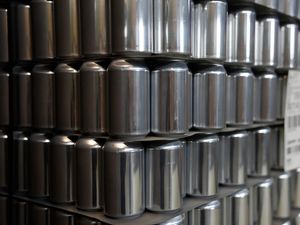
At Revolution Brewing in Chicago, the aluminium they use for cans costs as much as the ingredients that go inside them because of tariffs Mr Trump has placed on metals that are not affected by Friday’s ruling. While the cans are made in Chicago, the aluminium comes from Canada, said Josh Deth, managing partner at the brewery.
Tariffs have been just one challenge for his business, which is also affected by volatile barley prices and a slowdown in demand for craft beer.
“Everything kind of adds up,” he said. “The beverage industry needs relief here. We’re getting crushed by the prices of aluminium.”