Iran says it now considers all militaries of EU nations to be terror groups
It comes as tensions are high in the Middle East as US President Donald Trump weighs a possible military strike against Iran.
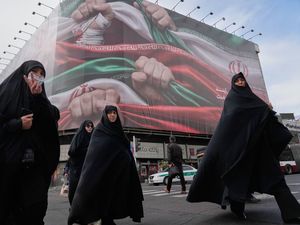
The speaker of Iran’s parliament has said the Islamic Republic now considers all European Union militaries to be terrorist groups, lashing out after the bloc declared the country’s paramilitary Revolutionary Guard a terror group over its bloody crackdown on nationwide protests.
The announcement by Mohammad Bagher Qalibaf, a former Guard commander, of the terror designation will likely be mostly symbolic. Iran has used a 2019 law to reciprocally declare other nations’ militaries terror groups following the United States declaring the Guard a terror group that year.
However, it comes as tensions are high in the Middle East as US President Donald Trump weighs a possible military strike against Iran.
The Islamic Republic has planned a live fire military drill for Sunday and Monday in the strategic Strait of Hormuz, the narrow mouth of the Persian Gulf through which a fifth of all oil traded passes.

Qalibaf made the announcement as he and others in parliament wore Guard uniforms in support of the force. The Guard, which also controls Iran’s ballistic missile arsenal and has vast economic interests in Iran, answers only to Iran’s 86-year-old Supreme Leader Ayatollah Ali Khamenei.
“By seeking to strike at the (Guard), which itself has been the greatest barrier to the spread of terrorism to Europe, Europeans have in fact shot themselves in the foot and, once again through blind obedience to the Americans, decided against the interests of their own people,” Qalibaf said.
Parliamentarians at the session later chanted: “Death to America!” and “Death to Israel!” at the session.
Mr Trump has laid out two red lines for military action: the killing of peaceful protesters or the possible mass execution of those detained in a major crackdown over the demonstrations.
Has increasingly begun discussing Iran’s nuclear programme as well, which the US negotiated over with Tehran in multiple sessions before Israel launched a 12-day war with Iran back in June.

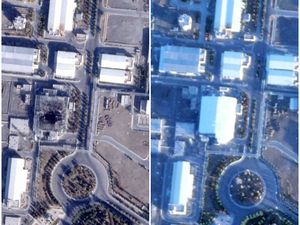
The US bombed three Iranian nuclear sites during the war. Activity at two of the sites suggests Iran may be trying to obscure the view of satellites as it tries to salvage what remains there.
Mr Trump on Saturday night declined to say whether he has made a decision on what he wants to do regarding Iran.
Speaking to reporters as he flew to Florida, the president sidestepped a question about whether Tehran would be emboldened if the US backed away from launching strikes on Iran, saying: “Some people think that. Some people don’t.”
Mr Trump said Iran should negotiate a “satisfactory” deal to prevent the Middle Eastern country from getting any nuclear weapons, but added: “I don’t know that they will. But they are talking to us. Seriously talking to us.”
Ali Larijani, a top security official in Iran, wrote on X late on Saturday that “structural arrangements for negotiations are progressing”. However, there is no public sign of any direct talks with the United States, something Mr Khamenei has repeatedly ruled out.