EU announces sanctions on Iran after deadly crackdown on protests
The measures add to international pressure on the Islamic Republic as it faced US threats to potentially launch a military strike against it.
The European Union has announced sanctions on 15 Iranian officials, including top commanders of the paramilitary Revolutionary Guard, over Tehran’s deadly crackdown on nationwide protests.
Six Iranian organisations, including bodies responsible for monitoring online content in Iran, were also included on the sanctions list.
The decision by the 27-nation bloc marks the latest Western response over the violence which activists say has killed more than 6,300 people.
The measures add to international pressure on the Islamic Republic as it faced US threats to potentially launch a military strike against it.
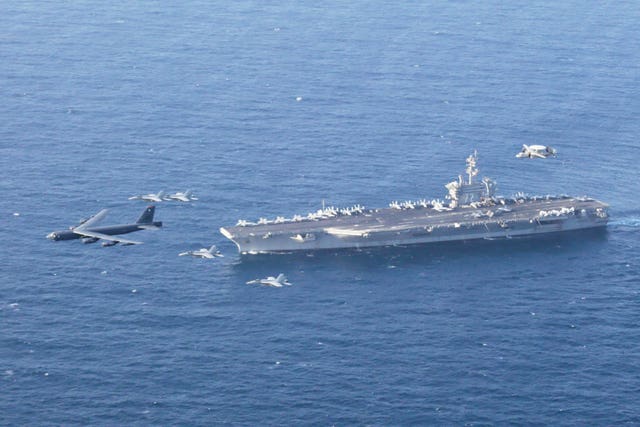
America has moved the USS Abraham Lincoln and several guided-missile destroyers into the Middle East, which can be used to launch attacks from the sea.
Iran has kept up its own threats as well, saying it could launch a pre-emptive strike or broadly target the Middle East, including American military bases and Israel.
It remains unclear what President Trump will decide about using force, though he has threatened to use it in response to the killing of peaceful demonstrators and over possible mass executions.
At least 6,373 people have been killed in the protests, activists said.
But the move by Europe will put new pressure on Iran as its economy already struggles under the weight of international sanctions.
Its rial currency fell to a record low of 1.6 million to one dollar on Thursday. Economic woes had sparked the protests that broadened into challenging the theocracy before the crackdown.
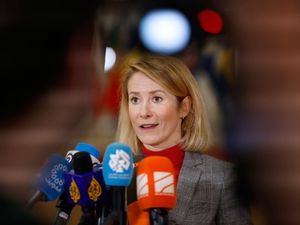
“This will put them on the same footing with al Qeida, Hamas, Daesh,” the EU’s top diplomat, Kaja Kallas said, using an Arabic acronym for the so-called Islamic State group.
“If you act as a terrorist, you should also be treated as a terrorist.”
Iran had no immediate comment, but it has been criticising Europe in recent days as it considered the move, which follows the US earlier sanctioning the Guard.
By EU law, sanctions require unanimity across the bloc’s 27 nations. That has at times hindered Brussels’ ability to flex its economic clout to crack down on Russia over its invasion of Ukraine.

France had objected to listing the Revolutionary Guard as a terrorist organization over fears it would endanger French citizens detained in Iran, as well as diplomatic missions, which provide some of the few communication channels between the Islamic Republic and Europe and its allies.
However, the office of President Emmanuel Macron on Wednesday signalled that Paris backed the decision.
French foreign minister Jean-Noel Barrot said on Thursday before the Foreign Affairs Council in Brussels that France supports more sanctions in Iran and the listing “because there can be no impunity for the crimes committed”.
“In Iran, the unbearable repression that has engulfed the peaceful revolt of the Iranian people cannot go unanswered,” he said.
Kristina Kausch, a deputy director at the German Marshall Fund, said the listing would be “a symbolic act” showing that for the EU “the dialogue path hasn’t led anywhere and now it’s about isolation and containment as a priority”.
“The designation of a state military arm, of an official pillar of the Iranian state as a terrorist organisation is one step short of cutting diplomatic ties,” she said. “But they haven’t cut diplomatic ties and they won’t.”