Bloody crackdown over Iranian protests comes into focus
Authorities have cut off the internet in the Islamic Republic.
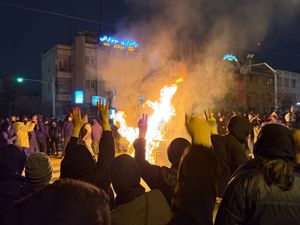
The bloodiest crackdown on dissent since Iran’s 1979 Islamic Revolution is slowly coming into focus, despite authorities cutting off the Islamic Republic from the internet and much of the wider world.
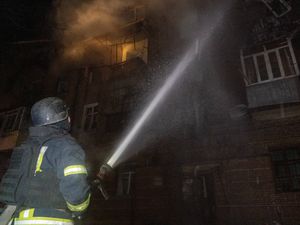
Cities and towns smell of smoke as fire-damaged mosques and government offices line streets. Banks have been torched, their cash machines smashed.
Officials estimate the damage to be at least 125 million dollars (£92.2 million), according to an Associated Press tally of reports by the state-run IRNA news agency from more than 20 cities.
The number of dead demonstrators reported by activists continues to swell.
For two weeks, Iran offered no overall casualty figures. Then on Wednesday, the government said 3,117 people were killed, including 2,427 civilians and security forces. That left another 690 dead that officials identified as “terrorists”.
That conflicts with figures from the US-based Human Rights Activists News Agency, which put the death toll on Saturday at 5,137, based on activists inside Iran verifying fatalities against public records and witness statements.
It said 4,834 were demonstrators, 208 were government-affiliated personnel, 54 were children and 41 were civilians not participating in protests.

Activists warn Iran is engaging in the same tactics it has used for decades, but at an unprecedented scale – opening fire from rooftops on demonstrators, firing metal birdshot into crowds and sending motorcycle-riding paramilitary Revolutionary Guard volunteers in to beat and detain those who cannot escape.
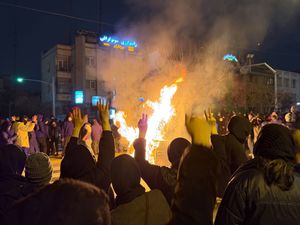
Raha Bahreini of Amnesty International said: “The vast majority of protesters were peaceful. The video footage shows crowds of people – including children and families – chanting, dancing around bonfires, marching on their streets.
“The authorities have opened fire unlawfully.”
The killing of peaceful protesters – as well as the threat of mass executions – have been a red line for military action for US president Donald Trump.
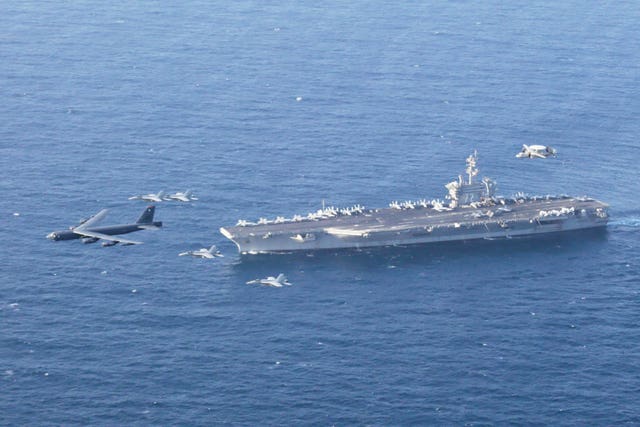
An American aircraft carrier and warships are approaching the Middle East, possibly allowing Mr Trump to launch another attack on Iran after bombing its nuclear enrichment sites last year. That risks igniting a new war in the Middle East.
Iran’s paramilitary Revolutionary Guard is “more ready than ever, finger on the trigger”, its commander said on Saturday.
Nournews, a news outlet close to Iran’s Supreme National Security Council, reported on its Telegram channel that the commander, Gen Mohammad Pakpour, warned the United States and Israel “to avoid any miscalculation”.
“The Islamic Revolutionary Guards and dear Iran stand more ready than ever, finger on the trigger, to execute the orders and directives of the Commander-in-Chief,” Nournews quoted Pakpour as saying.
Iran’s mission to the United Nations did not respond to detailed questions from the AP regarding the suppression of the demonstrations.
The demonstrations began on December 28 at Tehran’s historic Grand Bazaar, initially over the collapse of Iran’s currency, the rial, then spread across the country.
Tensions exploded on January 8, with demonstrations called for by Iran’s exiled crown prince, Reza Pahlavi. Witnesses in Tehran told the AP before authorities cut internet and phone communication that they saw tens of thousands of demonstrators on the streets.
As communications failed, gunfire echoed through Tehran.
“Many witnesses said they had never seen such a large number of protesters on the streets,” said Bahar Saba of Human Rights Watch.
“Iranian authorities have repeatedly shown they have no answers other than bullets and brutal repression to people taking to the streets.”
Ali Akbar Pourjamshidian, a deputy interior minister speaking on state TV on Wednesday, acknowledged the violence began in earnest on January 8.
“More than 400 cities were involved,” he said.
By January 9, Revolutionary Guard general Hossein Yekta, previously identified as leading plainclothes units of the force, went on state TV to warn “mothers and fathers” to keep their children home.
“Tonight you all must be vigilant. Tonight is the night for keeping mosques, all bases everywhere filled with ‘Hezbollahi,’” Gen Yekta said, using a word for “followers of God” that carries the connotation of fervent supporters of Iran’s theocracy.
Already weakened by the 12-day war Israel launched against Iran in June, the authorities decided to fully employ violence to end the demonstrations, experts said.
“I think the regime viewed it as this was a moment of existential threat and that they could either allow it to play out and allow the protests to build and allow foreign powers to increase their rhetoric and increase their demands on Iran,” said Afshon Ostovar, an expert on the Revolutionary Guard and professor at the Naval Postgraduate School in Monterrey, California.
“Or they could turn out the lights, kill as many people as necessary … and hope they could get away with it. And I think that’s what they ultimately did.”