Protests in Iran sparked by economic woes now nationwide, activists say
Wednesday was the most intense day of demonstrations, reaching rural towns and major cities in every province.
Protests in Iran sparked by economic woes have now spread nationwide in the Islamic Republic, activists said on Thursday, signalling both their staying power and intensity as they challenge the country’s theocracy.
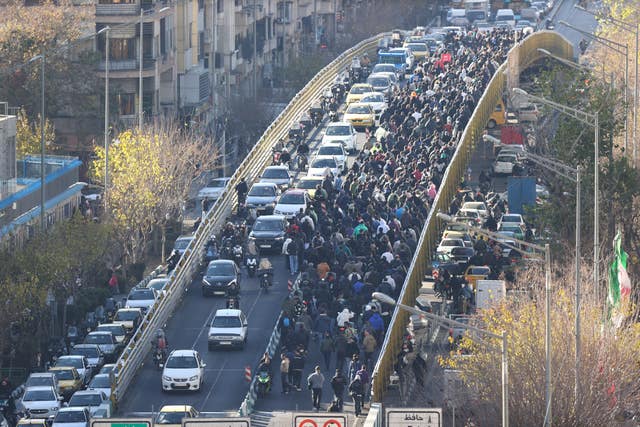
Wednesday was the most intense day of demonstrations, reaching rural towns and major cities in every province, though still localised enough for daily life to continue in Tehran, Iran’s capital, and elsewhere.
So far, violence around the demonstrations has killed at least 38 people while more than 2,200 others have been detained, said the US-based Human Rights Activists News Agency.
The growth of the protests increases the pressure on Iran’s civilian government and its Supreme Leader Ayatollah Ali Khamenei.
So far, authorities have not shut down the internet or fully flooded the streets with security forces like they did to put down the 2022 Mahsa Amini demonstrations. But any intensification may cause them to act.
Meanwhile, the protests themselves have remained broadly leaderless, though a call for protests by Iran’s exiled crown prince will test whether or not demonstrators are being swayed by messages from abroad.
On Wednesday, at least 37 protests took place across the country, activists said.
They included in Shiraz, where online videos purported to show an anti-riot truck using a water cannon to target demonstrators.
The state-run IRNA news agency, which has largely been silent about the demonstrations, reported on a mass demonstration in Bojnourd, and demonstrations in Kerman and Kermanshah.
Iranian officials have offered no acknowledgment of the scale of the protests.
However, there has been reporting regarding security officials being hurt or killed.
The judiciary’s Mizan news agency said a police colonel suffered fatal stab wounds in a town outside Tehran, while the semi-official Fars news agency said gunmen killed two security force members and wounded 30 others in the city of Lordegan in Chaharmahal and Bakhtiari province.
A deputy governor in Iran’s Khorasan Razavi province told Iranian state television that an attack at a police station killed five people on Wednesday night in Chenaran, some 430 miles north-east of Tehran.
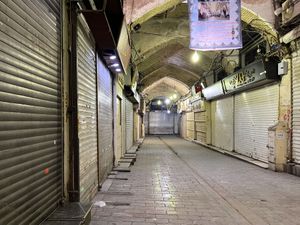
Demonstrations continued on Thursday, with merchants closing their shops in Iran’s Kurdistan province and soon after in other cities.
It remains unclear why Iranian officials have yet to crack down harder on the demonstrators.
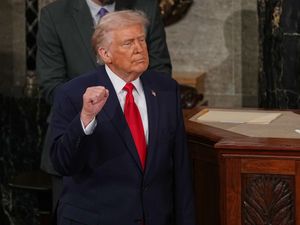
US President Donald Trump warned last week that if Tehran “violently kills peaceful protesters”, America “will come to their rescue”.
Mr Trump’s comments drew a new rebuke from Iran’s foreign ministry.
“Recalling the long history of criminal interventions by successive US administrations in Iran’s internal affairs, the foreign ministry considers claims of concern for the great Iranian nation to be hypocritical, aimed at deceiving public opinion and covering up the numerous crimes committed against Iranians,” it said.
But those comments have not stopped the US State Department from highlighting on X footage purporting to show demonstrators putting up stickers naming roads after Mr Trump or throwing away government-subsidised rice.
“When prices are set so high that neither consumers can afford to buy nor farmers can afford to sell, everyone loses,” the State Department said in one message. “It makes no difference if this rice is thrown away.”
The demonstrations so far broadly appear to be leaderless, like other rounds of protests in Iran in recent years.
However, Iran’s exiled crown prince Reza Pahlavi, the son of the late shah, has urged the public in Iran to shout from their windows and roofs on Thursday and Friday nights at 8pm.

“Wherever you are, whether in the streets or even from your own homes, I call on you to begin chanting exactly at this time,” Mr Pahlavi said in an online video that has also been promoted by Iranian satellite news channels abroad.
“Based on your response, I will announce the next calls to action.”
Whether people take part will be a sign of possible support for Mr Pahlavi, whose support of and from Israel has drawn criticism in the past, particularly after the 12-day war Israel waged on Iran in June.
Iranian officials appear to be taking the planned protests seriously. The Kayhan newspaper published a video online claiming security forces would use drones to identify those taking part.
Meanwhile, Nobel Peace Prize laureate Narges Mohammadi remains imprisoned by authorities after her arrest in December.
“Since December 28, 2025, the people of Iran have taken to the streets, just as they did in 2009, 2019,” her son Ali Rahmani said.
“Each time, the same demands came up: an end to the Islamic Republic, an end to this patriarchal, dictatorial and religious regime, the end of the clerics, the end of the mullahs’ regime.”
Iran has faced rounds of nationwide protests in recent years. As sanctions tightened and Iran struggled after a 12-day war with Israel in June, its rial currency collapsed in December, reaching 1.4 million to the US dollar.
This round of protests has yet to reach the level of the months of protests surrounding the death of 22-year-old Mahsa Amini in police custody in 2022.
Ms Amini was detained for not wearing her hijab, or headscarf, to the liking of authorities.
Her death became a rallying cry for women who continue to refuse to wear the hijab.