US and Ukraine have reached consensus on key issues in peace plan – Zelensky
The US has shown the 20-point plan, hammered out after marathon talks in Florida in recent days, to Russian negotiators.
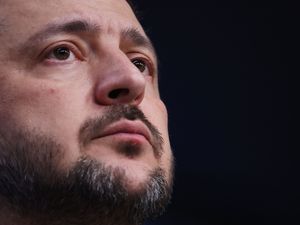
The United States and Ukraine have reached a consensus on several critical issues aimed at bringing an end to the conflict with Russia, Volodymyr Zelensky has said.
However, Ukraine’s president said sensitive issues around territorial control in Ukraine’s eastern industrial heartland, along with the management of the Zaporizhzhia Nuclear Power Plant (ZNPP), remain unresolved.
Mr Zelensky briefed journalists on each point of the plan on Tuesday but his comments were embargoed until Wednesday morning.
The draft proposal, which reflects Ukraine’s wishes, intertwines political and commercial interests to safeguard security while boosting economic potential.

Asked about the plan, Kremlin spokesperson Dmitry Peskov said that Moscow would set out its position based on information received by Russian presidential envoy Kirill Dmitriev, who met US envoys in Florida over the weekend.
Mr Peskov declined to share further details, saying that Moscow believed it was “highly inappropriate to conduct any kind of communication via the media”.
At the heart of the negotiations lies the contentious territorial dispute concerning the Donetsk and Luhansk regions, known as the Donbas. This is “the most difficult point”, Mr Zelensky said, and that these matters will be discussed at the leaders level.
Russia continues to assert maximalist demands, insisting that Ukraine relinquish the remaining territory in Donesk that it has not captured — an ultimatum that Ukraine has rejected. Russia has captured most of Luhansk and about 70% of Donetsk.
In a bid to facilitate compromise, the United States has proposed transforming these areas into free economic zones.

Ukraine insists that any arrangement must be contingent upon a referendum, allowing the Ukrainian people to determine their own fate. Ukraine is demanding the demilitarisation of the area and the presence of an international force to ensure stability, Mr Zelensky said.
How the Zaporizhzhia plant, which is under Russian occupation, will be managed is another contentious issue. The US is proposing a consortium with Ukraine and Russia, with each party having an equal stake in the enterprise.
But Mr Zelensky countered with a joint venture proposal between the US and Ukraine, in which the Americans are able to decide how to distribute their share, presuming it would go to Russia.
“We did not reach a consensus with the American side on the territory of the Donetsk region and on the ZNPP,” Mr Zelensky said. “But we have significantly brought most of the positions closer together. In principle, all other consensus in this agreement has been found between us and them.”
Point 14 of the 20-point plan, which covers territories that cut across the eastern front line, and Point 12, which discusses management of the Zaporizhzhia plant, will likely be major sticking points in the talks.
Mr Zelensky said: “We are in a situation where the Russians want us to leave the Donetsk region, and the Americans are trying to find a way so that it is ‘not a way out’ — because we are against leaving — they want to find a demilitarised zone or a free economic zone in this, that is, a format that can provide for the views of both sides.”
The draft states that the contact line, which cuts across five Ukrainian regions, be frozen once the agreement is signed.
Ukraine’s stance is that any attempt to create a free economic zone must be ratified by a referendum, affirming that the Ukrainian people ultimately hold the decision-making power, Mr Zelensky said. This process will require 60 days, he added, during which time hostilities should stop to allow the process to happen.
More difficult discussions would require hammering out how far troops would be required to move back and where international forces would be stationed. Mr Zelenskyy said ultimately “people can choose: this ending suits us or not”.
The draft also proposes that Russian forces withdraw from Dnipropetrovsk, Mykolaiv, Sumy and Kharkiv regions, and that international forces be located along the contact line to monitor the implementation of the agreement.
“Since there is no faith in the Russians, and they have repeatedly broken their promises, today’s contact line is turning into a line of a de facto free economic zone, and international forces should be there to guarantee that no one will enter there under any guise — neither ‘little green men’ nor Russian military disguised as civilians,” Mr Zelensky said.
Ukraine is also proposing that the occupied city of Enerhodar, which is connected to the Zaporizhzhia power plant, be a demilitarised free economic zone, Mr Zelensky said.