Putin and Modi to diversify mutual economic ties after India-Russia talks
The summit comes as the US pushes for a peace deal in Ukraine.
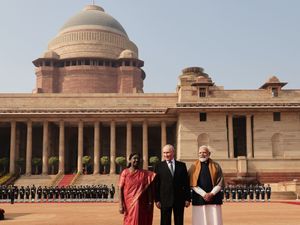
Russian President Vladimir Putin has held talks with Indian Prime Minister Narendra Modi at an annual summit and agreed to diversify mutual economic ties as the United States presses India to revise its decades-old partnership with Russia.
The 23rd Russia-India Summit comes at a pivotal moment as the US pushes for a Ukraine peace deal while seeking global co-operation.
It will test New Delhi’s efforts to balance relations with Moscow and Washington as the nearly four-year war in Ukraine grinds on.

Mr Putin was received by Mr Modi at an airport in New Delhi on Thursday. The Indian leader gave Putin a bear hug and a tight handshake with the gusto of an old friend.
After the talks, Mr Putin and Mr Modi announced that India and Russia have finalised an economic co-operation programme until 2030 which will help diversify mutual businesses to boost annual trade to 100 billion US dollars (£75 billion) by 2030.
Bilateral trade between the two countries stood at 68.7 billion dollars (£51.5 billion) in the last fiscal year ended March.
The trade is heavily skewed in favour of Russia with deep deficits for India, which it is looking to bridge by pushing exports.
Mr Putin said: “To achieve this significant goal, a programme for the development of Russian-Indian economic co-operation until 2030 has been agreed upon.”

He said work is under way on an agreement for India to establish a free trade zone with the Eurasian Economic Union, a Moscow-dominated economic grouping of several ex-Soviet nations, adding that it could help increase trade.
Mr Putin said: “Russia is a reliable supplier of energy resources and everything necessary for the development of India’s energy sector.
“We are ready to continue ensuring the uninterrupted supply of fuel for the rapidly growing Indian economy.”
Mr Modi said after the talks that the two countries will work toward early conclusion of the free trade agreement with the Eurasian Economic Union.
He also announced that India will soon start issuing free electronic visas for Russian tourists and groups visiting the country.
The Indian leader said energy security has long anchored India-Russia ties, with civil nuclear co-operation spanning decades.

He added that such co-operation will continue alongside collaboration in clean energy, shipbuilding, fertilisers and labour mobility.
Critics say Mr Putin’s visit could strain relations with the European Union (EU) and the United States, and might jeopardise negotiations for major trade agreements with both that are seen as critical for India’s exports.
US President Donald Trump raised tariffs on Indian goods to 50% in August, citing New Delhi’s discounted Russian oil. India has been the second biggest importer of Russian crude after China.
India and the US set a target for the first tranche of a trade deal by the autumn but the deal has not come through yet amid strains in relations.
India is also in the final stages of talks on a trade agreement with the EU, which sees Russia’s war in Ukraine as a major threat.