Missing bodies of hostages top list of uncertainties as Gaza ceasefire holds
On Tuesday, the Israeli military said troops in Gaza had ‘opened fire to remove the threat’ of several people approaching them, killing three.
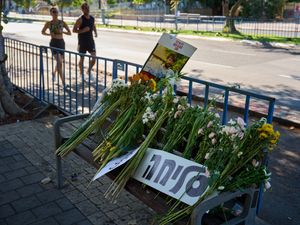
The tenuous ceasefire in the Israel-Hamas war was holding on Tuesday even as the return of deceased hostages from Gaza progressed more slowly than Israelis had hoped and health officials in the devastated territory said the Israeli military fatally shot three Palestinians.
A day earlier, Israelis celebrated the return of the last 20 living hostages in Gaza and Palestinians rejoiced at Israel’s release of some 2,000 prisoners and detainees as part of the ceasefire’s first phase.
But now attention in Israel has turned to when Hamas will return all the bodies of hostages who died in captivity.
While Israeli officials understood there could be some delay in the recovery effort, the families of hostages and their supporters expressed dismay that only four of the 28 bodies were returned on Monday.
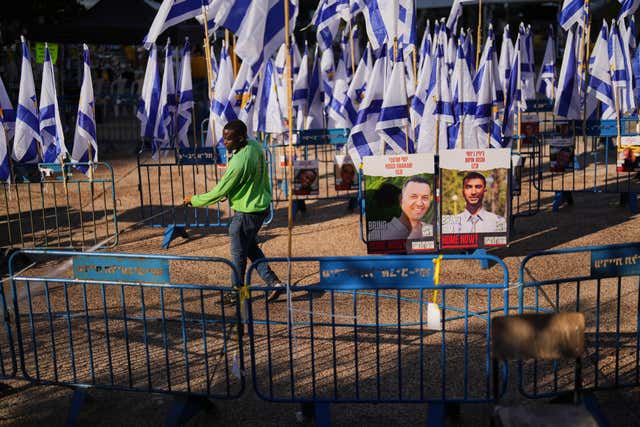
The Hostages Family Forum, a grassroots organisation representing many of the hostage families, called it a “blatant violation of the agreement by Hamas”.
The top official in Israel co-ordinating the return of hostages and the missing, Gal Hirsch, told the families in a note that pressure was being applied on Hamas through international mediators to expedite the process. A copy of the note was seen by The Associated Press and its authenticity was confirmed by someone with knowledge of the statement.
In Gaza, the Health Ministry said on Tuesday that the bodies of three people killed by the Israeli military in the northern part of the territory were taken to Al Ahli hospital.
The Israeli military said troops there had “opened fire to remove the threat” of several people approaching them and not complying with orders to stop. It did not immediately comment on any casualties.
Under the ceasefire deal, Israeli forces pulled back to where they were in August, before launching their latest offensive on the Gaza City. The pullback leaves a number of hard-hit Palestinian neighbourhoods under Israeli control, and Israel has warned residents not to try to return to homes there.
Complex issues remain ahead in the first phase of the ceasefire deal brokered by US President Donald Trump, including when Hamas will return to Israel the bodies of the hostages believed to be dead in Gaza, as well as the health conditions of the released hostages and prisoners.

On Tuesday, the Israeli military identified two of the four dead hostages – Guy Illouz from Israel and Bipin Joshi, a student from Nepal. A third dead hostage, Yossi Sharabi, was identified by Be’eri Kibbutz, from where he was taken.
Mr Illouz and Mr Joshi were both in their 20s when Hamas-led militants took them during the October 7 2023 attack on that ignited the war – Mr Illouz from the Nova music festival and Mr Joshi from Israel’s Kibbutz Alumim.
Israel said Mr Illouz died of his wounds while being held captive without proper medical treatment, while Mr Joshi was murdered in captivity in the first months of the war – adding that the National Centre of Forensic Medicine would later provide the final cause of death.

The International Committee of the Red Cross (ICRC) is cautioning that finding and returning the remains of former hostages in Gaza is “an even bigger challenge” than freeing those who were still alive.
“The search for human remains, it’s obviously (an) even bigger challenge than having — I would say — the people alive being released,” Christian Cardon, an ICRC official, said at a UN news briefing in Geneva.
“There will be human remains handed over from both sides” in the future, and the ICRC will again have a role in the “very sensitive operation”, Mr Cardon said, adding that he was not able to say how soon that might happen. Some remains may not be found, he acknowledged.
He said decontamination of rubble-strewn sites that may be littered with unexploded ordnance and the difficulty of identifying bodies were among top challenges.
The freed Israeli hostages were in medical care on Tuesday, and some families said it would be weeks before the men could go home. In the West Bank and Gaza, where hundreds of prisoners were released, several were also taken to hospitals.
Some of the near 2,000 Palestinian prisoners released on Monday are suffering from a range of health problems they developed during years in Israeli detention, doctors and freed prisoners in the occupied West Bank told The Associated Press.
The Palestine Medical Complex in Ramallah received 14 men released on Monday as part of the exchange and discharged all but two. Doctors examining the men said their conditions suggested they had been beaten.
“It indicates that these patients were subjected to severe beatings, reflecting the extent of the violence they endured,” said Imed al-Shami, a resident doctor at the hospital’s emergency department.
The AP could not independently verify the claims. The Israel Prison Service said it was unaware of such claims.
“All inmates are held according to legal procedures, and their rights including access to medical care and adequate living conditions are upheld,” it said in a statement on Tuesday.
Israel says it adheres to its prison standards under law and investigates any reports of violations. But such allegations are consistent with findings previously documented by media organisations and human rights groups.

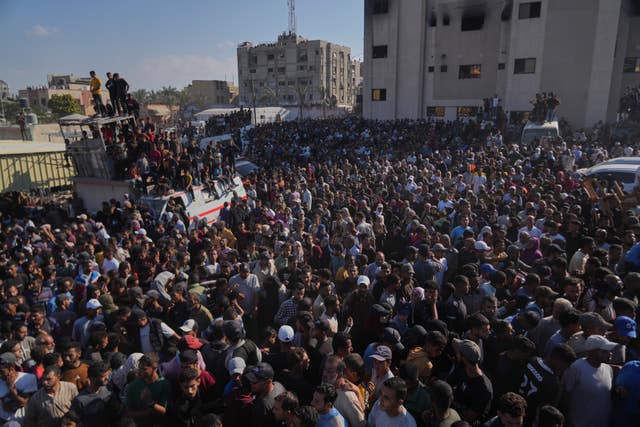
Gaza’s Nasser Hospital said it received the first 45 bodies of Palestinians who had been detained by the Israeli military since the 2023 Hamas-led attack.
The bodies were handed over by the ICRC as part of the ceasefire agreement. A total of 450 bodies were to be returned to Gaza from Israel, the hospital said.
Longer-term issues also hang in the balance, including whether Hamas will disarm, who will govern and help rebuild Gaza, and the overarching question of Palestinian statehood, which is central for Palestinians and many countries in the region.
“The first steps to peace are always the hardest,” Mr Trump had said as he stood with foreign leaders in Egypt on Monday for a summit on Gaza’s future.
He hailed the ceasefire deal he brokered between Israel and Hamas as the end of the war in Gaza and the start of rebuilding the devastated territory.
On Tuesday, the United Nations development agency said the latest joint estimate from the UN, the European Union and the World Bank is that 70 billion dollars (£53 billion) will be required to rebuild Gaza.
That figure was tallied in September, and up from 53 billion dollars (£40 billion) estimated in February.
Jaco Cillers, special representative of UNDP administrator for a programme to help Palestinians, said 20 billion dollars (£15 billion) would be needed in the next three years, and the rest would be needed over a longer period, possibly decades.
“The estimated damage and rubble, throughout the whole of Gaza is in the region of 55 million tons,” he said. “Another way to put it … is (that it’s) also equal to 13 pyramids in Giza.”
“That is the amount and size of the challenge,” Mr Cillers told the UN press briefing in Geneva by video from Jerusalem.
Mr Cillers pointed to “good indications” from potential donors such as those in the Arab world, Europe and the United States, without specifying.
In Egypt, Mr Trump urged regional leaders to “put old feuds aside” as world leaders met to discuss the challenges ahead in securing a lasting peace.
Representatives from Israel or Hamas were not at the summit.

Turkish President Recep Tayyip Erdogan stressed that an agreement signed in Egypt is not a peace deal but rather a framework for a ceasefire and said the United States and other nations must exert pressure on Israel to ensure its compliance.
Speaking to journalists on his return from the ceremony in the resort of Sharm El Sheikh late on Monday, the Turkish leader insisted that the only viable solution is a two-state solution recognising Palestinian statehood.
“Turkey is determined to continue working toward this goal,” he said, according to a transcript of his comments made available on Tuesday.
Mr Erdogan said the US and others should ensure that Israel complies with agreement, citing what he said was the country’s alleged poor track record on honouring ceasefires.
Mr Erdogan would not say whether Turkish troops would be deployed to Gaza, saying discussions about the structure and role of a task force for the region were still continuing.
He said, however, that his government was focused on reconstruction and providing humanitarian support, including the possibility of sending container homes to Gaza.
Spanish Prime Minister Pedro Sanchez said on Tuesday that those responsible for the destruction in Gaza should he held accountable in spite of the fragile ceasefire.
Mr Sanchez said there should be no impunity for “the main actors in the genocide that has been perpetrated in Gaza”, without naming Israeli Prime Minister Benjamin Netanyahu or others in his government.
“Peace cannot mean forgetting, there can be no impunity. There are cases open now in the International Criminal Court,” Mr Sanchez told Spanish radio station Cadena SER, in an apparent reference to the arrest warrants issued by the world’s top war-crimes court against Mr Netanyahu and his former defence minister over Israel’s military offensive in Gaza.
Spain was one of Europe’s sharpest critics of Israel’s two-year war in Gaza with Mr Sanchez last month calling Israel’s actions there a genocide.
Egyptian Foreign Minister Badr Abdelatty told the AP ahead of Monday’s summit said that 15 Palestinian technocrats have been selected to administer post-war Gaza.
He said their names were already vetted by Israel, without disclosing them and that the 15-member committee had already been approved by all Palestinian factions, including Hamas.
Egypt announced that it would host a reconstruction and recovery conference for Gaza with the help of the US and Germany.