Palestinian who filmed parts of Oscar-winning documentary killed in West Bank
Father of three Awdah Hathaleen was an activist who contributed footage to Oscar-winning documentary No Other Land.
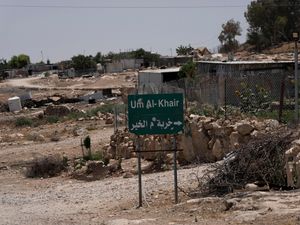
A Palestinian man who filmed parts of an Oscar-winning documentary has been shot dead in the occupied West Bank, according to witnesses.
A radical Israeli settler accused of shooting activist Awdah Hathaleen during a confrontation with unarmed Palestinians was filmed firing a pistol during the incident in Umm al-Khair, a village that has long seen conflict between the two communities.
Witnesses say Yinon Levi, who was previously under US sanctions that were lifted by the Trump administration, killed Mr Hathaleen, who was also an English teacher and father of three.
Umm al-Khair is in Masafer Yatta, the focal point of the Oscar-winning documentary No Other Land, which chronicles the Palestinians’ effort to remain on their land in the face of violence and the expansion of Jewish settlements considered illegal by most of the international community.
Mr Hathaleen, whose footage appears in the documentary, was outspoken about life under Israeli occupation.
His death sparked an outpouring of grief from family, international activists and rights groups.
The Israeli co-director of the documentary, Yuval Abraham, described Mr Hathaleen in an Instagram post as “a remarkable activist who helped us film No Other Land in Masafer Yatta”.
The film, which won the Oscar for best documentary feature film in March, had two Israeli and two Palestinian co-directors.
The Israeli military said an Israeli civilian had opened fire toward “terrorists” who hurled rocks at Israelis.
Israeli police said they detained eight people including an Israeli for questioning “on suspicion of reckless conduct resulting in death and unlawful use of a firearm”, five Palestinians and two foreigners.
Police said on Tuesday a court had denied their request to extend the detention of the Israeli and ordered the suspect’s release to house arrest.
The police did not identify the suspect, but Israeli media ran photos of a smiling Levi inside a courthouse on Tuesday.
Meanwhile, residents said four of the five arrested Palestinians remained in Israeli custody.
“They took the other half of my heart,” Mr Hathaleen’s brother-in-law, Tariq Hathaleen, wrote on Instagram.
“You were always telling the story, and now you’ve become the story.”
The encounter in which witnesses said Awdah Hathaleen was shot was filmed in footage obtained by The Associated Press.
The video shows Levi waving a pistol during a stand-off with a group of Palestinians on a dusty road, a yellow excavator visible in the background.
Witnesses said Levi was there to protect the excavator, which had rolled down from a nearby settlement and damaged Palestinian property earlier in the day.
The extended Hathaleen family and activists gathered at a mourning tent on Tuesday.
Israeli troops arrived later, ordering all foreign passport holders and media to leave, saying the area was a closed military zone.
Umm Al-Khair was founded in the 1950s by traditionally nomadic Bedouin, who settled there after being uprooted from the Negev desert during the 1948 war surrounding Israel’s creation.
Israel captured the West Bank in the 1967 Middle East war.
Last year, Israel’s military tore down a quarter of the homes in Umm Al-Khair, saying they had been built without Israeli authorisation.
On the day he died, Mr Hathaleen sent an urgent call to his network of activists and reporters.
“The settlers are working behind our houses and the worst (is) that they tried to cut the main water pipe for the community,” he wrote.
“If you can reach people like the congress, courts, whatever, please do everything. If they cut the pipe the community here will literally be without any drop of water.”