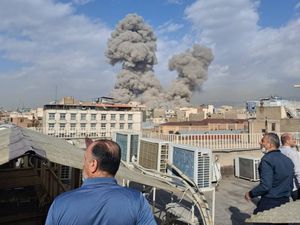
US strikes Iranian nuclear sites and Tehran warns of ‘everlasting consequences’
Donald Trump claimed three key sites had been ‘completely and fully obliterated’.
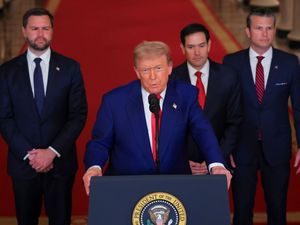
The United States has attacked three sites in Iran, inserting itself into Israel’s war aimed at destroying the country’s nuclear programme in a risky gambit to weaken a long-time foe which has prompted fears of a wider regional conflict.
US President Donald Trump asserted that Iran’s key nuclear sites had been “completely and fully obliterated”, in an address to the nation from the White House.
The Atomic Energy Organisation of Iran confirmed attacks took place on its Fordo, Isfahan and Natanz sites, but it insisted its nuclear programme will not be stopped. Iran has not commented on the damage.
Iran and the UN nuclear watchdog said there are no immediate signs of radioactive contamination at the three locations following the strikes.
Satellite images taken on Sunday show damage to the entrances to the underground site at Fordo.
The images, by Planet Labs PBC, also appear to show damage to the mountain itself that Fordo is under.
Sealing those entry tunnels means Iran would have to dig out the facility to reach anything inside.
The once-brown mountain had parts turned gray and its contours appeared slightly different than in previous images, suggesting a blast threw up debris around the site. That suggests the use of specialised American bunker-buster bombs on the facility. Light gray smoke also hung in the air.
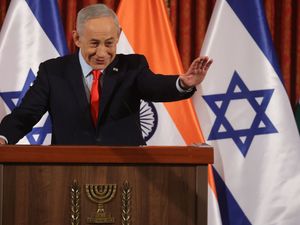
It is not clear whether the US will continue attacking Iran alongside its ally Israel, which has been engaged in a nine-day war with Iran.
Mr Trump acted without congressional authorisation, and he warned there will be additional strikes if Tehran retaliates against US forces.
“There will either be peace or there will be tragedy for Iran,” he said.
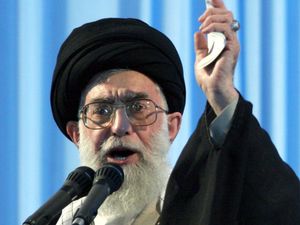
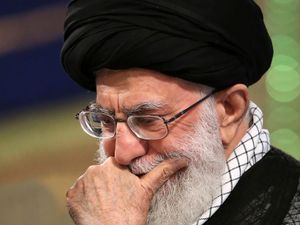
Iran’s top diplomat, foreign minister Abbas Araghchi, warned in a post on X that the US attacks “will have everlasting consequences” and that Tehran “reserves all options” to retaliate.
The foreign ministry in Tehran said Washington had “betrayed diplomacy” with the military strikes, and that “the US has itself launched a dangerous war against Iran”.
Its statement added: “The Islamic Republic of Iran reserves its right to resist with full force against US military aggression and the crimes committed by this rogue regime, and to defend Iran’s security and national interests.”
Hours after the American attacks, Iran’s paramilitary Revolutionary Guard said it launched a barrage of 40 missiles at Israel, including its Khorramshahr-4, which can carry multiple warheads.
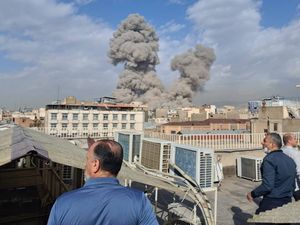
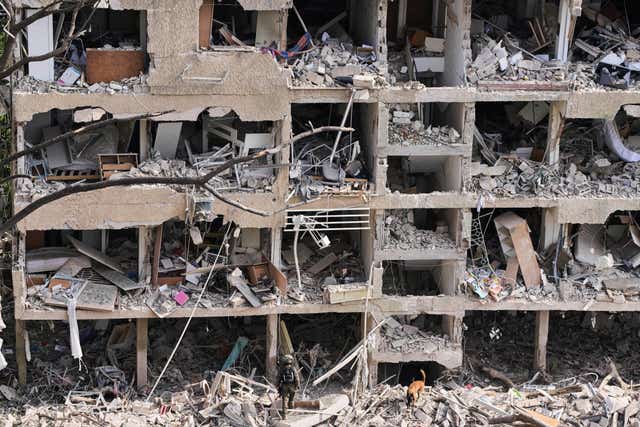
Israeli authorities reported that more than 80 people suffered mostly minor injuries, though one multi-storey building in Tel Aviv was significantly damaged, with its entire facade torn away to expose the apartments inside. Houses across the street were almost completely destroyed.
Following the Iranian barrage, Israel’s military said it had “swiftly neutralised” the Iranian missile launchers that had fired, and that it had begun a series of strikes towards military targets in western Iran.
Iran has maintained its nuclear programme is for peaceful purposes only, and US intelligence agencies have assessed that Tehran is not actively pursuing a bomb. However, Mr Trump and Israeli leaders have argued Iran could quickly assemble a nuclear weapon, making it an imminent threat.

The decision to directly involve the US in the war comes after more than a week of strikes by Israel that significantly degraded Iran’s air defences and offensive missile capabilities, and damaged its nuclear enrichment facilities.
But US and Israeli officials have said American B-2 stealth bombers and the 30,000-pound bunker-buster bomb that only they have been configured to carry offered the best chance of destroying heavily fortified sites connected to the Iranian nuclear programme buried deep underground.
Mr Trump appears to have made the calculation – at the prodding of Israeli officials and many Republicans – that Israel’s operation had softened the ground and presented a perhaps unparalleled opportunity to set back Iran’s nuclear programme, perhaps permanently.
“We have completed our very successful attack on the three Nuclear sites in Iran, including Fordo, Natanz, and Esfahan,” Mr Trump said in a post on social media.
“All planes are now outside of Iran air space. A full payload of BOMBS was dropped on the primary site, Fordo. All planes are safely on their way home.”
Mr Trump later added: “This is an HISTORIC MOMENT FOR THE UNITED STATES OF AMERICA, ISRAEL, AND THE WORLD. IRAN MUST NOW AGREE TO END THIS WAR. THANK YOU!”
Israel announced on Sunday that it had closed its airspace to both inbound and outbound flights in the wake of the US attacks.
The White House and Pentagon did not immediately elaborate on the operation but an update is expected on Sunday morning.
But one US official said the attack used bunker-buster bombs on Iran’s Fordo nuclear fuel enrichment plant that is built deep into a mountain. The weapons are designed to penetrate the ground before exploding.
In addition, US submarines launched about 30 Tomahawk missiles, according to another US official.
The decision to attack was a risky one for Mr Trump, who won the White House partially on the promise of keeping America out of costly foreign conflicts and scoffed at the value of American interventionism.
But he has vowed he will not allow Iran to obtain a nuclear weapon and he had initially hoped the threat of force would bring the country’s leaders to give up its nuclear programme peacefully.