Foreign leaders visit Ukraine to show support on war’s third anniversary
Western leaders warned of the war’s wider implications for global security.
Ukraine has marked the bleakest anniversary yet of its war against the Russia invasion, with the country’s forces under severe pressure on the battlefield and the Trump administration apparently embracing the Kremlin in a reversal of US policy.
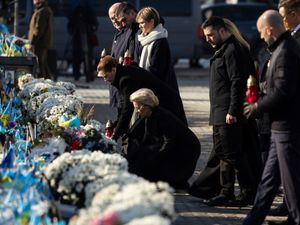
The three-year milestone drew more than a dozen western leaders to Kyiv for commemorative events in a conspicuous show of support.
They warned of the war’s wider implications for global security and vowed to keep providing billions in support for Ukraine as uncertainty deepens over the US commitment to help.
Washington did not send any senior official to the event.
The fourth year of fighting could be pivotal as US President Donald Trump uses his return to office to press for a peace deal.
World security is at stake in talks over how the war ends, European Commission president Ursula von der Leyen warned.
“The autocrats around the world are watching very carefully whether there’s any impunity if you violate international borders or invade your neighbour, or if there is true deterrence,” she said.
Canadian Prime Minister Justin Trudeau echoed that sentiment.
He said Canadians “believe deeply that it’s not just about Ukraine”, adding: “It’s about the rules and the values and the principles of sovereignty, of independence, territorial integrity that protects every country in the world. All of us rely on those rules to be able to build peace and security.”
Some observers say Russian success in Ukraine could embolden China’s ambitions. Just as Moscow claims that Ukraine is rightfully Russian territory, China claims the self-governing island of Taiwan as its own. North Korea and Iran have also aided Russia’s war effort.
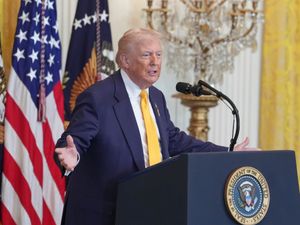
In a cascade of unwelcome developments for Kyiv, Mr Trump has in recent days called Ukrainian President Volodymyr Zelensky a dictator, suggested Ukraine is to blame for the war and ended Vladimir Putin’s three-year diplomatic isolation by the United States.
US officials have also indicated to Ukraine that its hopes of joining Nato are unlikely to be realised and that it probably will not get back the land that Russia’s army occupies, which amounts to nearly 20% of the country.
Meanwhile, Mr Putin’s troops are making steady progress on the battlefield while Ukraine is grappling with shortages of troops and weapons.
The guests in Kyiv and the leaders appearing via video had similar messages: Ukraine and its European partners must be consulted in any peace negotiations, Mr Putin’s ambitions must be thwarted, and Europe must take on more of the burden for its own defence.
The shift in Washington’s policy has set off alarm bells in Europe, where governments fear being sidelined by the US in efforts to secure a peace deal.
They are mulling how they might pick up the slack of any cut in US aid for Ukraine. The changes have also placed strain on transatlantic relations.
European Council president Antonio Costa on Sunday announced that he would convene an emergency summit of the 27 EU leaders in Brussels on March 6, with Ukraine at the top of the agenda.

British Prime Minister Sir Keir Starmer and French President Emmanuel Macron are both visiting Washington this week.
EU foreign ministers on Monday approved a new raft of sanctions against Russia. The measures target Russia’s so-called “shadow fleet” of ships that it uses to skirt restrictions on transporting oil and gas, or to carry stolen Ukrainian grain. The EU said 74 vessels were added to its shadow fleet list.
Asset freezes and travel bans were imposed on 83 officials and “entities” — usually government agencies, banks or companies.
Britain, too, imposed new sanctions, targeting 107 businesses and individuals in what it says is its biggest package targeting Russia’s war machine since the early days of the conflict in 2022.
The measures take aim at Russia’s military supply chains, including companies in several countries — notably China — that Britain says are supplying machine tools, electronics and dual-use goods for Russia’s military.
Sir Keir said Ukrainians’ voices “must be at the heart of the drive for peace,” while Mr Trump’s intervention had “changed the global conversation” and “created an opportunity”.
“Russia does not hold all the cards in this war,” he said.

Coming off a victory in Sunday’s German elections, conservative leader Friedrich Merz — also a staunch backer of Ukraine — posted on X: “More than ever, we must put Ukraine in a position of strength.”
“For a fair peace, the country that is under attack must be part of peace negotiations,” he wrote.
On Sunday, Russia launched its biggest single drone attack of the war, pounding Ukraine with 267 drones.
The EU’s top diplomat, Kaja Kallas, insisted that the US cannot seal any peace deal to end the war without Ukraine or Europe being involved. She highlighted what she claimed were pro-Russian positions being taken up by the Trump administration.
“You can discuss whatever you want with Putin. But if it comes to Europe or Ukraine, then Ukraine and Europe also have to agree to this deal,” Ms Kallas told reporters in Brussels.
Ms Kallas is scheduled to travel to Washington on Tuesday for talks with US secretary of state Marco Rubio.
UN secretary-general Antonio Guterres said the third anniversary was “a grim milestone”.
“More than 12,600 civilians killed, with many more injured. Entire communities reduced to rubble. Hospitals and schools destroyed,” he said.