Express & Star man Rob Golledge in Kenya: Harsh times in a blighted land
There's a poster on the wall at Elizabeth Oliech's home. 'Don't worry be happy', it reads.
But it seems to me Elizabeth doesn't have much reason to be happy.
Her father is dead. He was HIV positive.
Her mother, who also has the disease, is miles away in Uganda trying to earn a small living following the migratory fishing trade. Sexual exploitation is a near-certainty.
And now, aged just 17, Elizabeth is pregnant.
The age of consent is 18.
How she got pregnant? She won't say. It is not for me to speculate, but the reality is likely to be grim.
She lives with two sisters, two brothers and her grandmother in a house made out of sand with a corrugated roof among the dunes of Lake Victoria in the village of Agokgot in Siaya County.
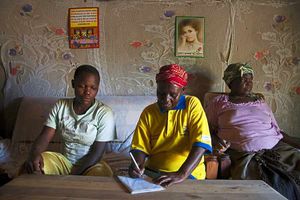
Her home has no windows.
The outlook is poor.
They drink water out of the lake, though they do boil it.
This is the most deprived area of Kenya with the highest rates of HIV and malaria infection.
Pregnant women are at even greater risk of malaria. Mother and baby exposed to the deadly disease in the harshest of conditions.
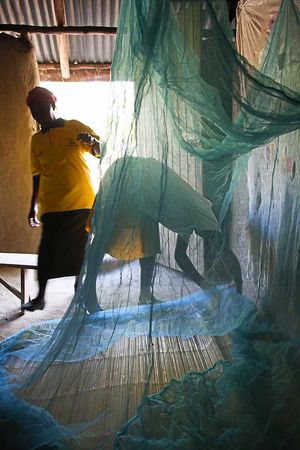
At night she sleeps on a bamboo mat alongside her siblings under a malaria net.
But there is a helping hand.
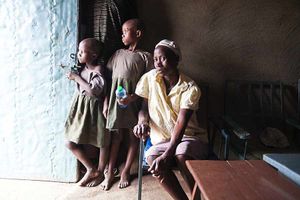
Having walked several miles across the uneven terrain of sand and stone in temperatures reaching 33C (91F), retired teacher Esther Wasonga pays Elizabeth a visit.
She is a community health volunteer.
There is now a small army of these volunteers working over rural communities all over counties in Nyanza province in the Western Kenya.
In an area where witch doctors are still turned to, their advice and help is crucial in the effort to improve access to basic health services.
"She motivates me," says Elizabeth in impeccable English which surprises me.
"I feel good when she comes.
"She gives me a referral letter if I need to go to the medical centre and we discuss the things that affect people like me at my stage.
"She has told me a lot about how to look after myself.
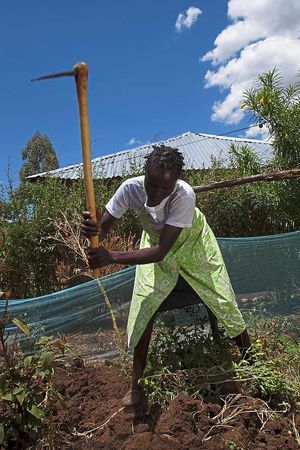
"She has told me how to use preventative measures such as sleeping under a mosquito net."
The volunteers are trained by the Anglican church organisation ADS-Nyanza (Anglican Development Services Nyanza).
It is a project supported by Christian Aid, which is using its 2015 Christmas appeal to raise funds for health initiatives such as this one.
More than half a million people die of malaria every year.
Three quarters of these are African children under five and 90 per cent of all malaria deaths are in Africa.
Malaria nets treated with insecticides are seen as a relatively cheap and effective measure.
In Nyanza province 81 per cent of households had at least one insecticide treated net, with an average of 1.6 nets per household.
But for large households, one net is not enough.
"The government holds mass net distributions but it still means there could be several people to a net," said Tobias Aulo project coordinator for health with ADS-Nyanza.
"The problem was the government just distributed the nets and nobody really knew what to do with them.
"Most of these people are really poor so they used the nets to go fishing or to protect their crops from being eaten by animals.
"Part of our job is to fill the gaps left by the government and to continue educating people."
Elizabeth was forced to drop out of school because of her pregnancy.
Sex is still a taboo topic in parts of Kenya and is often not talked about between parents and their children.
A girl getting pregnant underage is seen as shameful.
The pressure and feeling of disgrace has been known to cause some underage pregnant girls to commit suicide.
Elizabeth is clearly bright.
She is articulate and knowledgeable.
She said her favourite lesson a school was English.
"My dream since I was in class four is to become a journalist," she says.
She was inspired after watching Citizen TV's Lilian Muli – the Susanna Reid of Kenyan TV news.
"My mum says she will take me back to school," she says.
A silence falls on the room. And tears trickle down her young face.
"I don't know if I will be able to finish."
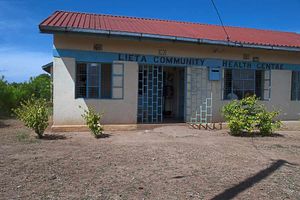
In Lieta village, chief Alfred Oticha, a government employee working under the local government administration, says the impact of the volunteers has been huge.
"We used to have very big problems," he said.
"We were widely infected with diseases like malaria and HIV. But since the intervention from NGOs (non-governmental organisations) we have seen areas of eduction.
"People are not continually dying. We can see there are still many challenges with us but we trying to do as much as we can to prevent these diseases.
"The community health volunteers go door to door.
"In Lieta there are 15.
"Before they used to go to the hospital. Some people were not used to going there.
"There were some people who still relied on herbal treatments.
"The community health volunteers have made access to advice and provision easier."
Joyce Omondi is 30 with four children.
Her husband died of HIV two years ago.
The children play in among dried mud outside her hut made out of sand and cow dung.
Chickens walk freely in and out of the house. And a cow wanders among planting beds.
The rains have been late, so the year's second harvest is yet to come.
Joyce only has one malaria net which she shares with her youngest son Boaz who is two years-old.
The others are left exposed.
"Not a month can pass without one of them having malaria," she said.
"I get worried when they go to sleep without the net.
"I know they can get malaria without it."
It is a heartbreaking choice she has to make. How do you choose which of your children can sleep under a net and who doesn't?
"It is just me to provide for the family so if I become ill who will look after them?" she asks.
Up a mountainous hill is the small village of Upper Kokumu.
Monica Achieng is 32 years old and she is currently pregnant with her third child.
It is important she sleeps under a malaria net to protect her unborn baby.
But it means her two boys, aged 10 and eight, sleep exposed in a small dark hut used for burning a fire.
The smell of smoke fills the room.
Their bed for the night is hard red earth.
"I have only one net. I cannot afford another.
"I am scared that my boys will get malaria.
"There was a child who died in the village not long ago."
The conversation is interrupted by a familiar tune.
The melody of We Wish You A Merry Christmas rings out from the phone of community health volunteer David Oyuga.
He is 65 and walks more than five hours a day visiting households.
He does not know what the song is – unaware of its relevance to a Christian Aid's Christmas Appeal.
"It is very painful for us that as community health volunteers we have no solution to the lack of nets.
"Many of the members buy nets for people but then we have to explain to our families why we then have no money."
He rises at 6am every day and finishes very late to complete his voluntary duties.
"If there was no David I would face a lot of pain," said Monica.
"He tells me of what preventative measures to take and how to look after myself and the baby."
In the flats of Agutu village, Carolyn Omonbi appreciates the regular contact with her local community health volunteer.
Two years ago she miscarried.
"I had an incredible pain in my stomach. It kept coming and coming and coming.
"After one month I felt like something had come out of me.
"I went and saw my community health worker.
"I was beyond help. It was me or the baby."
The baby was lost because of the effects of malaria.
She is pregnant again and now the work of the volunteers is paying off.
"We were still in shock and pain at what happened.
"I didn't know what to do. I was depressed.
"Last time I didn't use a net in good time. Now I use it all the time.
"We are happy that there are people who care and want to help us."
Pictures courtesy of Christian Aid / Tom Pilston