Meningitis: ‘Sporadic’ household clusters could appear elsewhere in UK
Two people have died and more have been admitted to hospital as health leaders deal with an ‘unprecedented’ outbreak of the deadly bug.
Sporadic household clusters of meningitis could appear over the next four weeks in other parts of the UK linked to the travel of people away from Kent, a health leader has said.
Kent County Council’s director of public health Dr Anjan Ghosh told a briefing three scenarios were being looked at over the next four weeks, with the most likely being that students who have travelled away from Kent will “incubate” the bug and there could be “household” cases elsewhere.
However, he said these would be “containable” and stressed the risk of infection is low.
It comes as the UK Health Security Agency (UKHSA) said the number of cases linked to the outbreak has reached 29, up from 27 previously.
Some 18 cases have been confirmed, alongside a further 11 “probable cases” – all with links to Kent, the UKHSA said.
Dr Ghosh told the briefing that three “rough” scenarios are being modelled for the next four weeks, as “that’s the time it takes for this whole thing really subside”.
The first scenario is that the outbreak remains contained in Kent.
“Second scenario is that there are people who’ve left, they’ve gone off campus, and many of them don’t stay in Kent, they go and stay elsewhere,” Dr Ghosh said.
“They were incubating when they left, and then they become cases, and there are small household, sporadic clusters outside of Kent.”
He stressed these cases would be “containable”.

The third scenario, described by Dr Ghosh as the “worst-case scenario”, would result in another cluster outside Kent.
However, he said this is “highly unlikely”, with the second scenario “most likely to be the case”.
Thirteen of the 18 cases confirmed by UKHSA are menB. All cases have required hospital admission.
Dr Ghosh stressed that meningitis is much more difficult to catch then Covid, saying it “requires protracted close contact in order for it to be spread, and that usually is in a household context or in a dormitory context”.
He added: “It requires close contact in the form of kissing, sharing utensils, things like that.
“So in general, if you’re just coming across someone who is positive, you’re very unlikely to get the disease from them the way it was with Covid.”
He urged anyone identified as a close contact by the UKHSA to come forward for preventative antibiotics.
He added: “There’s no reason for people to not be going about leading their normal lives.”
Speaking to the Press Association, Dr Ghosh explained that he thought the worst case scenario of another type of “super spreader” event is “very unlikely to happen”.
He said: “The worst case scenario is that there’s another type of event like what happened in Kent, so some sort of super spreader event or something more, and therefore you have a bigger, much bigger cluster like you had in Kent happening elsewhere. That’s very unlikely to happen.”
He said the “most likely scenario” is that it is contained in Kent, with a few additional cases outside of Kent “which can be easily contained”.
He added: “A lot of the cases come from University of Kent students resident in the campus, who now have broken up for holidays and Easter breaks.
“So theoretically you could have someone who was incubating at that time, not showing symptoms and then going off on holiday home… many of the students live outside of Kent.
“And then they start to show symptoms and then with their close contacts potentially spread it.
“Even if that was to happen that would be a very limited to household kind of thing, which can be easily managed.”
Asked by PA whether the disease is more transmissible than before and why there have been so many cases in a short period, he said: “That’s a question we’re asking as well.”
He said the issue was being looked at, adding it was “too early to say” if the number of cases has peaked.
He said: “Hopefully it’s starting to slow down. I think until next week, we won’t be able to say for sure, the normal sequelae of an outbreak of this sort is about four weeks.
“That’s the timeframe for it to really slow down.
“So we fully expect, in four weeks’ time that it has slowed down, but we can’t say whether it’s peaked yet.”
Dr Ghosh told PA about what is classified as a household, saying: “When we talk about households, it’s the person who actually got the infection spreading it to others around.
“So households aren’t that big and as you know, like I said, it’s close contact over a prolonged, sustained period of time so it would be two to three people, something like that.”
Earlier, the family of Juliette Kenny, 18, who died from meningitis in the Kent outbreak described their “immeasurable loss”.

In a statement to PA, Mr Kenny said his daughter had been “fit, healthy and strong” before her death. The family are campaigning for teenagers and young people to be routinely given access to the meningitis B vaccination.
Juliette is one of two students who have died in the outbreak.
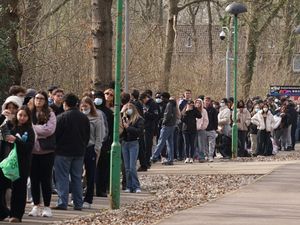
On Friday morning, hundreds of students on the University of Kent campus queued for a vaccine.
More than 100 students were told to leave the queue by staff on Thursday afternoon after the university said “nursing staff are unable to see any more people within the clinic’s remaining opening hours today”, with the clinic closing at 5pm.
By 8.45am on Friday, around 700 staff and students were in the queue, according to estimates by PA reporters at the scene.
One student near the front said she had joined the queue at 7.55am. The clinic is operating from 9am to 5pm, with students told to join the queue by 2pm.
The chief scientific officer of the UKHSA, Professor Robin May, said a “staffing issue” led to people being turned away on Thursday.
He told Times Radio: “Yesterday, it was a staffing issue. To emphasise – we are not short of vaccine. Yesterday, demand exceeded the ability of staff to fulfil it within the time allocated.”

Ed Waller, deputy chief executive of NHS Kent and Medway, said on Friday his “top priority” is to “maximise capacity” and “make sure we can get through everyone who wants a vaccine”.
He told reporters: “What we’re trying to do is to use our capacity to deliver consistently through the days”, adding clinics would be open this weekend.
He added: “6,500 doses of vaccine have been delivered to Kent and Medway from the national stock. There was a request today for a further 5,000.”
Elsewhere, Paul Hunter, professor in medicine at the University of East Anglia, said the “peak” of the initial meningitis “superspreading event” at Club Chemistry in Canterbury may have passed.

However, secondary cases affecting people who were not infected at the nightclub, but caught the illness from someone who was there, are still a possibility, he said.
The UKHSA has said the Bexsero vaccine for menB used on the NHS should offer protection against the strain identified, and it published details of an “initial genetic analysis” of the strain.
Similar strains have been circulating in the UK for around five years but more detailed analysis is required, the UKHSA said, as it invited researchers to look at its code in detail.
Asked if such an outbreak could happen again, Prof May told Times Radio: “Well obviously that’s something we’re very conscious of.
“We’ll be mindful both of the possibility of this particular strain, for example, re-emerging in the future, but also general principles that we’ll learn about the bacteria.”
NHS Kent and Medway says 4,514 vaccines have been administered in Kent as of Friday afternoon. The health trust’s website, last updated at 2.08pm, adds that 10,561 antibiotics have also been handed out.