Meningitis outbreak: Tribute paid to student who died as hundreds seek treatment
A year 13 pupil in Faversham and a student at the University of Kent have died, with others being treated in hospital.
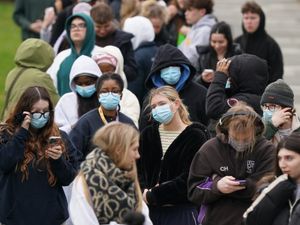
Hundreds of students have been queuing for antibiotics after two young people died in an outbreak of meningitis and others were admitted to hospital.
One of those who died was a year 13 student called Juliette, who was described by her headteacher at Queen Elizabeth’s Grammar School in Faversham in Kent as “incredibly kind, thoughtful and intelligent”.
The other person who died attended the University of Kent.
The Press Association understands that some of those in hospital have been put into induced comas.
A local nightclub said it has been contacted by officials to try and trace people who may be affected.
The UK Health Security Agency (UKHSA) has so far said it is aware of 13 cases with signs and symptoms of meningitis from Friday to Sunday in the Canterbury area of Kent
A spokeswoman for the UKHSA told the Press Association: “We can confirm that UKHSA has worked with the University of Kent to provide advice letters to all 16,000 students, advising on recent cases, signs and symptoms, how to obtain antibiotics, and what to do if they feel unwell.”
Not all 16,000 students at the university will be given antibiotics.

Amelia McIlroy, the headteacher of Queen Elizabeth’s Grammar School in Faversham, confirmed one of its year 13 pupils had died.
She said: “It is with great sadness that we are confirming the loss of Juliette, a much loved and treasured member of our school community.
“Juliette was a student at our school for seven years. She was incredibly kind, thoughtful and intelligent and she loved our school and was very happy here.
“Juliette embraced everything that school had to offer with great enthusiasm and joy and her humour and positivity were captivating.
“She was a genuinely caring and attentive listener, a true friend – who listened with warmth, respect and sincere interest to her peers and to our staff.
“In short, she was a lovely girl – her beautiful smile, her loving nature and her sense of fun will be hugely missed. We are all devastated.
“Our love and thoughts are with her family and friends at this terribly sad time.
“Our priority now is the safety and well-being of all members of our school community and we are continuing to work closely with UKHSA.”

At the university campus on Monday, students described their worries as they queued for antibiotics.
The specific strain of meningitis has not yet been identified.
Several students were wearing face masks and staff handed out more to those waiting.
Two teenage brothers said they had been left terrified after going to a party which was hosted by a friend who is now in hospital with meningitis.
Matthew McDonagh, 16, and his brother Luca, 17, were at a party in Whitstable, Kent, on Saturday with one person who has now been diagnosed with the infection.
Another person from their friendship circle was already in an induced coma after recently contracting meningitis.
Luca, who is in year 13, said no one in his year group at Simon Langton Grammar School is allowed to go in for lessons.
He and his brother, also at same school, were told to come to the University of Kent to receive a precautionary antibiotic.
Matthew told the Press Association: “It’s quite scary. Like, just like, I can’t believe it. It’s just insane..
“It’s completely unbelievable. I never thought this would happen again (after Covid).
“We’ve been told that we don’t even know if the pill that they give you is actually going to help us.”
Luca said: “It’s pretty terrifying.”
Headteacher Ben Greene, from the Norton Knatchbull School in Ashford, Kent, told PA one of its year 13 students “is receiving medical care in hospital with a suspected case of meningitis”.
He added: “We are taking precautionary steps as a school in line with UKHSA, including measures to enhance hygiene.
“Our priority is to ensure the safety and wellbeing of all students and staff, and we have communicated to all parents and carers so that they are aware of the symptoms to look out for and have appropriate guidance.
“The school’s pastoral team are working closely our students to provide care, reassurance and support.”
Rosie Duffield, Independent MP for Canterbury, said she has received a briefing from the UKHSA, who were stressing that meningitis needs “fairly intimate contact” to spread between people.
She said people could contact her office if they were worried.
She told PA: “We’ve all got to be really sensible but we should not panic too much.”
She added: “If anyone is worried they can call my office or their GP. We can also put them in touch with the right people at the university.”
Anyone can get meningitis but it is most common in babies, children, teenagers and young adults and it can spread very quickly in places such as universities and colleges.
Louise Jones-Roberts, owner of Club Chemistry in Canterbury, told PA the venue had been contacted by the UKHSA in the hope of tracing anyone affected, but explained there may be challenges.

“We have been told somebody was in our club at the weekend who has since been diagnosed with meningitis,” she said.
“They have asked us if we have any methods for tracing who has been in to us.
“We have an ID scanner but that is more of a security measure… It takes pictures of driving licences, ID cards and on so on.
“We’ve got tickets for events so we could trace ticket holders, but most people pay on the door.
“I’m devastated,” she said. “I can’t imagine what the families are going through…
“We will stay closed until we get further advice from the UKHSA.”
A University of Kent spokesperson said on Monday it was taking advice from UKHSA and communicating with students and staff.
“They have also been contacting known contacts of any cases in our community with advice on what to do and any next steps,” it said.
“A reminder that there will be no in-person assessments or exams this week, and schools will be in direct contact with students to provide details on alternative arrangements.
“We recognise that this is a very sad and worrying time for many members of our community.”
Trish Mannes, UKHSA regional deputy director for the South East, said: “Meningococcal disease can progress rapidly, so it’s essential that students and staff are alert to the signs and symptoms of meningococcal meningitis and septicaemia, which can include a fever, headache, rapid breathing, drowsiness, shivering, vomiting and cold hands and feet.
“Septicaemia can also cause a characteristic rash that does not fade when pressed against a glass.
“Students are particularly at risk of missing the early warning signs of meningitis because they can be easily confused with other illnesses such as a bad cold, flu or even a hangover.”