‘Human swan’ breaks down in tears while giving evidence in fatal accident probe
Dan Burton, 54, died in a mid-air paramotor collision with climate activist Sacha Dench in the Highlands in 2021.
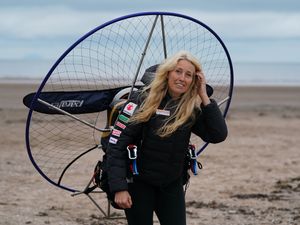
A paramotorist known as the “human swan” has broken down in tears while giving evidence to an inquiry about a mid-air crash between herself and her co-pilot that left the latter dead.
Sacha Dench was attempting a 3,000-mile round Britain by paramotor challenge when the aircraft she was flying was involved in a collision with one flown by Dan Burton, 54.
Mr Burton died in the incident, while Ms Dench survived but suffered serious injuries.

Named the Round Britain Climate Challenge, the expedition started in June and had been intended to highlight the issue of climate change ahead of the Cop26 conference, which took place in Glasgow later that year.
Climate activist Ms Dench had previously received acclaim for a similar expedition, recounted in BBC documentary Flight Of The Swans.
On Monday a fatal accident inquiry (FAI) at Tain Sheriff Court heard evidence from Ms Dench, who broke down in tears on several occasions.
At one point the inquiry was adjourned to allow her time to compose herself, and took an early lunch break for the same reason.
She told the inquiry she first met Mr Burton in about 2005 or 2006 during her time as a free diver, and that the pair had started flying paramotors together around 2012.
They had previously flown together on the Flight of the Swans expedition, and had also been planning a paramotor expedition in Africa when he died.
Asked for her assessment of Mr Burton’s level of experience with paramotors she replied: “Highly experienced – potentially the most experienced expedition pilot I know.”
Fiscal depute Jemma Eadie asked Ms Dench about the planning and preparation for the round-Britain expedition, which the inquiry heard had originally been expected to last eight weeks.
Ms Dench said it was originally envisaged as a continuous “circumnavigation” of the UK, but that this changed to only doing “a few segments” because of the batteries in the paramotors’ electric motors only lasting 30 minutes at a time.
The inquiry heard the pair agreed on take-off sites, landing sites and mid-way stopping points every evening and morning before flying, and that they could communicate while in the air through Bluetooth headsets built into their helmets.
Ms Dench said the headsets connected automatically when they were within “about 800 metres” of each other, and that they provided an “open channel” that did not need any buttons to be pressed to speak.
Asked what they would talk about she said: “We’d be chatting about the scenery, where we were going to, any changes in weather conditions.”
She said on the day of the crash the pair had been planning to land in a field “near Ullapool”, and that the area in which they had both come down had not been the planned landing site.
The FAI previously heard some evidence during hearings in May last year and in January this year.
Ms Dench, an Australian, is known as the “human swan” for her adventures using a paramotor to follow swans migrating from Russia across Europe to the UK.
Mr Burton was from Devon.
The inquiry continues.