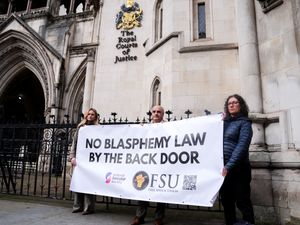
Koran burning case ruling rejection of ‘back door blasphemy law’ – campaigners
The High Court upheld the acquittal of Hamit Coskun, who burned the Koran outside the Turkish consulate, in a ruling on Friday.
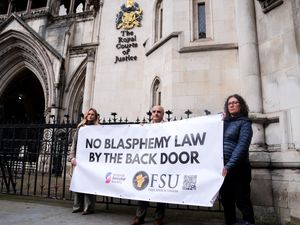
Campaigners have said the High Court has rejected a “wrongheaded attempt to introduce a blasphemy law by the back door” as judges upheld the acquittal of a man who burned a Koran in public.
Hamit Coskun was initially convicted last June of a religiously aggravated public order offence after he held a flaming copy of the Islamic text aloft and shouted “f*** Islam” outside the Turkish embassy on February 13 last year.
The 51-year-old successfully appealed against his conviction, having it overturned by Mr Justice Bennathan at Southwark Crown Court in October.
The Crown Prosecution Service (CPS) brought an appeal against that decision at the High Court and asked for it to be reconsidered.
But dismissing the appeal in a decision on Friday, Lord Justice Warby and Ms Justice Obi said: “We are not persuaded that the court left any material factor out of account or relied on any immaterial factor.”
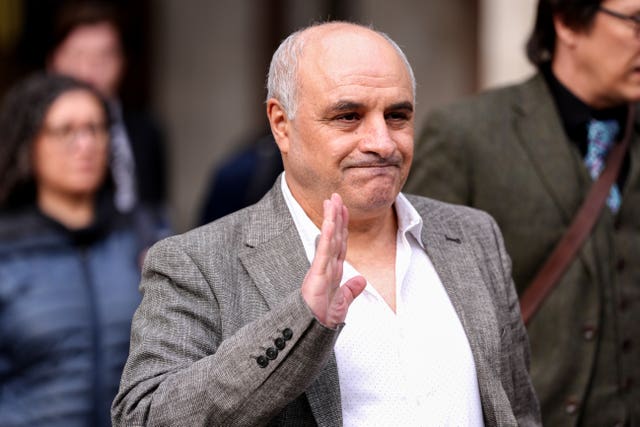
After the ruling, Mr Coskun said: “In England, I hoped that I would be free to speak about the damage of sectarian politics and Islamism.
“I am relieved that after a year, the courts have ruled that I am free to do so.”
Mr Coskun thanked the National Secular Society and the Free Speech Union, which both also welcomed the ruling, for their support.
The National Secular Society’s chief executive Stephen Evans called for a “serious review” of why Mr Coskun was originally charged and why the CPS took the case to the High Court.
He said: “The High Court has rightly rejected this wrongheaded attempt to introduce a blasphemy law by the back door.
“However offensive some may have found the Koran-burning protest, it was lawful.
“Criminal law protects people from harm, not from being offended.
“This judgment makes clear that it is not the state’s job to police religious sensibilities.
“A hostile – even violent – reaction to speech cannot be allowed to determine whether that speech is criminal.”
Lord Young of Acton, general secretary of the Free Speech Union, said CPS head, Director of Public Prosecutions Stephen Parkinson, had “no choice” but to resign.
He said: “This appeal should never have been brought by the Crown Prosecution Service, just as Hamit should never have been prosecuted.
“We have not had blasphemy laws in this country for 18 years and, for that reason, this prosecution was bound to fail.”
A CPS spokesperson said the body would be carefully reviewing the High Court decision, adding: “There is no law to prosecute people for ‘blasphemy’ and burning a religious text on its own is not a criminal act – our case was always that Hamit Coskun’s words, choice of location and burning of the Koran amounted to disorderly behaviour, and that at the time he demonstrated hostility towards a religious group.”
Lawyers for the CPS told a hearing earlier in February that the judge was wrong to find that Mr Coskun’s behaviour was not “disorderly” and, if it was, was unlikely to cause harassment, alarm or distress.
David Perry KC said in written submissions that Mr Coskun’s prosecution was “not an attempt to introduce an offence of blasphemy” and was not “an impermissible encroachment” on his right to free speech.
In written submissions on behalf of Mr Coskun, Tim Owen KC said that the CPS’s appeal was “unarguable” and “merely seeks to rehash arguments” that had “ultimately failed”.
And in their 14-page ruling, Lord Justice Warby and Ms Justice Obi said the CPS’s submissions “are essentially no more than counter-arguments offering a different perspective, or a different approach to the facts and circumstances of the case”.
Mr Coskun was fined £240 after his conviction, with District Judge John McGarva stating that he had a “deep-seated hatred of Islam and its followers”.
But overturning his conviction, Mr Justice Bennathan ruled that the right to freedom of expression “must include the right to express views that offend, shock or disturb”, and that the criminal law “is not a mechanism that seeks to avoid people being upset, even grievously upset”.