UK hits out at Putin’s ‘heinous’ acts in Ukraine after Russia’s nuclear claim
Downing Street flatly denied Moscow’s claim that the UK and France were working on providing Ukraine with a nuclear weapon.
Vladimir Putin has been accused of trying to distract attention from his “heinous” atrocities in Ukraine after Russian spies claimed the UK was plotting to supply Ukraine with a nuclear weapon.
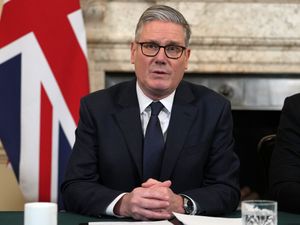
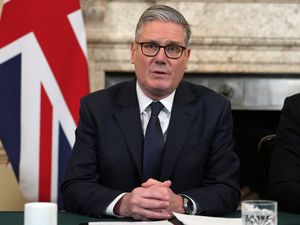
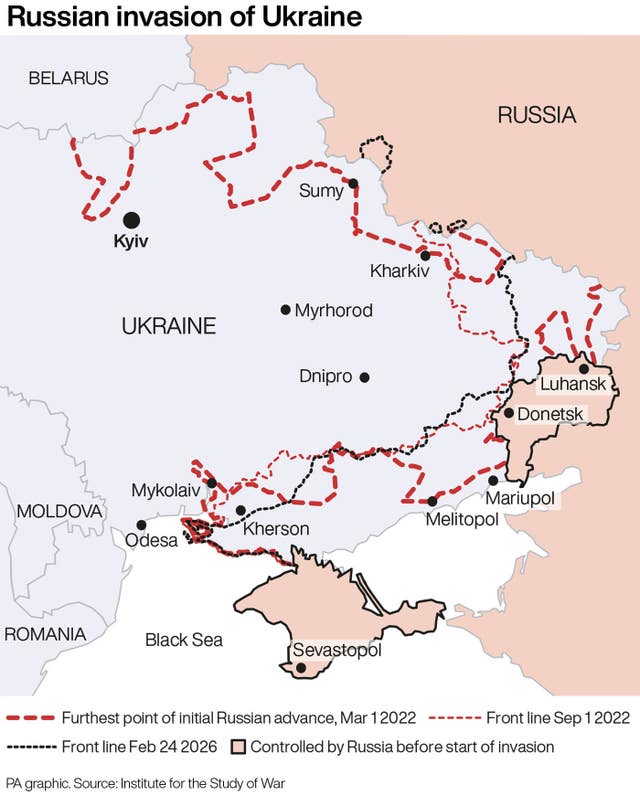
On the fourth anniversary of the Russian president’s invasion of Ukraine, Prime Minister Sir Keir Starmer hit out at Mr Putin for blocking the path to peace and vowed to stand with Kyiv for as long as it takes.
He said it was a “falsehood” to suggest Russia is winning the conflict, which is costing Mr Putin’s forces tens of thousands of lives every month.
Russia’s foreign intelligence service SVR publicly claimed that the UK and France were “actively working” on providing Ukraine with a nuclear weapon, possibly a makeshift “dirty bomb”, to give Volodymyr Zelensky greater leverage in peace talks.
Downing Street dismissed the allegation, with the Prime Minister’s official spokesman saying: “This is a clear attempt by Vladimir Putin to distract from his heinous actions in Ukraine.
“There is no truth to this.”
The UK targeted Russia’s economy with the largest sanctions package since 2022 in an attempt to restrict the flow of money and arms to Mr Putin’s war machine.
The giant pipeline company PJSC Transneft, 175 companies and 48 oil tankers involved in “shadow fleet” operations to supply Russian exports around the world in defiance of restrictions were hit by new sanctions.
Firms involved in providing components for Russian drones, banks and the nuclear power and gas industries were also among the almost 300 new sanctions.
Sir Keir said the sanctions were “essential in terms of weakening the ability of Russia to continue with this aggression”.
Addressing a Cabinet meeting he said: “This is not a remote conflict a long way away from the United Kingdom.
“It’s about our values of freedom, democracy and the right of a country to decide for itself what it does, which is democracy and sovereignty.”
The impact of the war was being felt in households across the UK because of the spike in energy prices since the invasion, he said.
“They are still 40% higher than they were before,” he said.
“So, every family is feeling it.
“And how and when this conflict ends is going to affect everybody in the United Kingdom for a very long time, which is why it is so important we make sure that it’s a just and lasting peace.”
But he said “it is Putin who is standing in the way” of that outcome.
Cabinet Secretary Dame Antonia Romeo was next to the Prime Minister as she attended her first Cabinet meeting since being promoted to the top Civil Service post.
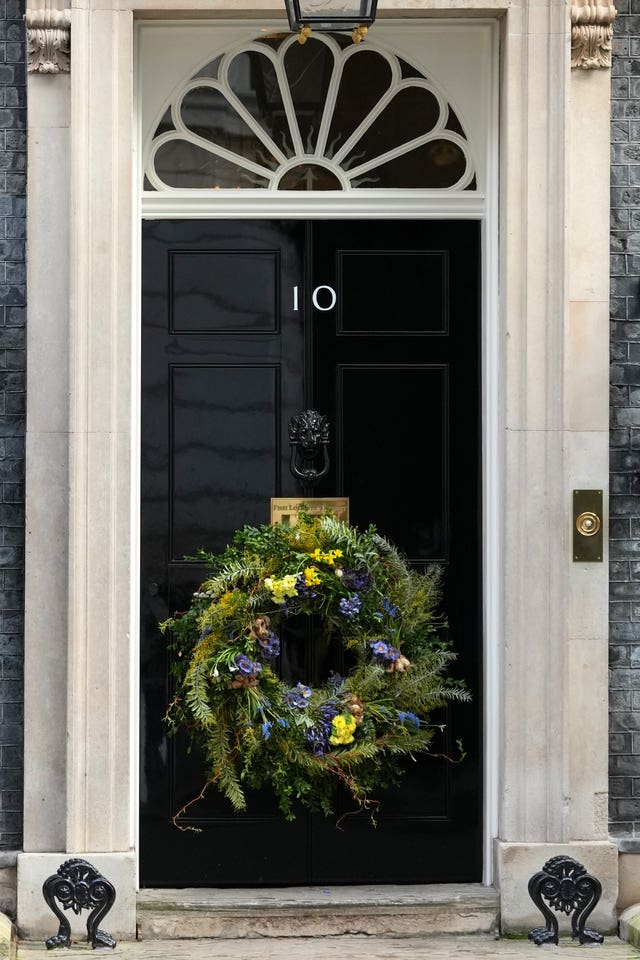
The door to No 10 was decorated with a wreath with flowers in the yellow and blue colours of Ukraine, designed by artist Yulia Borysenko.
Sir Keir spoke of three personal impressions of “four long years of suffering in Ukraine”.
The Prime Minister said he went to Bucha near Kyiv in the early days of the war, where he saw “the roads and the ditches in which Ukrainian civilians were handcuffed with their hands behind their back, blindfolded and shot in the head, the bodies left in the road”.
He added: “The second etched in my memory was last year when I went to one of the busiest hospitals in Kyiv and saw for myself the incredibly awful burns on some of those who had returned from the front line.
“Burns the like of which I’d never seen in my life before.
“And at the same time, I went to a primary school and these children who were five, six, seven-years-old had lost both their parents to the conflict.”
Defence Secretary John Healey told the Press Association the war had been “four years of failure for Putin”.
He said: “This is a war he thought he would win in a week, he has lost more than a million men during that time and Russia has been fighting in Ukraine for longer than the Soviet Union was fighting Germany during the Second World War.”
Mr Healey added: “I want to make 2026, like President Zelensky does, the year that this war ends, that we can bring peace.
“The UK is ready to play a part in securing that peace for the long term.”
Western officials believe Russian troops are now being killed faster than Mr Putin is able to replace them.
Between 30,000 and 35,000 Russian soldiers are recruited each month, according to Western officials.
But the number of those killed over the past three months is believed to have been higher than those who joined up.
This means that for the first time in the four years of war, for a sustained period, Moscow’s battlefield numbers are falling.
The Western experts believe this will have a significant impact on the Kremlin’s ability to “generate offensive power” for a spring or summer offensive.
Sir Keir convened a meeting of the so-called coalition of the willing on Tuesday morning, alongside French president Emmanuel Macron and German chancellor Friedrich Merz.
The more than 30 leaders present on the call “reiterated their unwavering commitment to working together to achieve a just and lasting peace” and called on Russia to engage in negotiations “in a meaningful way, and to agree to a full, unconditional ceasefire”.
Mr Zelensky joined the call from Kyiv, alongside visiting leaders from Nordic Baltic countries, the EU, and Croatia.