Gold prices rise and dollar dips after Trump declares 15% global tariff
Rising gold prices typically indicate that investors are seeking out so-called safe haven assets.
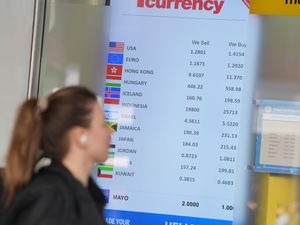
Gold prices have risen and the US dollar has dipped as uncertainty ripples through global financial markets in the aftermath of the US Supreme Court striking down Donald Trump’s tariff policy.
One expert described the situation as an “unholy mess” after Mr Trump hit back at the ruling and said he was raising the global tariff rate to 15%.
The price of gold briefly shot up to highs of about 5,280 US dollars (£3,901) per ounce. The commodity settled about 0.7% higher at 5,140 US dollars (£3,805) per ounce by early trading on Monday.
Rising gold prices typically indicate that investors are seeking out so-called safe haven assets, particularly if they anticipate volatility affecting other investments, such as stocks and shares.
Meanwhile, the US dollar was down about 0.3% against the pound, to 0.74. The currency was also down around 0.3% against the euro, to 0.85.
US futures also fell for the S&P 500 and Dow Jones indexes, indicating stocks would move lower when Wall Street opens on Monday afternoon.
Investors and businesses around the world will be digesting developments over the weekend regarding Mr Trump’s tariffs agenda.
The highest US court struck down a significant portion of tariffs in a major ruling on Friday, including the sweeping “reciprocal” tariffs he levied on nearly every other country.
These were imposed under an emergency powers law known as the International Emergency Economic Powers Act (IEEPA).
The US president responded by saying he would be increasing the global tariff rate to 15%, “effective immediately”, hitting back at the Supreme Court’s ruling as an “extraordinarily anti-American decision”.
Mr Trump signed an executive order enabling him to bypass Congress and impose the tax on imports from around the world, but that are limited to 150 days before the administration must seek approval.
Richard Hunter, head of markets at Interactive Investor, said: “Tariff developments have turned the situation into an unholy mess, prompting far more questions than answers.
“After the Supreme Court ruled against the president’s tariffs, the implications are far from clear.
“No reference was apparently made in the ruling as to whether the monies raised from tariffs so far would need to be repaid and, even if this is the case, whether the refunds would go to companies or the ultimate customer who will have suffered higher prices.”
Some experts have said the US has already collected around 130 billion dollars (£96 billion) in tariffs using IEEPA rules.
Russ Mould, investment director for AJ Bell, said Mr Trump’s latest plan “creates yet another cliff edge and the events of recent days have left global governments scrambling to work out whether the deals they had agreed with the US will be affected, and also whether money collected by the US government will have to be paid back”.
The renewed uncertainty appeared to be weighing on some European markets, with German carmakers BMW and Volkswagen moving lower on Monday, helping bring the Dax index down by about 0.4%.
It was a mixed picture, however, with the UK’s FTSE 100 and France’s Cac 40 more or less flat by mid-morning.