Trump announces new 10% ‘global tariff’ after Supreme Court strikes down levies
Mr Trump’s ‘reciprocal tariffs’ were overturned by the US Supreme Court on Friday.
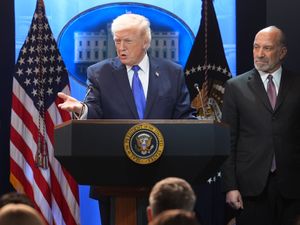
US President Donald Trump has announced a 10% global tariff after the Supreme Court struck down his reciprocal levies policy.
Mr Trump’s “reciprocal tariffs”, imposed on most of the rest of the world last April under an emergency powers law, were overturned by the US Supreme Court on Friday in a major blow to the president’s economic agenda.
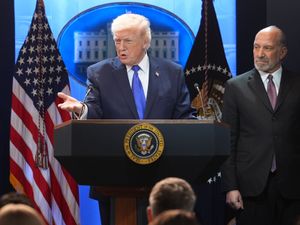
Speaking at the White House, Mr Trump said the Supreme Court decision affirmed his ability to charge more tariffs under different statutes.
He said: “In order to protect our country, a president can actually charge more tariffs than I was charging in the past… period of a year.
“Under the various tariffs authorities, so we can use other of the statutes, other of the tariff authorities, which have also been confirmed and are fully allowed.
“Therefore, effective immediately, all national security tariffs under Section 232 and existing Section 301 tariffs, they’re existing, they’re there, remain in place, fully in place. And in full force.
“Today I will sign an order to impose a 10% global tariff under Section 122, over and above our normal tariffs already being charged.
“And we’re also initiating several Section 301 and other investigations to protect our country from unfair trading practises of other countries and companies.”

In the UK, ministers said they expected the country’s “privileged trading position with the US” to continue after the Supreme Court’s ruling.
The UK received the lowest tariff rate of 10%, and a subsequent deal struck by Sir Keir Starmer and Mr Trump saw further carve-outs for Britain’s steel industry and car manufacturers.
Friday’s decision raises questions over whether those deals still stand, although officials are understood to believe it will not impact on most of the UK’s trade with America, including preferential deals on steel, cars and pharmaceuticals.
A Government spokesperson said: “This is a matter for the US to determine but we will continue to support UK businesses as further details are announced.
“Under any scenario, we expect our privileged trading position with the US to continue and will work with the administration to understand how the ruling will affect tariffs for the UK and the rest of the world.”
It was an updated version of a statement released earlier in response to the court ruling but removed a reference to the UK enjoying “the lowest reciprocal tariffs globally”.
Mr Trump said that some trade deals negotiated after he imposed his reciprocal tariffs will no longer be valid after the US Supreme Court ruling.
“Some of them stand. Many of them stand. Some of them won’t, and they’ll be replaced with the other tariffs,” he said.
The US president said the 10% “global tariff” would be in place for around five months.
“We’re going straight ahead with 10% straight across the board… and then during that period of about five months, we are doing the various investigations necessary to put fair tariffs, or tariffs period, on other countries.
“So we’re doing that, period, but we’re immediately instituting the 10% provision, which we’re allowed to do. And in the end, I think we’re taking more money than we’ve taken in before.”
The US has collected more than 133 billion dollars (£98.4 billion) since Mr Trump imposed the tariffs, but now faces the prospect of having to refund that money to importers.
Friday’s decision, approved by a 6-3 majority, found that a 1977 law did not give Mr Trump the power to impose tariffs without the approval of the US Congress.
The British Chambers of Commerce (BCC) said the decision did little to “clear the murky waters for business” around US tariffs.

William Bain, head of trade policy at the BCC, said Mr Trump could use other legislation to reimpose tariffs.
He said: “For the UK, the priority remains bringing tariffs down wherever possible. It’s important the UK Government continues to negotiate on issues like steel and aluminium tariffs and reduces the scope of other possible duties.”
Campaign group Best for Britain said the decision “underlines the instability of doing deals with Trump’s USA and the importance of forging deeper, more reliable trade with our EU neighbours”.
Andy Prendergast, national secretary at GMB, said the removal of the tariffs was very welcome.
“This ruling by the Supreme Court will be popular and represents an overdue slap down for a president who doesn’t seem to have any idea of what he’s doing,” he said.
Richard Rumbelow, director of international business at Make UK, said: “Subject to the details to come from the US administration, the Supreme Court’s ruling to remove tariffs will offer some good news and much-needed clarity for UK manufacturers.
“As the situation continues to evolve, businesses now need clear, practical guidance on how the ruling will be implemented, alongside progress on resolving the remaining Section 232 tariffs on UK steel and aluminium.”