Man’s conviction for burning Koran should have been upheld, High Court told
Hamit Coskun successfully appealed in October against his conviction for a religiously aggravated public order offence.
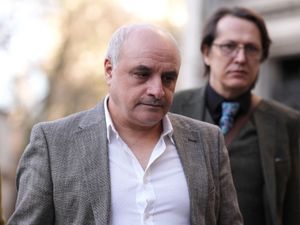
Burning a religious text “is in itself disorderly” and should have led to a man’s conviction for burning a Koran being upheld, the High Court has been told.
Hamit Coskun was convicted last June of a religiously aggravated public order offence after he held a flaming copy of the Islamic text aloft and shouted “f*** Islam” outside the Turkish embassy on February 13 last year.
The 51-year-old successfully appealed against his conviction, having it overturned by Mr Justice Bennathan at Southwark Crown Court in October.
The Crown Prosecution Service (CPS) is now appealing against that decision at the High Court, with its barristers telling a hearing on Tuesday that the judge was wrong to find that Mr Coskun’s behaviour was not “disorderly” and, if it was, was unlikely to cause harassment, alarm or distress.
It is asking the High Court to send the case back to the Crown Court for reconsideration.
Mr Coskun, who has been provided accommodation by the Home Office since his protest because of threats made to him, is resisting the legal challenge and attended the hearing in London.
David Perry KC, for the CPS, told the court: “Burning a book in a residential or commercial part of central London, between Knightsbridge and Hyde Park, is in itself disorderly and even more so when the book is a holy text, whatever the religion.”
In written submissions, the barrister said Mr Coskun’s actions “did not involve an exercise of legitimate freedom of expression” and instead “crossed the border into criminal conduct and was deliberately intended to be disorderly”.
Mr Coskun, an atheist, also shouted “Islam is religion of terrorism” and “Koran is burning” during his protest in Rutland Gardens, London.
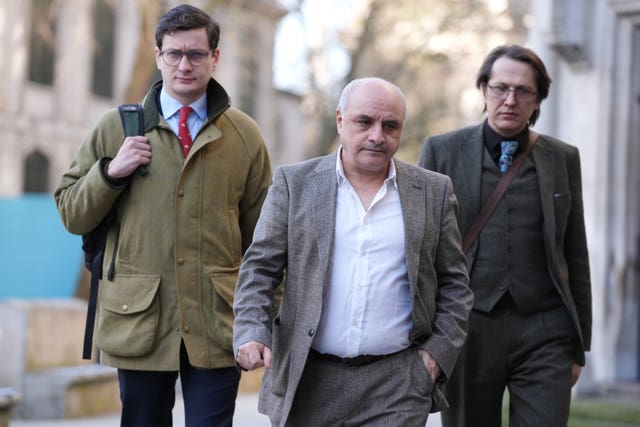
He was later attacked by others, including a Muslim man who slashed at him with a knife, with Mr Perry telling the court that this was “effectively provoked” by Mr Coskun’s actions.
Mr Coskun was charged and convicted of a religiously aggravated public order offence of using disorderly behaviour “within the hearing or sight of a person likely to be caused harassment, alarm or distress”, motivated by “hostility towards members of a religious group, namely followers of Islam”, contrary to the Crime and Disorder Act 1998 and section five of the Public Order Act 1986.
He was fined £240 for the offence, with District Judge John McGarva stating that Mr Coskun had a “deep-seated hatred of Islam and its followers”.
But Mr Justice Bennathan ruled in October that the right to freedom of expression “must include the right to express views that offend, shock or disturb”, and that the criminal law “is not a mechanism that seeks to avoid people being upset, even grievously upset”.
Mr Perry said in written submissions that Mr Coskun’s prosecution was “not an attempt to introduce an offence of blasphemy” and was not “an impermissible encroachment” on his right to free speech.
Blasphemy laws were abolished in England and Wales in 2008 and in Scotland in 2021, but blasphemy and blasphemous libel remain offences in Northern Ireland.
In written submissions on behalf of Mr Coskun, Tim Owen KC said that the CPS’s appeal was “unarguable” and “merely seeks to rehash arguments” that “ultimately failed to persuade the court of the respondent’s guilt”.
He said: “This ill-judged, frivolous attempt to convert what is a question of fact into one of law should be rejected.”
Speaking ahead of the hearing, Stephen Evans, the chief executive of the National Secular Society, which funded Mr Coskun’s appeal along with the Free Speech Union, said the CPS’s approach “casts those subjected to violence for offending religious sensibilities as the wrongdoer”, which he said was a “stark inversion of justice”.
He continued: “It is not the role of prosecutors to determine what citizens should think or feel about contentious expression.
“The law should never be used to enforce religious orthodoxy.”
The hearing before Lord Justice Warby and Ms Justice Obi is due to conclude on Tuesday.