What is measles and how does it spread?
Dozens of suspected cases have been reported in north London amid an outbreak across several schools.
Global health officials announced earlier this year that the UK is no longer considered to have eliminated measles.
Dozens of suspected cases have now been reported in north London, amid an outbreak across several schools.
Here, the Press Association explains what the illness is and why vaccinations are vital to prevention.
What is measles?
Measles is a highly infectious viral illness that can spread very easily among people who are not fully vaccinated.

It usually starts with cold-like symptoms, followed by a rash a few days later – the rash starts on the face and behind the ears before spreading to the rest of the body.
The spots of the measles rash, which are not usually itchy, are sometimes raised and join together to form blotchy patches.
Some people may also get small spots in their mouth.
What are the risks?
While many people recover, the illness can lead to serious complications such as pneumonia, brain inflammation and in rare cases, long-term disability or death.
Babies and people with weakened immune systems are more at risk.
Measles can also cause miscarriage or stillbirth, premature birth (before the 37th week of pregnancy), and a baby to have a low birthweight.
How measles spreads
Measles is spread when an infected person breathes, coughs or sneezes.

A person is infectious from when they first have symptoms (around four days before the rash appears) until four days after they get the rash.
The NHS recommends opening windows and doors to help reduce the risk of measles spreading, frequently washing hands with soap and warm water, and using tissues when you cough or sneeze and throwing them in the bin immediately after using them.
It advises against sharing cutlery, cups, towels, clothes, or bedding.
What vaccinations are offered?
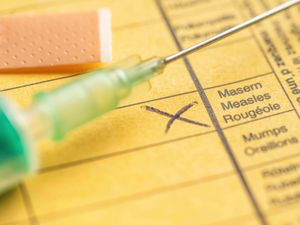
There is no treatment for measles, but two doses of a measles-containing vaccine provide high levels of protection and help prevent further outbreaks.
Both the MMRV and MMR vaccines provide protection against measles, mumps and rubella and the MMRV vaccine also provides protection from chickenpox.
The MMRV vaccine is usually offered to children when they are 12 months and 18-months-old.
The MMR vaccine is still available for older children and adults born on or before 31 December 2019 who were not vaccinated against measles, mumps and rubella when they were younger.
How many children are getting vaccinated?
The latest UK Health Security Agency (UKHSA) figures show that not a single childhood vaccine in England last year met the target needed to ensure diseases cannot spread among youngsters.
The World Health Organisation (WHO) recommends at least 95% of children should receive vaccine doses for each illness to achieve herd immunity.
Some 91.9% of five-year-olds had received one dose of the MMR (measles, mumps & rubella) vaccine, unchanged from 2023/24 and the lowest level since 2010/11, while just 83.7% of five-year-olds had received both MMR doses, the lowest level since 2009/10.
Uptake of the first MMR dose at 24 months stood at 88.9% in 2024/25 – unchanged on the previous year, but again the lowest figure since 2009/10.