Starmer says UK-China relations have gone from ‘golden age to ice age’
He said the UK was ‘missing out’ by not engaging with China.
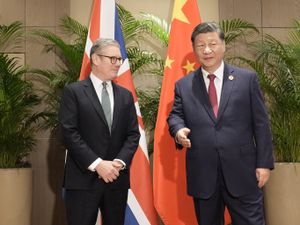
Sir Keir Starmer told ministers the UK’s relations with China had gone from the “golden age to the ice age” ahead of a trip to the country this week in the hope of a thaw.
The Prime Minister will travel to China on Tuesday as he attempts to continue building bridges with Beijing after a freeze in Sino-British relations in the final years of the Conservative government.
In a Cabinet meeting ahead of his departure, Sir Keir told ministers the UK had “veered from the golden age to the ice age in its relations with China” in recent years, but said his Government would follow “a strategic and consistent strategy”.
He noted there were “significant business opportunities” on the table, but stressed that protecting the UK’s national security remains “non-negotiable”, according to a Downing Street readout.
Sir Keir is due to be accompanied by business leaders as he seeks to improve trading relations with the superpower on the trip, which is the first by a British prime minister since Baroness Theresa May’s visit in 2018.
In what appeared to be a defence of his decision to take the trip, he said the UK was “missing out” by not engaging with China.
French president Emmanuel Macron has visited China three times, while German chancellor Friedrich Merz and US president Donald Trump are due to visit soon, he said.
Ahead of Sir Keir’s trip, a No 10 source said the Government was “bringing a hard-headed, grown-up approach to our relationship with China” that would chart a “steady, consistent course” with Beijing.

The trip follows the approval of a new Chinese embassy in London and Sir Keir will face pressure from home to raise several difficult subjects with Chinese leader Xi Jinping, including China’s espionage activity.
The Prime Minister’s official spokesman said he could not comment on reports that China had hacked the phones of senior Downing Street officials under previous governments between 2021 and 2024.
But he said Sir Keir was confident that his phone is not being monitored by the Chinese, and that No 10 has “robust communication security measures in place”.
“We’ll always take the necessary action to detect, disrupt and deter those who seek to do us harm, and that’s why we’ve sanctioned China-based tech firms for global cyber attacks, and why we’re training frontline police officers on spotting hostile state activity,” the spokesman said.

The Prime Minister has also faced calls to raise the treatment of the Uighur minority and the imprisonment of Jimmy Lai, a Hong Kong pro-democracy campaigner and British national.
Mr Lai, 78, has been in detention for more than five years, much of that time in solitary confinement, having been arrested in 2020 under Hong Kong’s new national security law.
Last month, following Mr Lai’s conviction on sedition and conspiracy charges, Foreign Secretary Yvette Cooper called for his “immediate release” and the Chinese ambassador was summoned to the Foreign Office.
Former Conservative leader Sir Iain Duncan Smith, a China hawk who has been sanctioned by Beijing, called for the Prime Minister to cancel his trip in protest.
The last governor of Hong Kong has urged Sir Keir to say “exactly what he thinks” when he meets Chinese leaders in Beijing this week.
Lord Chris Patten said the Prime Minister should not “lean over backwards” to avoid offending China, adding: “The Chinese do business on exactly the same basis as everybody else.”
In an interview with the Press Association, Lord Patten said British policy towards China rested on “a complete falsehood” that “in order to do business with them, we must avoid saying anything they don’t like or doing anything that they don’t like”.
He said: “That is just complete bilge.”

Lord Patten, who governed Hong Kong from 1992 until it was handed over to China in 1997, said Mr Lai’s case should be “one of the first things” Sir Keir raises with the Chinese government during his visit.
Lord Patten told PA he was not opposed to Sir Keir’s trip, but he urged the Prime Minister not to be afraid of offending China.

He said: “You have to say with them, without being impolite, exactly what you think.
“They know we’re different, but they want to have a reasonable relationship with us and, particularly given the state of the world with (US President Donald) Trump, we should want to have a reasonable relationship with them.”
Although Lord Patten said the UK should pursue a good relationship with Beijing, he warned that it was “dim sum we should consume, but with a very long spoon” and warned the Prime Minister to “recognise the realities” of dealing with China.
He told PA: “I don’t think we should kid ourselves that if you’re nice to China, they’re more likely to obey the rules.
“They sign up to agreements and they break them whenever it’s convenient.
“So I’m in favour of trying to have a better relationship with China, but we shouldn’t think that there is some way of cosying up to China and getting them to do what you want them to do in perpetuity, because it doesn’t happen like that.”