Inquiry told of victims’ last moments in fatal Stonehaven train crash
The train crashed at Carmont near Stonehaven on August 12 2020 after it hit a pile of gravel washed on to the track by heavy rain.
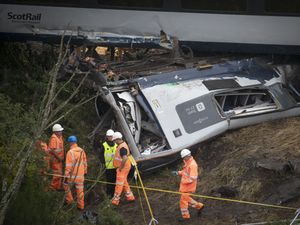
An inquiry into the derailment of a train in Aberdeenshire has heard of the last moments of three people killed when the carriages scattered following impact with debris on the tracks.
The train crashed at Carmont near Stonehaven on August 12 2020 after it hit a pile of gravel washed onto the railway track by heavy rain.
Of the nine people who were aboard the train, three: train driver Brett McCullough, 45; conductor Donald Dinnie, 58; and passenger Christopher Stuchbury, 62; were killed.
The fatal incident inquiry (FAI) at Aberdeen Sheriff Court heard on Tuesday the six remaining passengers were all injured, three of whom suffered serious injuries that required hospital treatment.
Dominique Louis, a principal inspector at the Rail Accident Investigation Branch (RAIB), told the inquiry Mr Stuchbury, who was originally travelling in coach B, was likely on his way to speak with the conductor Mr Dinnie in coach D when the crash happened.

“Mr Stuchbury was, we believe, standing and walking through the leading vestibule at the time of the incident,” Mr Louis said.
“He received fatal injuries after being ejected through the vestibule towards the trees.”
Mr Dinnie, who was in coach D, was also standing in the leading vestibule at the time of the crash, the inquiry was told.
Coach D suffered the greatest damage of any passenger vehicle, Mr Louis further told the hearing.
The damage to the structural components of the carriage was such that the area of the coach where Mr Dinnie was standing collapsed, “leading to the complete loss of survival space in the leading vestibule”, Mr Louis said.
Mr Dinnie’s body could not be recovered until August 13 due to its position inside carriage D, on top of which coaches A and C came to rest during the course of the crash.
The driver Mr McCullough, who was in the leading cab, suffered fatal injuries caused by secondary impact with the cab’s windscreen and interior, Mr Louis told the hearing.
“When the leading power car struck the embankment below the bridge, the driver’s cab became completely detached,” he said.
The hearing was also told of the two survivors in coach D, who reported finding themselves outside the coach when the vehicles finally came to rest – but they could not recall how they got there.
They had also received multiple cuts and lacerations, the inquiry heard.
“Coach D and C both underwent extreme movements and rolled over onto their roofs before they came to rest,” Mr Louis said.
“These movements would have subjected passengers to accelerations in the vertical, lateral, and longitudinal directions and would have caused them to impact the vehicle interior or fall off their seats.
“Some of the windows in the leading half of this vehicle had been completely broken through,” he added.
“Medical experts assisting the investigation considered that the shards of broken glass could have caused the lacerations but it is also possible some were caused by exposed edges of damaged interior fixtures and fittings.”

Despite the severity of the fires on site – the power car and coach B having caught on fire as a result of the crash – none of the occupants suffered injuries as a result of the fire, Mr Louis said.
The FAI was previously told the death toll would have “almost certainly” been higher had the train been full on August 12 2020.
The crash took place during the Covid-19 pandemic, with the Aberdeen area on lockdown, and there was a drop on around 65% in passenger numbers across the entire network at the time, Mr Louis said.
The inquiry heard earlier on Tuesday the transfer of safety-related information between Network Rail and its contractors had been “ineffective” prior to the derailment.
It concerned the most immediate cause of the crash: an incorrectly installed drainage system that led to a washout of gravel and soil debris onto the railway track following exceptionally heavy rainfall on the night of August 11 to August 12.
Inappropriate changes made to the drain during construction were not communicated by contractor Carillion to the designer Arup, or to Network Rail.
A criminal prosecution saw Network Rail fined £6.7 million in 2023 after it admitted health and safety failings over the crash.
Carillion went into compulsory liquidation in January 2018.
A Network Rail spokesperson said on Monday the Government-owned company is “committed to supporting the work of the inquiry and continuing to deliver on the recommendations made by RAIB”.
They added: “We’ve made significant changes to how we manage the risk of severe weather since the accident and our work to make our network more resilient will continue.”
The inquiry before Sheriff Lesley Johnson continues.