Duke of Sussex says British soldiers who died in Afghanistan ‘deserve respect’
Former soldier Harry appeared to respond to US President Donald Trump after he claimed Nato allies stayed away from the front lines in the conflict.
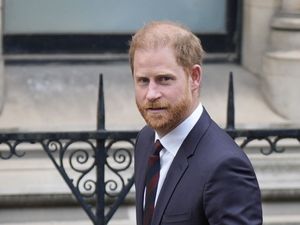
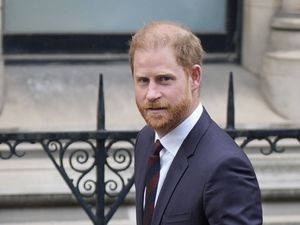
The Duke of Sussex has said British soldiers who served and died in Afghanistan “deserve to be spoken about truthfully and with respect”, after US President Donald Trump claimed Nato allies stayed away from the front lines in the conflict.
Mr Trump suggested in an interview with Fox News that Nato allied troops “stayed a little off the front lines” in Afghanistan.
The president also claimed America had “never needed” its Nato partners, despite being the only member state to have ever invoked the alliance’s “all for one, and one for all” clause, in the wake of 9/11.
Former soldier Harry, who carried out two frontline tours to Afghanistan, said in a statement on Friday evening: “In 2001, Nato invoked Article 5 for the first — and only — time in history.
“It meant that every allied nation was obliged to stand with the United States in Afghanistan, in pursuit of our shared security.
“Allies answered that call.
“I served there. I made lifelong friends there. And I lost friends there.
“The United Kingdom alone had 457 service personnel killed.
“Thousands of lives were changed forever.
“Mothers and fathers buried sons and daughters.
“Children were left without a parent. Families are left carrying the cost.
“Those sacrifices deserve to be spoken about truthfully and with respect, as we all remain united and loyal to the defence of diplomacy and peace.”

During his decade-long full-time military career, the duke fought the Taliban in 2007 and returned to Afghanistan for a second tour of duty in 2012, and qualified as an Apache aircraft commander.
He began training at the Royal Military Academy Sandhurst in May 2005.
He became a Cornet in the Blues and Royals, joining the Household Cavalry regiment and, in May 2006, began training to become a troop leader of an armoured reconnaissance unit.
He spent four-and-a-half months learning how to be a recce soldier at Camp Bovington in Dorset.
In February 2007, the Ministry of Defence confirmed Harry would be heading to Iraq on a six-month deployment, making him the first royal for 25 years to serve in a conflict zone.
Yet three months later, just before Harry was due to leave, he was pulled out of the tour of duty after intelligence revealed insurgents were specifically planning to target him and it was too dangerous to allow him to go.
The duke was reportedly devastated and considered quitting, but the hope of going to Afghanistan in the future kept him in the Army.
In late 2007, he was able to undertake a 10-week tour of duty fighting the Taliban in dangerous Helmand Province, operating as a battlefield air controller behind enemy lines.
The secret mission, however, ended early after it was leaked on the internet.
Upon his return, Harry was dubbed the “Warrior Prince”, “Harry the Brave”, and “One of Our Boys” by the press for fighting for his country.
The duke was promoted from second lieutenant to lieutenant in April 2008.
Hoping to go back to Afghanistan, he retrained and qualified as an Apache helicopter pilot after rigorous training in Britain and America.
He was promoted to the rank of captain in April 2011 and and also awarded his Apache Badge from the officer in command of his Squadron at the same time.
In September 2012, he made it back to Afghanistan for a 20-week stint which gave him the chance to use his Apache flying skills and head out on operations in his role as co-pilot gunner.
Kensington Palace officially confirmed Harry’s departure from the Army in March 2015, marking the end of 10 years of service.
Mr Trump’s recent remarks have drawn widespread condemnation from across the political spectrum in the UK, with critics pointing to both the number of UK deaths in Afghanistan and highlighting Mr Trump’s avoidance of military service in Vietnam.
Speaking in Downing Street, Prime Minister Sir Keir Starmer said the comments were “frankly appalling” and signalled the US president should apologise.
He said: “I consider President Trump’s remarks to be insulting and frankly appalling and I am not surprised they have caused such hurt to the loved ones of those who were killed or injured and, in fact, across the country.”
Sir Keir further said he would apologise if he had said the words used by Mr Trump.