Starmer: Trump tariffs over Greenland ‘wrong’ and UK ‘pursuing this’ with US
The US leader plans to apply 10% tariffs from February 1, increasing to 25% from June 1.
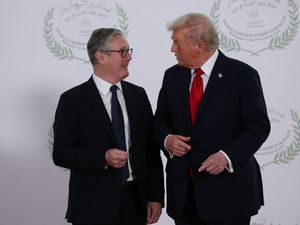
Sir Keir Starmer has called Donald Trump’s plan to apply tariffs to the UK until a deal is reached to purchase Greenland “completely wrong”, and said he would be “pursuing this directly” with the US administration.
The US president said the UK will be charged a 10% tariff “on any and all goods” sent to the US from February 1, increased to 25% from June 1, until a deal is reached for Washington to purchase Greenland from Denmark.
He said the same would apply to Denmark, Norway, Sweden, France, Germany, the Netherlands, and Finland, and that they had “journeyed to Greenland, for purposes unknown”.
The Prime Minister said: “Our position on Greenland is very clear – it is part of the Kingdom of Denmark and its future is a matter for the Greenlanders and the Danes.
“We have also made clear that Arctic Security matters for the whole of Nato and allies should all do more together to address the threat from Russia across different parts of the Arctic.
“Applying tariffs on allies for pursuing the collective security of Nato allies is completely wrong. We will of course be pursuing this directly with the US administration.”
Though Washington has been ratcheting up pressure over its plans for Greenland, US reports suggest the countries were given no notice of what was coming.
Sweden’s prime minister said his country was having “intensive discussions” with the other countries to decide on a coordinated response, while French President Emmanuel Macron said he would hold talks with European partners.
Earlier this week, the UK confirmed it had sent a military officer to Greenland as Denmark stepped up its military presence in the Arctic and High North.
Downing Street said they were sent at Denmark’s request to join a reconnaissance group ahead of a planned Arctic Endurance exercise, but denied it amounted to a “deployment”.
Denmark’s defence minister, Troels Lund Poulsen, said on Wednesday that an upcoming joint operation would involve several allied countries, warning that “no-one can predict what will happen tomorrow”.
In a post on Truth Social on Saturday, Mr Trump said: “These Countries, who are playing this very dangerous game, have put a level of risk in play that is not tenable or sustainable.
“Therefore, it is imperative that, in order to protect Global Peace and Security, strong measures be taken so that this potentially perilous situation end quickly, and without question.
“Starting on February 1st, 2026, all of the above mentioned Countries (Denmark, Norway, Sweden, France, Germany, The United Kingdom, The Netherlands, and Finland), will be charged a 10% Tariff on any and all goods sent to the United States of America.
“On June 1st, 2026, the Tariff will be increased to 25%. This Tariff will be due and payable until such time as a Deal is reached for the Complete and Total purchase of Greenland.”
Mr Trump said the US was “immediately open to negotiation with Denmark and/or any of these Countries that have put so much at risk, despite all that we have done for them, including maximum protection, over so many decades”.
He said that it was “time for Denmark to give back”, adding: “China and Russia want Greenland, and there is not a thing that Denmark can do about it.”
EU leaders said the Danish exercise “poses no threat to anyone” and warned that tariffs would risk a “dangerous downward spiral” in transatlantic relations.
European Commission president Ursula von der Leyen and European Council president Antonio Costa said: “The pre-coordinated Danish exercise, conducted with allies, responds to the need to strengthen Arctic security and poses no threat to anyone.
“The EU stands in full solidarity with Denmark and the people of Greenland. Dialogue remains essential, and we are committed to building on the process begun already last week between the Kingdom of Denmark and the US.
“Tariffs would undermine transatlantic relations and risk a dangerous downward spiral. Europe will remain united, coordinated, and committed to upholding its sovereignty.”
Mr Macron said he would not bow to “intimidation” and appeared to draw a parallel with the situation in Ukraine.
“No intimidation nor threat will influence us, neither in Ukraine, nor in Greenland, nor anywhere else in the world when we are confronted with such situations.
“Tariff threats are unacceptable and have no place in this context.
“Europeans will respond to them in a united and co-ordinated manner if they were to be confirmed. We will know how to uphold European sovereignty.”
Swedish Prime Minister Ulf Kristersson said “we will not let ourselves be blackmailed” while Finland’s Prime Minister Petteri Orpo said tariffs would be in “no-one’s interest”.
Norway’s Prime Minister Jonas Gahr Store wrote on social media: “Threats have no place among allies.”
Mr Trump’s move also prompted criticism across the board from UK politicians who fear for their impact on the economy.
Tory leader Kemi Badenoch said Mr Trump was “completely wrong” to impose tariffs over Greenland, adding they would be a “burden for businesses across our country”.
Reform leader Nigel Farage said the tariffs would “hurt” the UK, and Liberal Democrat leader Sir Ed Davey said Mr Trump was “punishing” the UK.
It comes as hundreds of people in Greenland’s capital Nuuk attended a rally on Saturday in support of self-governance.
Thousands of people also took part in rallies across Denmark on Saturday opposing any US takeover of Greenland.
Since the US began openly discussing the annexation of Greenland at the start of 2026, the UK has stepped up discussions on Arctic security, with Sir Keir raising the issue in calls with Mr Trump, the Danish Prime Minister Mette Frederiksen and Nato secretary-general Mark Rutte.
Last year, Mr Trump announced in his “Liberation Day” tariffs that the US would impose an additional 10% tariff on top of existing US duties, fees and taxes on imports from the UK.
The British Chambers of Commerce warned that the tariffs would be “more bad news” for businesses already struggling with levies from last year.
William Bain, its head of trade policy, said in a statement: “We know trade is one way to boost the economy and the success of transatlantic trade depends on reducing, not raising, tariffs.
“The Government must prioritise the implementation of the Economic Prosperity Deal and negotiate calmly to remove the threat of these new tariffs.”
The UK and US signed a trade deal in June that reduced tariffs on car and aerospace imports to the US, but failed to agree on terms for British steel, leaving tariffs on it at 25%.